Du Jinxin, Deng Tingting, Cao Baorui, Wang Zhiying, Yang Meina, Han Jinxiang
College of Traditional Chinese Medicine, Shandong University of Traditional Chinese Medicine, Jinan, China.
NHC Key Laboratory of Biotechnology Drugs (Shandong Academy of Medical Sciences), Biomedical Sciences College, Shandong First Medical University, Jinan, China.
Front Chem. 2023 Feb 17;11:1140128. doi: 10.3389/fchem.2023.1140128. eCollection 2023.
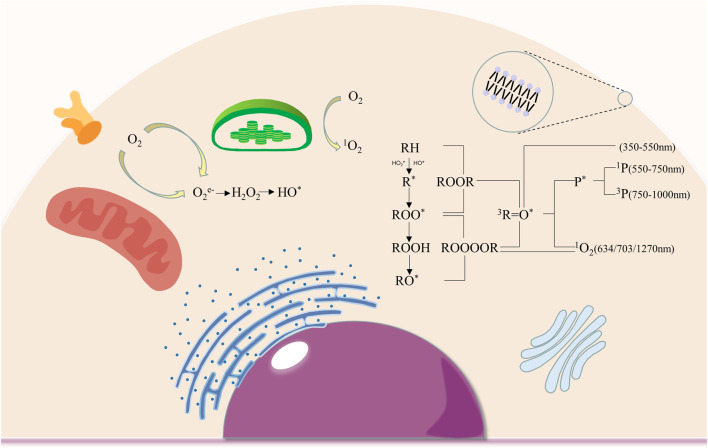
Ultra-weak bioluminescence, also known as ultra-weak photon emission (UPE), is one of the functional characteristics of biological organisms, characterized by specialized, low-energy level luminescence. Researchers have extensively studied UPE for decades, and the mechanisms by which UPE is generated and its properties have been extensively investigated. However, there has been a gradual shift in research focus on UPE in recent years toward exploring its application value. To better understand the application and trend of UPE in biology and medicine, we have conducted a review of relevant articles in recent years. Among the several topics covered in this review is UPE research in biology and medicine (including traditional Chinese medicine), primarily focused on UPE as a promising non-invasive tool for diagnosis and oxidative metabolism monitoring as well as a potential tool for traditional Chinese medicine research.
超微弱生物发光,也称为超微弱光子发射(UPE),是生物有机体的功能特性之一,其特点是具有特定的、低能量水平的发光。几十年来,研究人员对UPE进行了广泛研究,对UPE产生的机制及其特性进行了深入探究。然而,近年来对UPE的研究重点已逐渐转向探索其应用价值。为了更好地了解UPE在生物学和医学中的应用及趋势,我们对近年来的相关文章进行了综述。本综述涵盖的几个主题中包括UPE在生物学和医学(包括传统中医药)方面的研究,主要聚焦于UPE作为一种有前景的非侵入性诊断和氧化代谢监测工具以及传统中医药研究的潜在工具。