Department of Rehabilitation Medicine, The First Affiliated Hospital of Guangxi Medical University, Nanning, Guangxi, China.
Department of Rehabilitation, Shenzhen Second People's Hospital, The First Affiliated Hospital of Shenzhen University, Shenzhen, Guangdong, China.
Front Endocrinol (Lausanne). 2023 Feb 16;14:1120277. doi: 10.3389/fendo.2023.1120277. eCollection 2023.
The cardiometabolic index (CMI) has been proposed as a novel indicator of cardiometabolic status. However, evidence on the relationship between CMI and diabetes mellitus (DM) risk was limited. Our study aimed to explore the relationship between CMI and DM risk among a large cohort of Japanese adults.
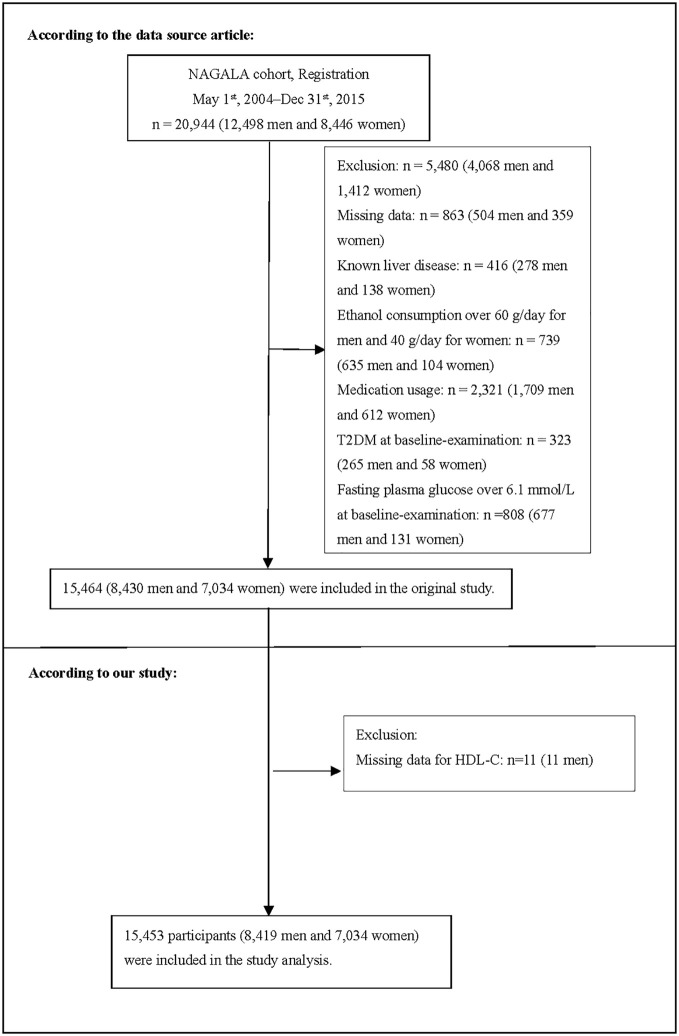
This retrospective cohort study recruited 15453 Japanese adults without diabetes at baseline who underwent physical examinations at the Murakami Memorial Hospital between 2004 and 2015. Cox proportional-hazards regression was applied to evaluate the independent relationship between CMI and diabetes. Our study performed a generalized smooth curve fitting (penalized spline technique) and an additive model (GAM) to determine the non-linear relationship between CMI and DM risk. In addition, a set of sensitivity analyses and subgroup analyses were employed to evaluate the relationship between CMI and incident DM.
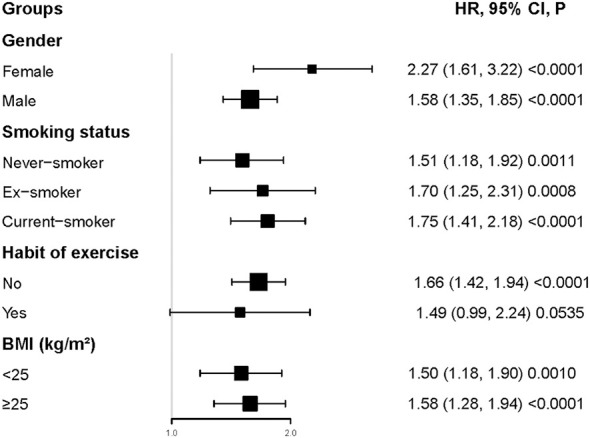
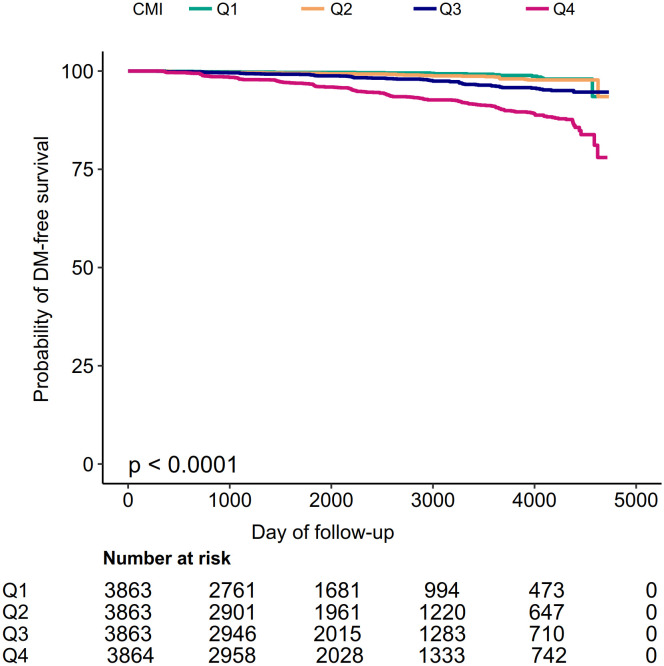
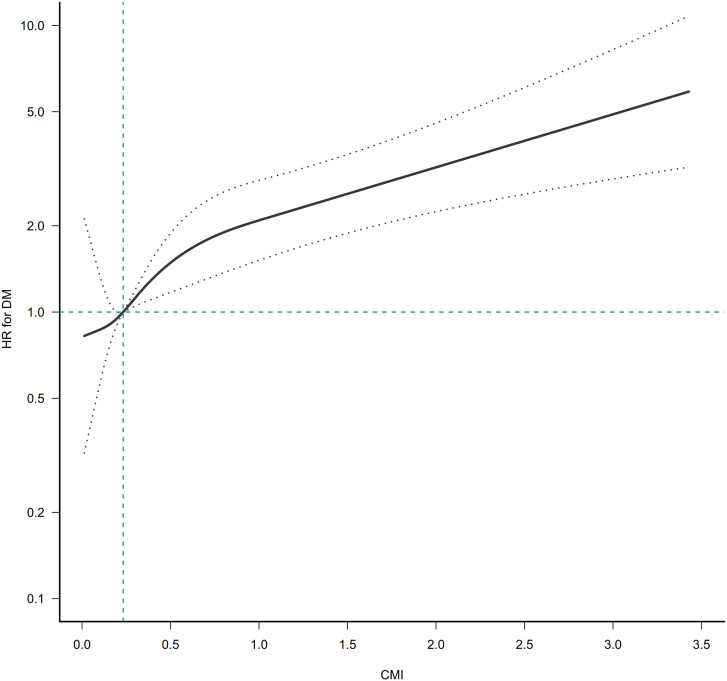
After adjusting for confounding covariates, CMI was positively related to the DM risk in Japanese adults (HR: 1.65, 95%CI: 1.43-1.90, P<0.0001). A series of sensitivity analyses were also employed in this study to guarantee the reliability of the findings. In addition, our study discovered a non-linear association between CMI and diabetes risk. CMI's inflection point was 1.01. A strong positive association between CMI and diabetes incidence was also discovered to the left of the inflection point (HR: 2.96, 95%CI: 1.96-4.46, P<<0.0001). However, their association was not significant when CMI was higher than 1.01 (HR: 1.27, 95%CI: 0.98-1.64, P=0.0702). Interaction analysis showed that gender, BMI, habit of exercise, and smoking status interacted with CMI.
Increased CMI level at baseline is associated with incident DM. The association between CMI and incident DM is also non-linear. A high CMI level is associated with an increased risk for DM when CMI is below 1.01.
代谢心血管风险指数(CMI)已被提出作为一种评估代谢心血管状态的新指标。然而,CMI 与糖尿病(DM)风险之间的关系证据有限。我们的研究旨在探讨日本成年人中 CMI 与 DM 风险之间的关系。
本回顾性队列研究纳入了 2004 年至 2015 年期间在村上纪念医院接受体检且基线时无糖尿病的 15453 名日本成年人。应用 Cox 比例风险回归评估 CMI 与糖尿病之间的独立关系。我们进行了广义平滑曲线拟合(惩罚样条技术)和加性模型(GAM),以确定 CMI 与 DM 风险之间的非线性关系。此外,还进行了一系列敏感性分析和亚组分析,以评估 CMI 与新发 DM 之间的关系。
在校正混杂协变量后,CMI 与日本成年人的 DM 风险呈正相关(HR:1.65,95%CI:1.43-1.90,P<0.0001)。本研究还进行了一系列敏感性分析,以保证研究结果的可靠性。此外,我们发现 CMI 与糖尿病风险之间存在非线性关系。CMI 的拐点为 1.01。在拐点左侧,CMI 与糖尿病发病率之间存在很强的正相关关系(HR:2.96,95%CI:1.96-4.46,P<<0.0001)。然而,当 CMI 高于 1.01 时,它们之间的相关性不显著(HR:1.27,95%CI:0.98-1.64,P=0.0702)。交互分析表明,性别、BMI、运动习惯和吸烟状态与 CMI 相互作用。
基线时 CMI 水平升高与新发 DM 相关。CMI 与新发 DM 之间的关系也是非线性的。当 CMI 低于 1.01 时,CMI 水平升高与 DM 风险增加相关。