Rightnour Josalynn, Baird Jennifer, Benjamin Kendall, Qing Megan, Gionfriddo Michael R, McConaha Jamie, Schoen Rebecca
Duquesne University School of Pharmacy, 600 Forbes Avenue, 321 Bayer Hall, Pittsburgh, PA 15219, United States.
Explor Res Clin Soc Pharm. 2023 Feb 1;9:100230. doi: 10.1016/j.rcsop.2023.100230. eCollection 2023 Mar.
Cost is a major barrier to medication accessibility. While a minority of adults experience problems affording their medications, older adults are particularly vulnerable due to increased polypharmacy and fixed incomes.Clinicians can help reduce cost-related non-adherence and improve medication affordability; however, opportunities to improve affordability are often missed due to failure of the patient or clinician to discuss the issue.
Identify the incidence and resolution of cost-related conversations between patients and clinicians during primary care visits.
We conducted this quality improvement project at a primary care office. Student pharmacists observed in-person encounters with patients ≥65 years of age and documented the incidence of cost-related conversations and who initiated the conversation. After the visit, they asked if the patient had affordability issues. Patients and clinicians were blinded to the study purpose and hypothesis.
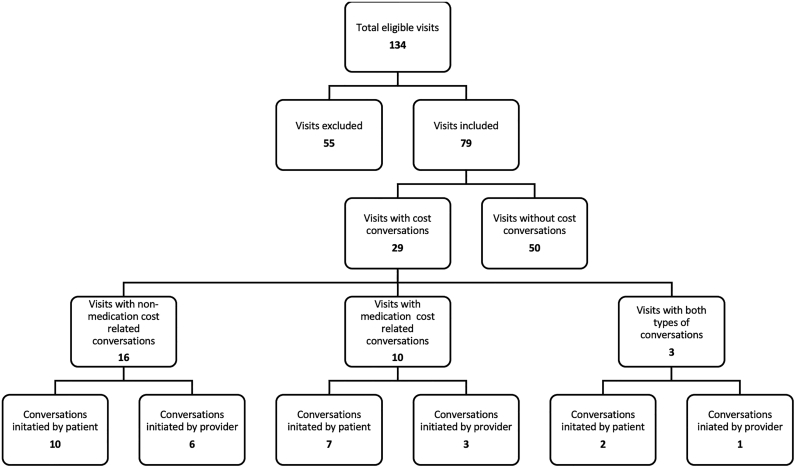
Students observed 79 primary care visits. Cost conversations (medication or non-medication related) occurred in 37% (29/79) of visits. Having concerns about affordability did not impact the likelihood of conversation about non-medication related healthcare costs (RR = 1.21 95% CI 0.35-4.19, = 0.67) or medication related costs (RR = 0.86 95% CI 0.13-5.65, = 1.0).
Our results indicated that cost conversations did not routinely occur at our site. Failure to discuss costs, especially for patients with underlying cost concerns, may lead to cost related non-adherence and worse outcomes.
成本是药物可及性的主要障碍。虽然少数成年人在支付药物费用方面存在问题,但由于多重用药情况增加和固定收入,老年人尤其脆弱。临床医生可以帮助减少与成本相关的不依从性并提高药物可负担性;然而,由于患者或临床医生未能讨论该问题,提高可负担性的机会常常错失。
确定初级保健就诊期间患者与临床医生之间与成本相关对话 的发生率及解决情况。
我们在一家初级保健办公室开展了这个质量改进项目。学生药剂师观察与65岁及以上患者的面对面诊疗,并记录与成本相关对话的发生率以及发起对话的人。就诊结束后,他们询问患者是否存在可负担性问题。患者和临床医生对研究目的和假设不知情。
学生观察了79次初级保健就诊。成本对话(与药物或非药物相关)发生在37%(29/79)的就诊中。对可负担性有担忧并未影响关于非药物相关医疗保健成本对话 的可能性(风险比 = 1.21,9