Musculoskeletal Research Group, Nottingham Trent University, Clifton Campus, Nottingham, UK.
Division of Bone Diseases, Geneva University Hospitals and Faculty of Medicine, University of Geneva, Geneva, Switzerland.
Br J Nutr. 2023 Nov 14;130(9):1487-1499. doi: 10.1017/S0007114523000545. Epub 2023 Mar 6.
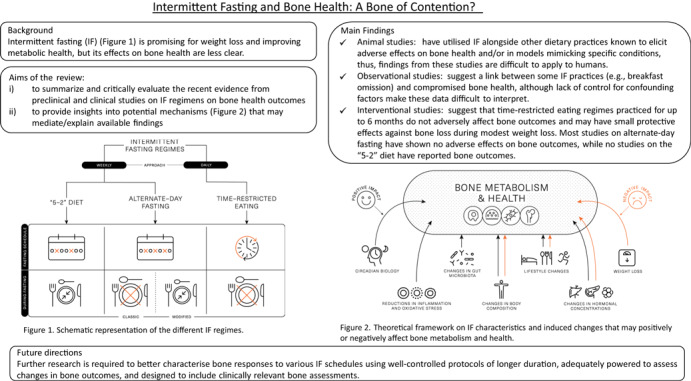
Intermittent fasting (IF) is a promising strategy for weight loss and improving metabolic health, but its effects on bone health are less clear. This review aims to summarise and critically evaluate the preclinical and clinical evidence on IF regimens (, alternate-day fasting (ADF) and time-restricted eating (TRE)/time-restricted feeding and bone health outcomes. Animal studies have utilised IF alongside other dietary practices known to elicit detrimental effects on bone health and/or in models mimicking specific conditions; thus, findings from these studies are difficult to apply to humans. While limited in scope, observational studies suggest a link between some IF practices (e.g. breakfast omission) and compromised bone health, although lack of control for confounding factors makes these data difficult to interpret. Interventional studies suggest that TRE regimens practised up to 6 months do not adversely affect bone outcomes and may even slightly protect against bone loss during modest weight loss (< 5 % of baseline body weight). Most studies on ADF have shown no adverse effects on bone outcomes, while no studies on the ‘5–2’ diet have reported bone outcomes. Available interventional studies are limited by their short duration, small and diverse population samples, assessment of total body bone mass exclusively (by dual-energy X-ray absorptiometry) and inadequate control of factors that may affect bone outcomes, making the interpretation of existing data challenging. Further research is required to better characterise bone responses to various IF approaches using well-controlled protocols of sufficient duration, adequately powered to assess changes in bone outcomes and designed to include clinically relevant bone assessments.
间歇性禁食(IF)是一种很有前途的减肥和改善代谢健康的策略,但它对骨骼健康的影响还不太清楚。本综述旨在总结和批判性评估关于 IF 方案(隔日禁食(ADF)和限时进食(TRE)/限时喂养)和骨骼健康结果的临床前和临床证据。动物研究将 IF 与其他已知对骨骼健康有不利影响的饮食实践结合使用,或者在模拟特定条件的模型中使用 IF;因此,这些研究的结果很难应用于人类。尽管范围有限,但观察性研究表明,一些 IF 实践(例如不吃早餐)与骨骼健康受损之间存在关联,尽管缺乏对混杂因素的控制,使得这些数据难以解释。干预性研究表明,TRE 方案实施长达 6 个月不会对骨骼结果产生不利影响,甚至可能在适度减肥(<基线体重的 5%)期间略微保护骨骼免受损失。大多数关于 ADF 的研究都没有显示出对骨骼结果的不良影响,而关于“5-2”饮食的研究则没有报告骨骼结果。现有的干预性研究受到其持续时间短、样本量小且多样化、仅评估全身骨量(通过双能 X 射线吸收法)以及对可能影响骨骼结果的因素控制不足的限制,使得解释现有数据具有挑战性。需要进一步的研究来更好地描述各种 IF 方法对骨骼的反应,使用足够长的、有足够能力评估骨骼结果变化的、并设计用于包含临床相关骨骼评估的良好控制方案。