Sugino A, Higgins N P, Brown P O, Peebles C L, Cozzarelli N R
Proc Natl Acad Sci U S A. 1978 Oct;75(10):4838-42. doi: 10.1073/pnas.75.10.4838.
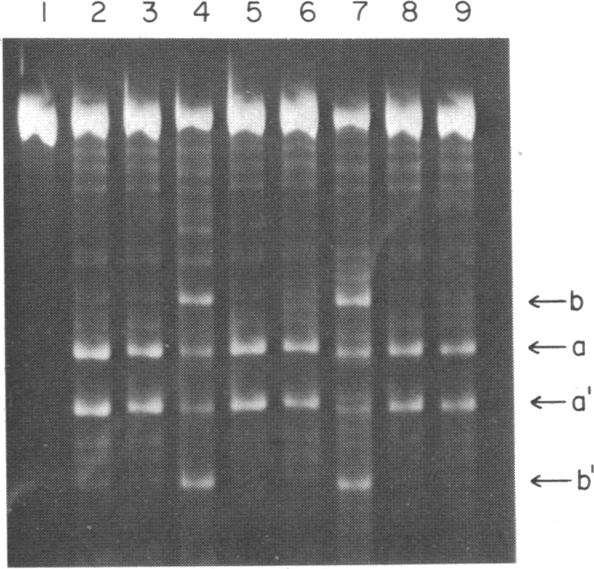
Escherichia coli DNA gyrase catalyzes negative supercoiling of closed duplex DNA at the expense of ATP. Two additional activities of the enzyme that have illuminated the energy coupling component of the supercoiling reaction are the DNA-dependent hydrolysis of ATP to ADP and P(i) and the alteration by ATP of the DNA site specificity of the gyrase cleavage reaction. This cleavage of both DNA strands results from treatment with sodium dodecyl sulfate of the stable gyrase-DNA complex that is trapped by the inhibitor oxolinic acid. Either ATP or a nonhydrolyzable analogue, adenyl-5'-yl-imidodiphosphate (App[NH]p), shifts the primary cleavage site on ColE1 DNA. The prevention by novobiocin and coumermycin A(1) of this cleavage rearrangement places the site of action of the antibiotics at a reaction step prior to ATP hydrolysis. The step blocked is the binding of ATP because coumermycin A(1) and novobiocin interact competitively with ATP in the ATPase and supercoiling assays; the K(i) values are more than four orders of magnitude less than the K(m) for ATP. This simple mechanism accounts for all effects of the drugs on DNA gyrase. Studies with App[NH]p, another potent competitive inhibitor of reactions catalyzed by gyrase, show that cleavage of a high energy bond is not required for driving DNA into the higher energy supercoiled form. With substrate levels of gyrase, App[NH]p induces supercoiling that is proportional to the amount of enzyme; a -0.3 superhelical turn was introduced per gyrase protomer A. We postulate that ATP and App[NH]p are allosteric effectors of a conformational change of gyrase that leads to one round of supercoiling. Nucleotide dissociation favored by hydrolysis of ATP returns gyrase to its original conformation and thereby permits enzyme turnover. Such cyclic conformational changes accompanying alteration in nucleotide affinity also seem to be a common feature of energy transduction in other diverse processes including muscle contraction, protein synthesis, and oxidative phosphorylation.
大肠杆菌DNA促旋酶以ATP为代价催化闭环双链DNA的负超螺旋化。该酶的另外两种活性阐明了超螺旋反应的能量偶联成分,即DNA依赖性的ATP水解为ADP和无机磷酸(Pi),以及ATP对促旋酶切割反应的DNA位点特异性的改变。两条DNA链的这种切割是由抑制剂奥索利酸捕获的稳定促旋酶-DNA复合物经十二烷基硫酸钠处理后产生的。ATP或一种不可水解的类似物腺苷-5'-亚氨二磷酸(App[NH]p)会改变ColE1 DNA上的主要切割位点。新生霉素和香豆霉素A1对这种切割重排的抑制作用将抗生素的作用位点置于ATP水解之前的反应步骤。被阻断的步骤是ATP的结合,因为在ATP酶和超螺旋测定中,香豆霉素A1和新生霉素与ATP竞争性相互作用;抑制常数(Ki)值比ATP的米氏常数(Km)小四个数量级以上。这种简单的机制解释了药物对DNA促旋酶的所有作用。对App[NH]p(另一种促旋酶催化反应的有效竞争性抑制剂)的研究表明,将DNA驱动到更高能量的超螺旋形式并不需要高能键的切割。在促旋酶的底物水平下,App[NH]p诱导的超螺旋与酶的量成正比;每个促旋酶原A引入了-0.3个超螺旋圈。我们推测,ATP和App[NH]p是促旋酶构象变化的变构效应剂,这种构象变化导致一轮超螺旋。ATP水解所促进的核苷酸解离使促旋酶恢复到其原始构象,从而允许酶周转。这种伴随核苷酸亲和力改变的循环构象变化似乎也是其他各种过程中能量转导的一个共同特征,包括肌肉收缩、蛋白质合成和氧化磷酸化。