Department of Medical Laboratory Diagnostics - Fahrenheit Biobank BBMRI.Pl, Medical University of Gdansk, 7 Debinki Street, 80-211, Gdansk, Poland.
Department of Neurobiology, Polish Academy of Sciences, Maj Institute of Pharmacology, 12 Smętna Street, 31-343, Kraków, Poland.
Cell Mol Biol Lett. 2023 Mar 9;28(1):21. doi: 10.1186/s11658-023-00423-2.
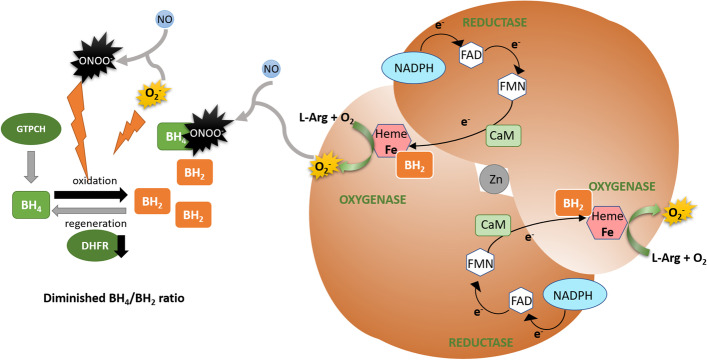
Nitric oxide (NO) is one of the most important molecules released by endothelial cells, and its antiatherogenic properties support cardiovascular homeostasis. Diminished NO bioavailability is a common hallmark of endothelial dysfunction underlying the pathogenesis of the cardiovascular disease. Vascular NO is synthesized by endothelial nitric oxide synthase (eNOS) from the substrate L-arginine (L-Arg), with tetrahydrobiopterin (BH) as an essential cofactor. Cardiovascular risk factors such as diabetes, dyslipidemia, hypertension, aging, or smoking increase vascular oxidative stress that strongly affects eNOS activity and leads to eNOS uncoupling. Uncoupled eNOS produces superoxide anion (O) instead of NO, thus becoming a source of harmful free radicals exacerbating the oxidative stress further. eNOS uncoupling is thought to be one of the major underlying causes of endothelial dysfunction observed in the pathogenesis of vascular diseases. Here, we discuss the main mechanisms of eNOS uncoupling, including oxidative depletion of the critical eNOS cofactor BH, deficiency of eNOS substrate L-Arg, or accumulation of its analog asymmetrical dimethylarginine (ADMA), and eNOS S-glutathionylation. Moreover, potential therapeutic approaches that prevent eNOS uncoupling by improving cofactor availability, restoration of L-Arg/ADMA ratio, or modulation of eNOS S-glutathionylation are briefly outlined.
一氧化氮(NO)是内皮细胞释放的最重要的分子之一,其抗动脉粥样硬化特性支持心血管稳态。NO 生物利用度降低是内皮功能障碍的共同标志,而内皮功能障碍是心血管疾病发病机制的基础。血管中的 NO 是由内皮型一氧化氮合酶(eNOS)从 L-精氨酸(L-Arg)的底物合成的,四氢生物蝶呤(BH)是必需的辅助因子。糖尿病、血脂异常、高血压、衰老或吸烟等心血管危险因素会增加血管氧化应激,这强烈影响 eNOS 的活性并导致 eNOS 解偶联。解偶联的 eNOS 产生超氧阴离子(O)而不是 NO,因此成为有害自由基的来源,进一步加剧氧化应激。eNOS 解偶联被认为是血管疾病发病机制中观察到的内皮功能障碍的主要潜在原因之一。在这里,我们讨论了 eNOS 解偶联的主要机制,包括关键 eNOS 辅助因子 BH 的氧化耗竭、eNOS 底物 L-Arg 的缺乏或其类似物非对称二甲基精氨酸(ADMA)的积累,以及 eNOS 的 S-谷胱甘肽化。此外,还简要概述了通过提高辅助因子可用性、恢复 L-Arg/ADMA 比值或调节 eNOS S-谷胱甘肽化来预防 eNOS 解偶联的潜在治疗方法。