Wessels Alette M, Dennehy Ellen B, Dowsett Sherie A, Dickson Samuel P, Hendrix Suzanne B
Eli Lilly and Company (AMW, EBD, SAD), Indianapolis, IN; Department of Psychological Sciences (EBD), Purdue University, West Lafayette, IN; and Pentara Corporation (SPD, SBH), Millcreek, UT.
Neurol Clin Pract. 2023 Apr;13(2):e200127. doi: 10.1212/CPJ.0000000000200127. Epub 2023 Feb 16.
To provide relevant background of the Integrated Alzheimer's Disease Rating Scale (iADRS), with examples, to assist the reader with the interpretation of iADRS findings from the TRAILBLAZER-ALZ study.
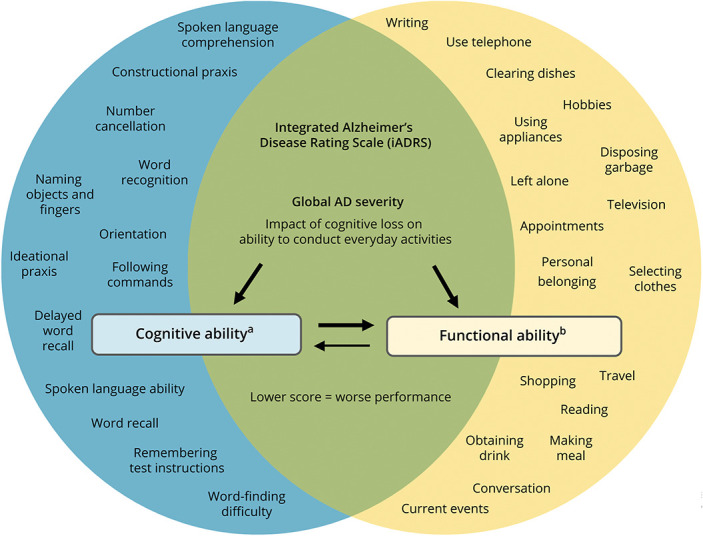
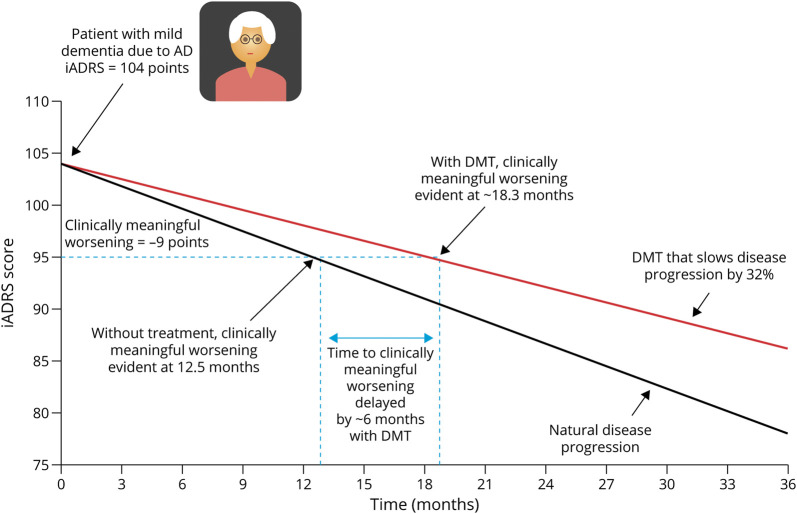
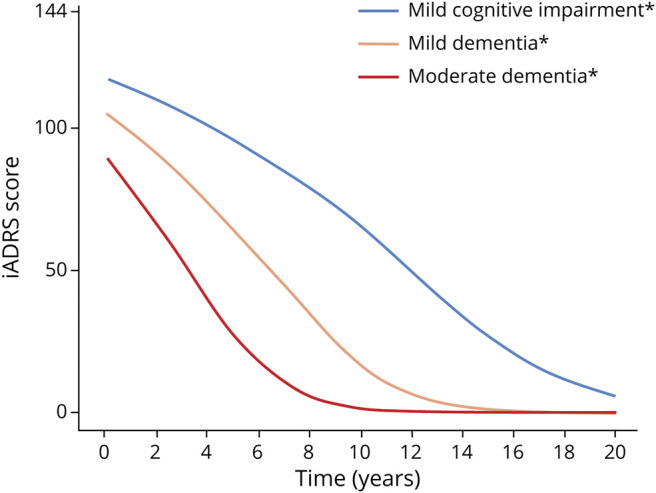
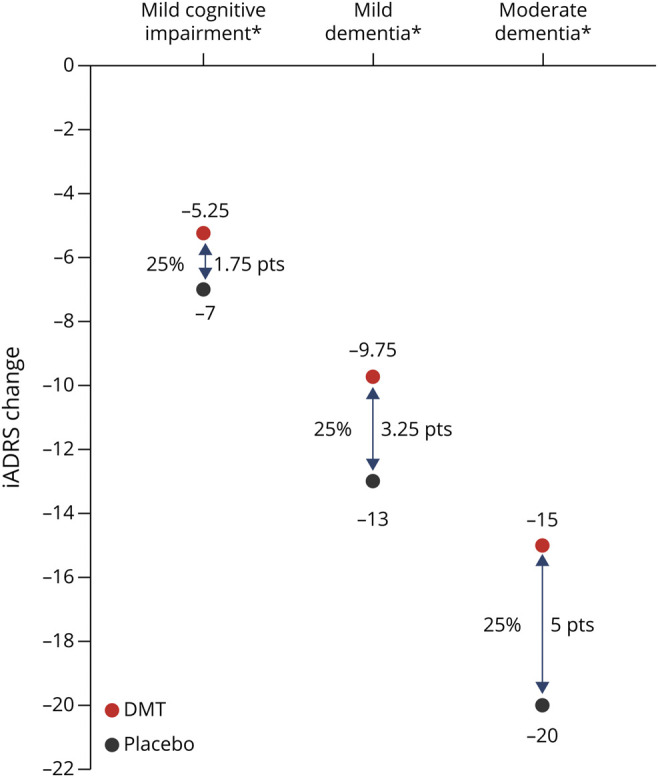
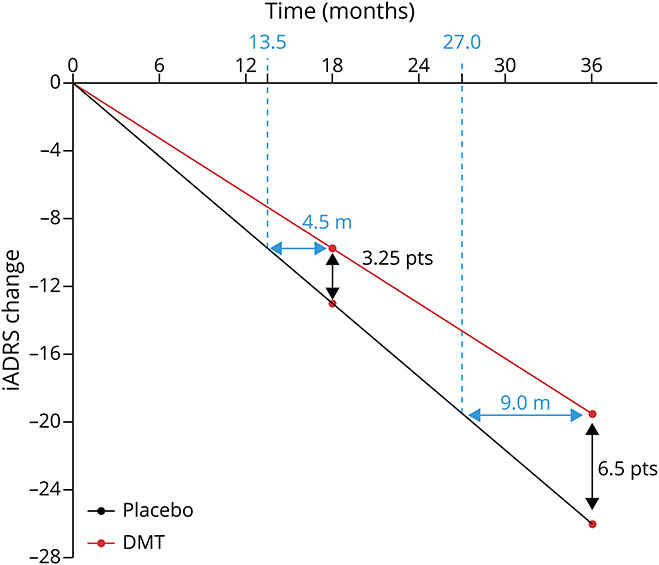
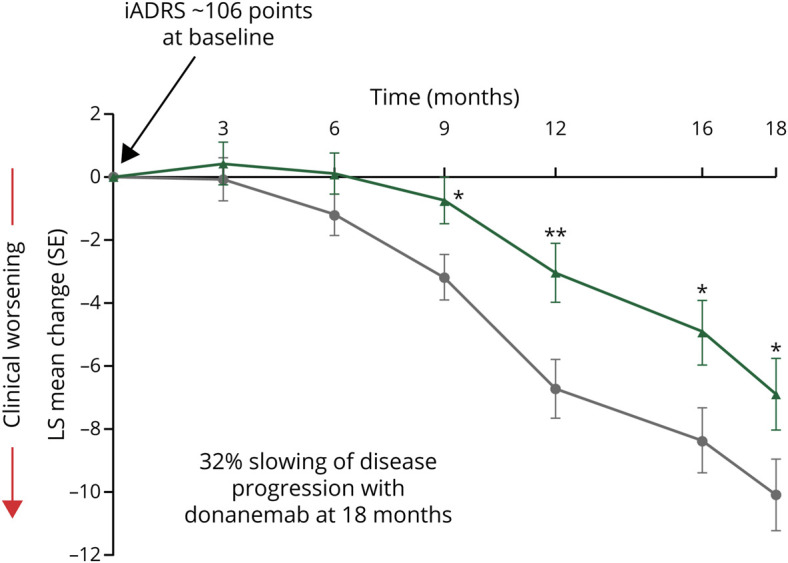
The iADRS is an integrated measure of global Alzheimer disease (AD) severity for use in the clinical trial environment. It provides a single score that captures commonalities across cognitive and functional ability domains, reflecting disease-related impairment, while minimizing noise not related to disease progression that may exist within each domain. In AD, disease-modifying therapies (DMTs) are expected to slow the rate of clinical decline, changing the trajectory of disease progression. The overall percent slowing of disease progression with treatment is a more informative outcome of effect than absolute point differences between treatment and placebo groups at any given time point because the latter is influenced by treatment period and disease severity. The TRAILBLAZER-ALZ trial was a phase 2 study designed to evaluate the safety and efficacy of donanemab in participants with early symptomatic AD; the primary outcome measure was the change from baseline to 76 weeks on the iADRS. In the TRAILBLAZER-ALZ study, donanemab slowed disease progression by 32% at 18 months ( = 0.04 vs placebo), demonstrating clinical efficacy. At the patient level, one can assess whether the DMT effect is clinically meaningful by estimating the threshold of change consistent with clinically meaningful worsening; based on the TRAILBLAZER-ALZ findings, treatment with donanemab would delay reaching this threshold by approximately 6 months.
The iADRS is capable of accurately describing clinical changes associated with disease progression and detecting treatment effects and is an effective assessment tool for use in clinical trials of individuals with early symptomatic AD.
提供综合阿尔茨海默病评定量表(iADRS)的相关背景,并举例说明,以帮助读者解读来自TRAILBLAZER-ALZ研究的iADRS结果。
iADRS是一种用于临床试验环境的综合测量全球阿尔茨海默病(AD)严重程度的工具。它提供一个单一分数,该分数捕捉认知和功能能力领域的共性,反映与疾病相关的损害,同时将每个领域内可能存在的与疾病进展无关的干扰因素降至最低。在AD中,疾病修饰疗法(DMTs)有望减缓临床衰退速度,改变疾病进展轨迹。与治疗相关的疾病进展总体减缓百分比是比在任何给定时间点治疗组与安慰剂组之间的绝对差值更具信息量的疗效结果,因为后者受治疗期和疾病严重程度的影响。TRAILBLAZER-ALZ试验是一项2期研究,旨在评估多奈单抗在早期有症状AD患者中的安全性和有效性;主要结局指标是iADRS从基线到76周的变化。在TRAILBLAZER-ALZ研究中,多奈单抗在18个月时使疾病进展减缓32%(与安慰剂相比,P = 0.04),证明了临床疗效。在患者层面,可以通过估计与临床有意义的恶化相一致的变化阈值来评估DMT效应是否具有临床意义;根据TRAILBLAZER-ALZ的研究结果,使用多奈单抗治疗将使达到该阈值的时间推迟约6个月。
iADRS能够准确描述与疾病进展相关的临床变化并检测治疗效果,是用于早期有症状AD个体临床试验的有效评估工具。