Fondazione Policlinico Universitario "Agostino Gemelli" IRCCS Rome Italy.
Department of Medicine and Surgery LUM University Casamassima Italy.
J Am Heart Assoc. 2023 Mar 21;12(6):e027088. doi: 10.1161/JAHA.122.027088. Epub 2023 Mar 9.
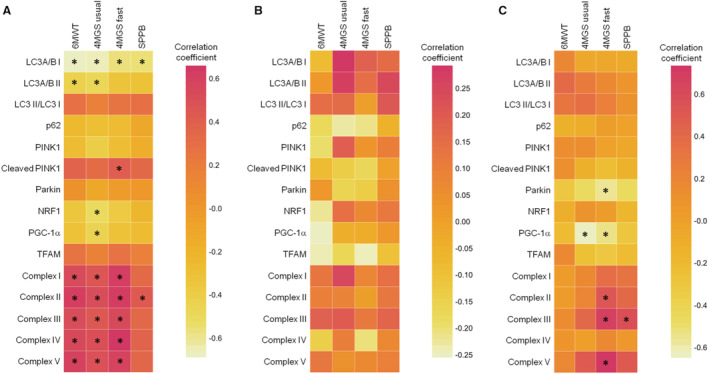
Background Mitochondrial abnormalities exist in gastrocnemius muscle of people with peripheral artery disease (PAD). Whether abnormalities in mitochondrial biogenesis and autophagy are associated with greater ischemia or walking impairment in PAD is unknown. Methods and Results Protein markers of mitochondrial biogenesis and autophagy and the abundance of mitochondrial electron transport chain complexes were quantified in gastrocnemius muscle biopsies from people with and without PAD. Their 6-minute walk distance and 4-m gait speed were measured. Sixty-seven participants (mean age 65.0 years [±6.8], 16 [23.9%] women, 48 [71.6%] Black) were enrolled, including 15 with moderate to severe PAD (ankle brachial index [ABI] <0.60), 29 with mild PAD (ABI 0.60-0.90), and 23 without PAD (ABI 1.00-1.40). Abundance of all electron transport chain complexes was significantly higher in participants with lower ABI (eg, complex I: 0.66, 0.45, 0.48 arbitrary units [AU], respectively, trend=0.043). Lower ABI values were associated with a higher LC3A/B II-to-LC3A/B I (microtubule-associated protein 1A/1B-light chain 3) ratio (2.54, 2.31, 2.15 AU, respectively, trend=0.017) and reduced abundance of the autophagy receptor p62 (0.71, 0.69, 0.80 AU, respectively, trend=0.033). The abundance of each electron transport chain complex was positively and significantly associated with 6-minute walk distance and 4-m gait speed at usual and fast pace only among participants without PAD (eg, complex I: =0.541, =0.008; =0.477, =0.021; =0.628, =0.001, respectively). Conclusions These results suggest that accumulation of electron transport chain complexes in gastrocnemius muscle of people with PAD may be because of impaired mitophagy in the setting of ischemia. Findings are descriptive, and further study in larger sample sizes is needed.
周围动脉疾病(PAD)患者的腓肠肌存在线粒体异常。线粒体生物发生和自噬的异常是否与 PAD 患者更大的缺血或行走障碍有关尚不清楚。
在有和没有 PAD 的患者的腓肠肌活检中定量测定了线粒体生物发生和自噬的蛋白标志物以及线粒体电子传递链复合物的丰度,并测量了他们的 6 分钟步行距离和 4 米步速。纳入了 67 名参与者(平均年龄 65.0±6.8 岁[±6.8],16 名[23.9%]女性,48 名[71.6%]黑人),包括 15 名中度至重度 PAD(踝肱指数[ABI]<0.60),29 名轻度 PAD(ABI 0.60-0.90)和 23 名无 PAD(ABI 1.00-1.40)。所有电子传递链复合物的丰度在 ABI 较低的患者中显著更高(例如,复合物 I:分别为 0.66、0.45、0.48 个任意单位[AU],趋势=0.043)。较低的 ABI 值与更高的 LC3A/B II-to-LC3A/B I(微管相关蛋白 1A/1B-轻链 3)比值(分别为 2.54、2.31、2.15 AU,趋势=0.017)和自噬受体 p62 的丰度降低相关(分别为 0.71、0.69、0.80 AU,趋势=0.033)。只有在无 PAD 的患者中,每个电子传递链复合物的丰度与 6 分钟步行距离和 4 米步速呈正相关且显著相关(例如,复合物 I:=0.541,=0.008;=0.477,=0.021;=0.628,=0.001,分别)。
这些结果表明,PAD 患者腓肠肌中电子传递链复合物的积累可能是由于缺血情况下的自噬受损所致。研究结果是描述性的,需要在更大的样本量中进一步研究。