MMWR Morb Mortal Wkly Rep. 2023 Mar 10;72(10):261-264. doi: 10.15585/mmwr.mm7210a3.
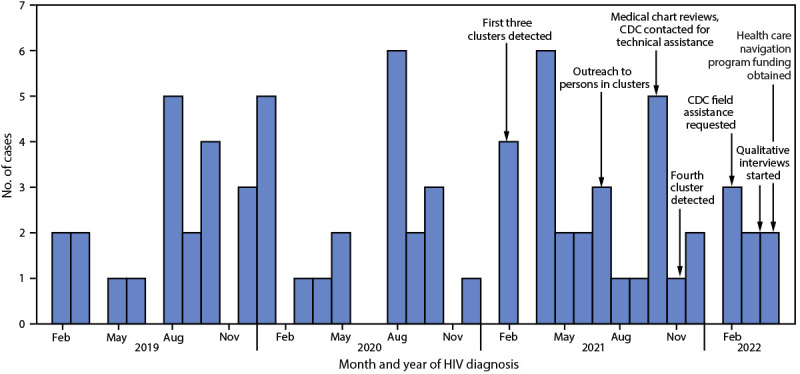
During February 2021-June 2022, the Georgia Department of Public Health (GDPH) detected five clusters of rapid HIV transmission concentrated among Hispanic or Latino (Hispanic) gay, bisexual, and other men who have sex with men (MSM) in metropolitan Atlanta. The clusters were detected through routine analysis of HIV-1 nucleotide sequence data obtained through public health surveillance (1,2). Beginning in spring 2021, GDPH partnered with health districts with jurisdiction in four metropolitan Atlanta counties (Cobb, DeKalb, Fulton, and Gwinnett) and CDC to investigate factors contributing to HIV spread, epidemiologic characteristics, and transmission patterns. Activities included review of surveillance and partner services interview data, medical chart reviews, and qualitative interviews with service providers and Hispanic MSM community members. By June 2022, these clusters included 75 persons, including 56% who identified as Hispanic, 96% who reported male sex at birth, 81% who reported male-to-male sexual contact, and 84% of whom resided in the four metropolitan Atlanta counties. Qualitative interviews identified barriers to accessing HIV prevention and care services, including language barriers, immigration- and deportation-related concerns, and cultural norms regarding sexuality-related stigma. GDPH and the health districts expanded coordination, initiated culturally concordant HIV prevention marketing and educational activities, developed partnerships with organizations serving Hispanic communities to enhance outreach and services, and obtained funding for a bilingual patient navigation program with academic partners to provide staff members to help persons overcome barriers and understand the health care system. HIV molecular cluster detection can identify rapid HIV transmission among sexual networks involving ethnic and sexual minority groups, draw attention to the needs of affected populations, and advance health equity through tailored responses that address those needs.
在 2021 年 2 月至 2022 年 6 月期间,佐治亚州公共卫生部(GDPH)在亚特兰大都会区检测到五组集中在西班牙裔或拉丁裔(西班牙语裔)男同性恋、双性恋和其他与男性发生性关系的男性(MSM)中的快速 HIV 传播集群。这些集群是通过对通过公共卫生监测获得的 HIV-1 核苷酸序列数据的例行分析检测到的(1,2)。从 2021 年春季开始,GDPH 与管辖佐治亚州四个都会区(科布、迪卡尔布、富尔顿和格温内特)的卫生区以及 CDC 合作,调查导致 HIV 传播的因素、流行病学特征和传播模式。活动包括审查监测和伙伴服务访谈数据、医疗记录审查以及与服务提供者和西班牙裔 MSM 社区成员的定性访谈。到 2022 年 6 月,这些集群包括 75 人,其中 56%的人自认为是西班牙裔,96%的人报告出生时为男性,81%的人报告有男男性接触,84%的人居住在四个亚特兰大都会区。定性访谈确定了获得 HIV 预防和护理服务的障碍,包括语言障碍、与移民和驱逐相关的担忧以及与性相关耻辱感相关的文化规范。GDPH 和卫生区扩大了协调,启动了具有文化共鸣的 HIV 预防营销和教育活动,与服务西班牙裔社区的组织建立了伙伴关系,以加强外展和服务,并获得了与学术合作伙伴的双语患者导航计划的资金,该计划提供员工帮助人们克服障碍并了解医疗保健系统。HIV 分子聚类检测可以识别涉及族裔和性少数群体的性网络中的快速 HIV 传播,引起人们对受影响人群需求的关注,并通过解决这些需求的量身定制的应对措施促进健康公平。