Department of Population Health, University of Toledo, Toledo, OH 43606, USA.
Department of Population Health, University of Toledo, Toledo, OH 43606, USA.
Vaccine. 2023 Mar 31;41(14):2404-2411. doi: 10.1016/j.vaccine.2023.02.079. Epub 2023 Mar 1.
Previous research suggests that racial and ethnic minority groups especially Black Americans showed stronger COVID-19 vaccine hesitancy and resistance, which may result from a lack of trust toward the government and vaccine manufacturers, among other sociodemographic and health factors.
The current study explored potential social and economic, clinical, and psychological factors that may have mediated racial and ethnic disparities in COVID-19 vaccine uptake among US adults.
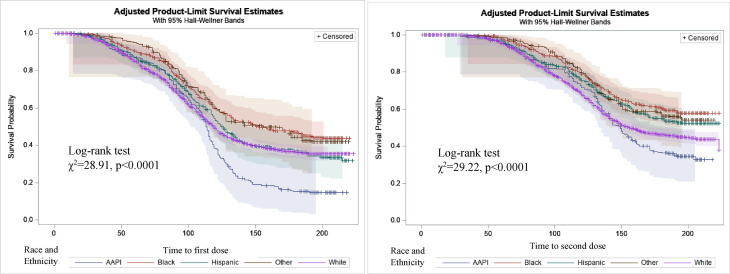
A sample of 6078 US individuals was selected from a national longitudinal survey administered in 2020-2021. Baseline characteristics were collected in December 2020, and respondents were followed up to July 2021. Racial and ethnic disparities in time to vaccine initiation and completion (based on a 2-dose regimen) were first assessed with the Kaplan-Meier Curve and log-rank test, and then explored with the Cox proportional hazards model adjusting for potential time-varying mediators, such as education, income, marital status, chronic health conditions, trust in vaccine development and approval processes, and perceived risk of infection.
Prior to mediator adjustment, Black and Hispanic Americans had slower vaccine initiation and completion than Asian Americans and Pacific Islanders and White Americans (p's < 0.0001). After accounting for the mediators, there were no significant differences in vaccine initiation or completion between each minoritized group as compared to White Americans. Education, household income, marital status, chronic health conditions, trust, and perceived infection risk were potential mediators.
Racial and ethnic disparities in COVID-19 vaccine uptake were mediated through social and economic conditions, psychological influences, and chronic health conditions. To address the racial and ethnic inequity in vaccination, it is important to target the social, economic, and psychological forces behind it.
先前的研究表明,少数族裔群体,尤其是非裔美国人,对 COVID-19 疫苗表现出更强的犹豫和抵触情绪,这可能是由于对政府和疫苗制造商缺乏信任,以及其他社会人口和健康因素造成的。
本研究旨在探讨可能存在的社会经济、临床和心理因素,这些因素可能导致美国成年人 COVID-19 疫苗接种率存在种族和族裔差异。
本研究从 2020 年至 2021 年期间进行的一项全国性纵向调查中选取了 6078 名美国个体作为样本。于 2020 年 12 月收集基线特征,随访至 2021 年 7 月。采用 Kaplan-Meier 曲线和对数秩检验首先评估了疫苗接种启动和完成(基于 2 剂方案)的时间方面的种族和族裔差异,然后采用 Cox 比例风险模型进行了探索,该模型调整了潜在的时变中介因素,如教育程度、收入、婚姻状况、慢性健康状况、对疫苗开发和批准过程的信任以及对感染风险的感知。
在调整中介因素之前,非裔美国人和西班牙裔美国人的疫苗接种启动和完成速度慢于亚裔美国人和太平洋岛民以及白人美国人(p 值均<0.0001)。在考虑了中介因素后,与白人美国人相比,每个少数族裔群体在疫苗接种启动或完成方面均无显著差异。教育程度、家庭收入、婚姻状况、慢性健康状况、信任和感染风险感知是潜在的中介因素。
COVID-19 疫苗接种率的种族和族裔差异是通过社会经济状况、心理影响和慢性健康状况来介导的。为了解决疫苗接种方面的种族和族裔不平等问题,重要的是要针对其背后的社会、经济和心理因素。