Department of Immunobiology, Yale School of Medicine, New Haven, CT, USA.
Department of Pediatrics, Section of Infectious Diseases and Global Health, Yale University School of Medicine, New Haven, CT, USA.
Nat Commun. 2023 Mar 9;14(1):1299. doi: 10.1038/s41467-023-36686-8.
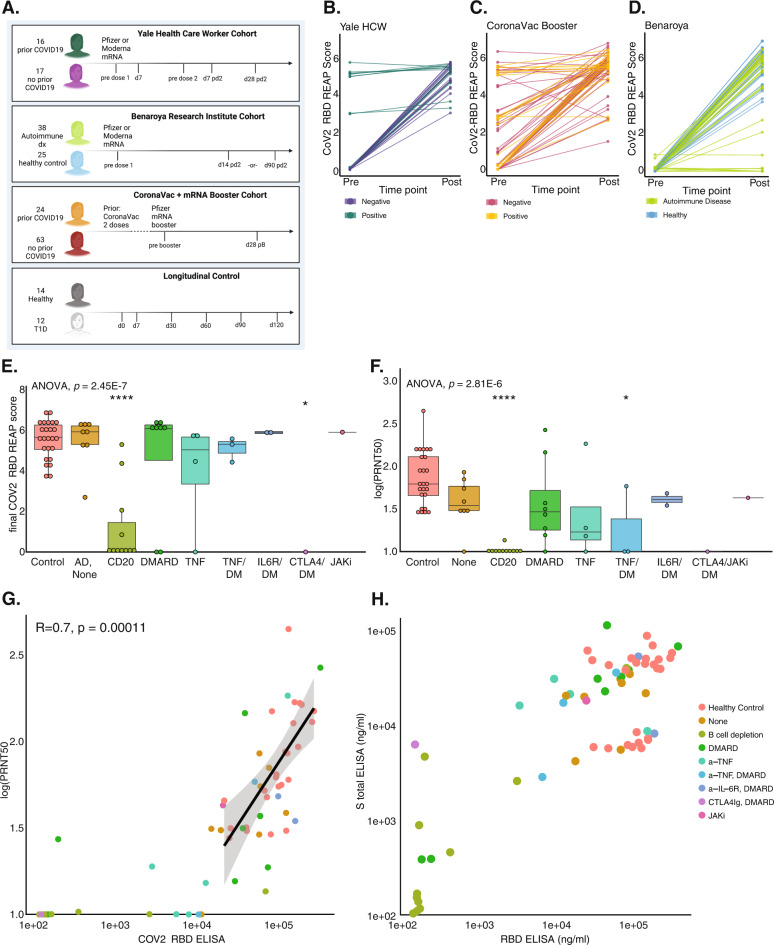
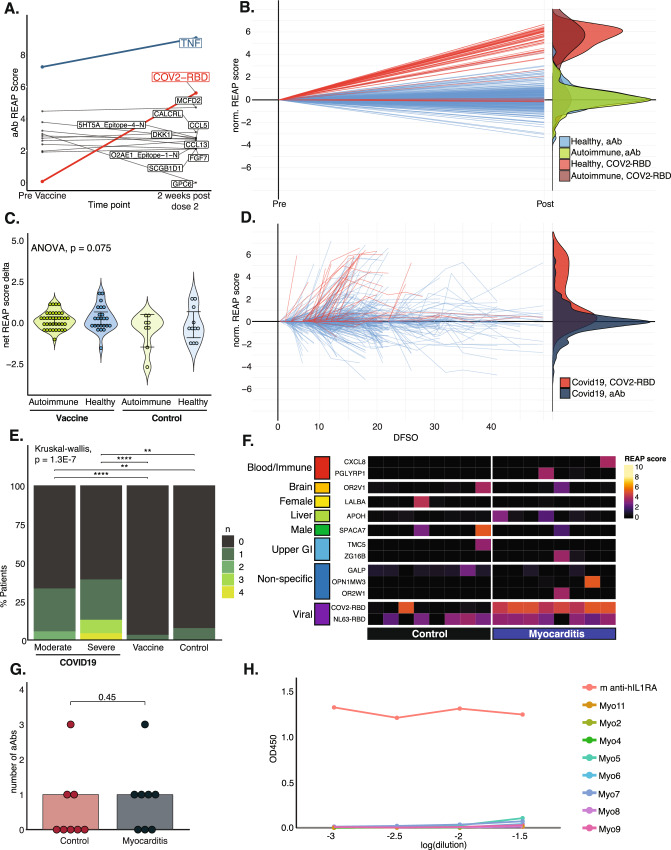
mRNA-based vaccines dramatically reduce the occurrence and severity of COVID-19, but are associated with rare vaccine-related adverse effects. These toxicities, coupled with observations that SARS-CoV-2 infection is associated with autoantibody development, raise questions whether COVID-19 vaccines may also promote the development of autoantibodies, particularly in autoimmune patients. Here we used Rapid Extracellular Antigen Profiling to characterize self- and viral-directed humoral responses after SARS-CoV-2 mRNA vaccination in 145 healthy individuals, 38 patients with autoimmune diseases, and 8 patients with mRNA vaccine-associated myocarditis. We confirm that most individuals generated robust virus-specific antibody responses post vaccination, but that the quality of this response is impaired in autoimmune patients on certain modes of immunosuppression. Autoantibody dynamics are remarkably stable in all vaccinated patients compared to COVID-19 patients that exhibit an increased prevalence of new autoantibody reactivities. Patients with vaccine-associated myocarditis do not have increased autoantibody reactivities relative to controls. In summary, our findings indicate that mRNA vaccines decouple SARS-CoV-2 immunity from autoantibody responses observed during acute COVID-19.
mRNA 疫苗显著降低了 COVID-19 的发生和严重程度,但与罕见的疫苗相关不良反应有关。这些毒性,加上观察到 SARS-CoV-2 感染与自身抗体的产生有关,这引发了一个问题,即 COVID-19 疫苗是否也会促进自身抗体的产生,特别是在自身免疫性疾病患者中。在这里,我们使用快速细胞外抗原分析,对 145 名健康个体、38 名自身免疫性疾病患者和 8 名与 mRNA 疫苗相关心肌炎患者接种 SARS-CoV-2 mRNA 疫苗后的自身和病毒定向体液反应进行了特征描述。我们证实,大多数个体在接种疫苗后产生了强大的病毒特异性抗体反应,但在某些免疫抑制模式下,自身免疫性疾病患者的这种反应质量受损。与 COVID-19 患者相比,所有接种疫苗的患者的自身抗体动力学都非常稳定,后者表现出新的自身抗体反应的患病率增加。与对照组相比,与疫苗相关的心肌炎患者自身抗体反应没有增加。总之,我们的研究结果表明,mRNA 疫苗将 SARS-CoV-2 免疫与急性 COVID-19 期间观察到的自身抗体反应解耦。