Department of Obstetrics and Gynecology, Wilhelmina Children's Hospital, University Medical Centre Utrecht, KE.04.123.1, Lundlaan 6, 3584 EA, Utrecht, The Netherlands.
Erasmus School of Health Policy & Management, Erasmus University Rotterdam, Rotterdam, The Netherlands.
J Patient Rep Outcomes. 2023 Mar 9;7(1):26. doi: 10.1186/s41687-023-00568-w.
In the transition towards value-based healthcare, patient-reported outcome and experience measures (PROM and PREM) are recommended by international collaborations and government programs to guide clinical practice and quality improvement. For many conditions, using PROM/PREM over the complete continuum of care requires implementation across care organizations and disciplines. Along PROM/PREM implementation in obstetric care networks (OCN), we aimed to evaluate implementation outcomes and the processes influencing these outcomes in the complex context of care networks across the continuum of perinatal care.
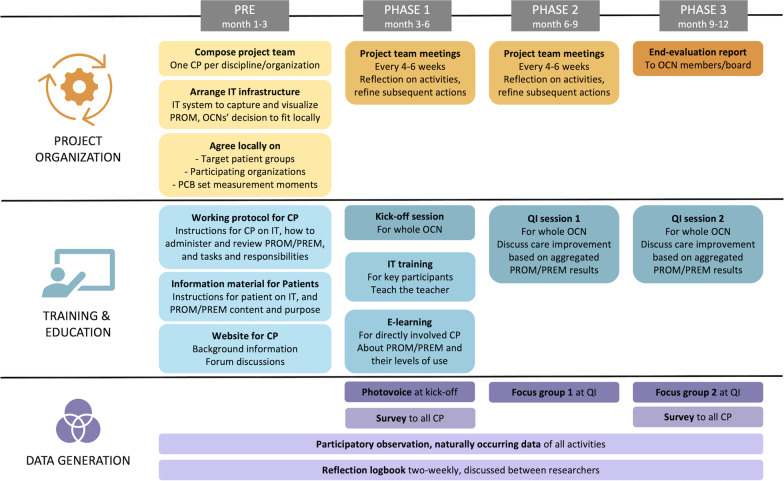
Three OCN in the Netherlands implemented PROM/PREM in routine practice, using an internationally developed outcomes set with care professionals and patient advocates. Their aim was to use PROM/PREM results individually to guide patient-specific care decisions and at group-level to improve quality of care. The implementation process was designed following the principles of action research: iteratively planning implementation, action, data generation and reflection to refine subsequent actions, involving both researchers and care professionals. During the one-year implementation period in each OCN, implementation outcomes and processes were evaluated in this mixed-methods study. Data generation (including observation, surveys and focus groups) and analysis were guided by two theoretical implementation frameworks: the Normalization Process Theory and Proctor's taxonomy for implementation outcomes. Qualitative findings were supplemented with survey data to solidify findings in a broader group of care professionals.
Care professionals in OCN found the use of PROM/PREM acceptable and appropriate, recognized their benefits and felt facilitated in their patient-centered goals and vision. However, feasibility for daily practice was low, mainly due to IT issues and time constraints. Hence PROM/PREM implementation did not sustain, but strategies for future PROM/PREM implementation were formulated in all OCN. Processes contributing positively to implementation outcomes were internalization (understand the value) and initiation (driven by key-participants), whereas challenges in relational integration (maintain confidence) and reconfiguration (refine activities) affected implementation negatively.
Although implementation did not sustain, network-broad PROM/PREM use in clinic and quality improvement matched professionals' motivation. This study provides recommendations to implement PROM/PREM meaningfully in practice in ways that support professionals in their drive towards patient-centered care. In order for PROM/PREM to fulfill their potential for value-based healthcare, our work highlights the need for sustainable IT infrastructures, as well as an iterative approach to refine their complex implementation into local contexts.
在向基于价值的医疗保健转变的过程中,国际合作和政府项目建议使用患者报告的结果和体验测量(PROM 和 PREM)来指导临床实践和质量改进。对于许多疾病,在整个护理连续体中使用 PROM/PREM 需要在护理组织和学科之间进行实施。在产科护理网络(OCN)中实施 PROM/PREM 时,我们旨在评估实施结果以及影响这些结果的过程,这些结果是在整个围产期护理连续体的复杂护理网络背景下进行的。
荷兰的三个 OCN 在护理专业人员和患者倡导者的共同努力下,使用国际上开发的结果集,在常规实践中实施 PROM/PREM。他们的目标是单独使用 PROM/PREM 结果来指导针对患者的护理决策,并在组级水平上提高护理质量。实施过程遵循行动研究的原则:迭代规划实施、行动、生成数据和反思,以改进后续行动,同时涉及研究人员和护理专业人员。在每个 OCN 的为期一年的实施期间,本混合方法研究评估了实施结果和过程。数据生成(包括观察、调查和焦点小组)和分析由两个理论实施框架指导:正常化过程理论和 Proctor 的实施结果分类法。定性研究结果补充了调查数据,以在更广泛的护理专业人员群体中巩固研究结果。
OCN 的护理专业人员认为使用 PROM/PREM 是可以接受和适当的,他们认识到了其益处,并认为这有助于他们实现以患者为中心的目标和愿景。然而,日常实践的可行性很低,主要是由于 IT 问题和时间限制。因此,PROM/PREM 的实施没有持续下去,但所有 OCN 都制定了未来实施 PROM/PREM 的策略。对实施结果产生积极影响的过程是内化(理解价值)和启动(由关键参与者驱动),而在关系整合(保持信心)和重新配置(改进活动)方面的挑战则对实施产生了负面影响。
尽管实施没有持续下去,但在诊所和质量改进方面的网络广泛使用 PROM/PREM 与专业人员的动机相匹配。本研究为在实践中以支持专业人员向以患者为中心的护理方向发展的方式有意义地实施 PROM/PREM 提供了建议。为了使 PROM/PREM 能够发挥其在基于价值的医疗保健中的潜力,我们的工作强调需要可持续的 IT 基础设施,以及迭代方法来完善其在本地环境中的复杂实施。
