Faculty of Social Sciences, Tampere University, Tampere, Finland.
Welfare State Research and Reform, Finnish Institute for Health and Welfare, Helsinki, Finland.
BMC Health Serv Res. 2023 Mar 9;23(1):233. doi: 10.1186/s12913-023-09223-y.
Resilience is often referred to when assessing the ability of health systems to maintain their functions during unexpected events. Primary healthcare forms the basis for the health system and thus its resilient responses are vital for the outcomes of the whole system. Understanding how primary healthcare organisations are able to build resilience before, during, and after unexpected or sudden shocks, is key to public health preparedness. This study aims to identify how leaders responsible for local health systems interpreted changes in their operational environment during the first year of COVID-19, and to elucidate how these views reflect aspects of resilience in healthcare.
The data consist of 14 semi-structured individual interviews with leaders of local health systems in Finland representing primary healthcare. The participants were recruited from four regions. An abductive thematic analysis was used to identify entities from the viewpoints of the purpose, resources, and processes of resilience in the healthcare organisation.
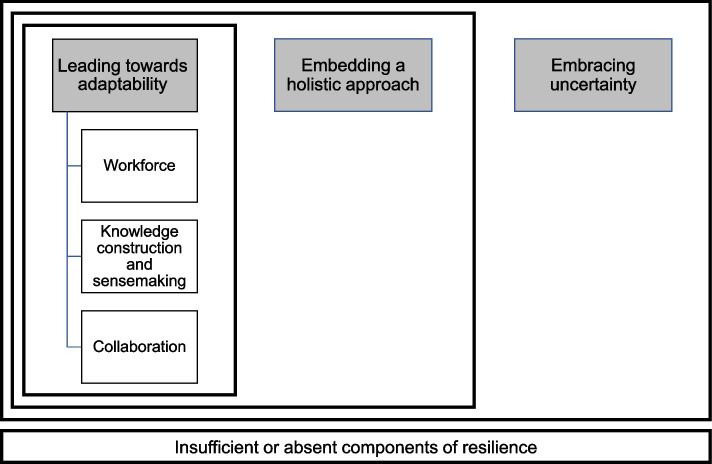
Results were summarised as six themes, which suggest that embracing uncertainty is viewed by the interviewees a basis for primary healthcare functioning. Leading towards adaptability was regarded a distinct leadership task enabling the organisation to modify its functions according to demands of the changing operational environment. Workforce, knowledge and sensemaking, as well as collaboration represented what the leaders viewed as the means for achieving adaptability. The ability to adapt functioned to comprehensively meet the population's service needs built on a holistic approach.
The results showed how the leaders who participated in this study adapted their work during changes brought on by the pandemic, and what they viewed as critical for maintaining organisational resilience. The leaders considered embracing uncertainty as a principal feature of their work rather than viewing uncertainty as aberrant and something to avoid. These notions, along with what the leaders considered as critical means for building resilience and adaptability should be addressed and elaborated in future research. Research on resilience and leadership should be conducted more in the complex context of primary healthcare, where cumulative stresses are encountered and processed continuously.
在评估卫生系统在意外事件中维持其功能的能力时,经常提到弹性。初级医疗保健是卫生系统的基础,因此其弹性反应对于整个系统的结果至关重要。了解初级医疗保健组织在意外或突发冲击之前、期间和之后如何建立弹性,是公共卫生准备的关键。本研究旨在确定负责地方卫生系统的领导者如何在 COVID-19 爆发的第一年解释其运营环境的变化,并阐明这些观点如何反映医疗保健弹性的各个方面。
数据包括对芬兰四个地区的 14 名负责地方卫生系统的初级医疗保健领导者进行的 14 次半结构化个人访谈。使用归纳主题分析从弹性在医疗保健组织中的目的、资源和流程的角度识别实体。
结果总结为六个主题,这些主题表明,受访者认为接受不确定性是初级医疗保健运作的基础。朝着适应性领导被视为一项独特的领导任务,使组织能够根据不断变化的运营环境的需求调整其功能。劳动力、知识和意义构建以及协作是领导者认为实现适应性的手段。适应功能旨在全面满足人口的服务需求,建立在整体方法的基础上。
结果表明,参与本研究的领导者在大流行带来的变化中调整了他们的工作,以及他们认为对维持组织弹性至关重要的工作。领导者认为接受不确定性是他们工作的主要特征,而不是将不确定性视为异常和需要避免的。这些概念,以及领导者认为建立弹性和适应性的关键手段,应该在未来的研究中得到解决和阐述。应该在初级医疗保健的复杂背景下进行更多关于弹性和领导力的研究,在这种背景下,会不断遇到并处理累积压力。