Department of Urology, Institute of Urology (Laboratory of Reconstructive Urology), West China Hospital, Sichuan University, Chengdu, Sichuan, China.
Department of Urology, Shengjing Hospital of China Medical University, Shenyang, Liaoning, China.
Front Immunol. 2023 Feb 21;14:1116224. doi: 10.3389/fimmu.2023.1116224. eCollection 2023.
The incidence rate of kidney stones increased over the past decades globally, which brought medical expenditure and social burden. The systemic immune-inflammatory index (SII) was initially identified as a prognosis of multiple diseases. We performed an updated analysis on the impact of SII on kidney stones.
This compensatory cross-sectional study enrolled participants from the National Health and Nutrition Examination Survey 2007-2018. Univariate and multivariate logistic regression analyses were performed to investigate the association between SII and kidney stones.
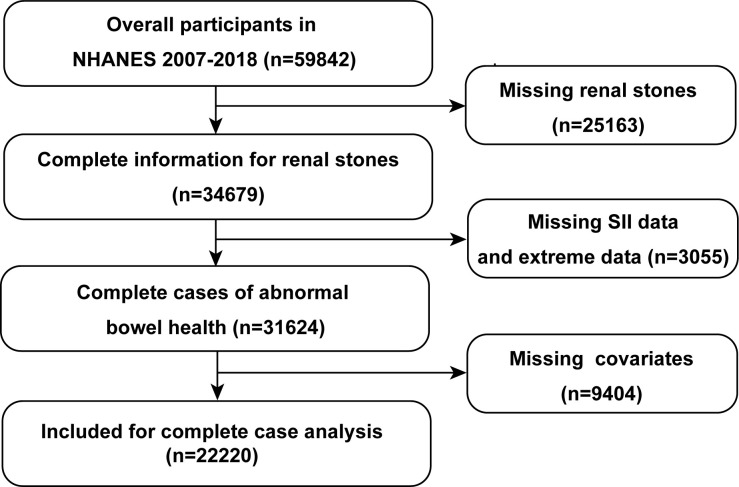
Of the 22220 participants, the mean (SD) age was 49.45 ± 17.36 years old, with a 9.87% incidence rate of kidney stones. A fully adjusted model showed that SII higher than 330 x 10/L was parallel associated with kidney stones (Odds ratio [OR] = 1.282, 95% Confidence interval [CI] = 1.023 to 1.608, = 0.034) in adults aged 20-50. However, no difference was found in the elderly subgroup. Multiple imputation analyses confirmed the robustness of our results.
Our findings suggested SII was positively associated with a high risk of kidney stones in US adults aged less than 50. The outcome compensated for previous studies that still needed more large-scale prospective cohorts for validation.
在过去几十年中,全球范围内肾结石的发病率有所上升,这给医疗支出和社会带来了负担。系统性免疫炎症指数(SII)最初被确定为多种疾病的预后指标。我们对 SII 对肾结石的影响进行了更新分析。
本补偿性横断面研究纳入了 2007 年至 2018 年国家健康和营养调查的参与者。采用单因素和多因素逻辑回归分析来研究 SII 与肾结石之间的关系。
在 22220 名参与者中,平均(SD)年龄为 49.45±17.36 岁,肾结石的发病率为 9.87%。完全调整模型显示,SII 高于 330×10/L 与成年人(年龄 20-50 岁)肾结石呈平行相关(优势比[OR] = 1.282,95%置信区间[CI] = 1.023 至 1.608,P = 0.034)。然而,在老年亚组中没有发现差异。多重插补分析证实了我们结果的稳健性。
我们的研究结果表明,SII 与美国 50 岁以下成年人肾结石的高风险呈正相关。该结果弥补了先前研究的不足,仍需要更多大规模的前瞻性队列研究来验证。