School of Management, Professorship for Digital Marketing, Technical University of Munich, Heilbronn, Germany.
LMU Center for Leadership and People Management, LMU Munich, Munich, Germany.
PLoS One. 2023 Mar 10;18(3):e0280271. doi: 10.1371/journal.pone.0280271. eCollection 2023.
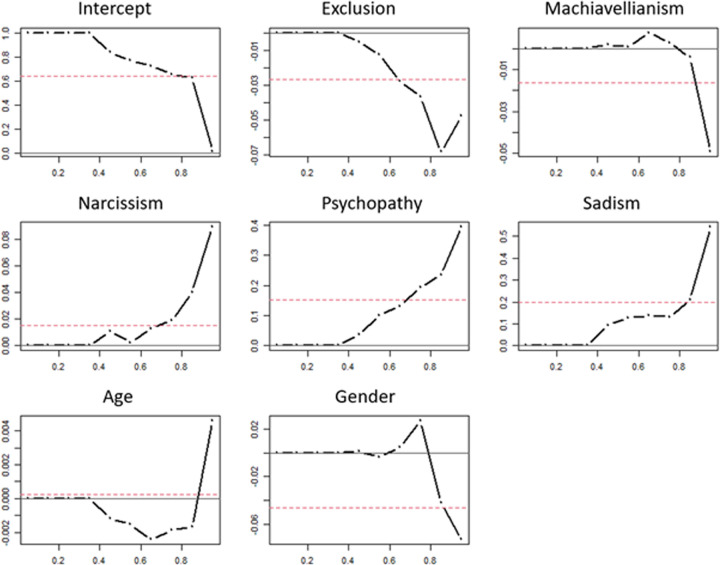
Internet trolling is considered a negative form of online interaction that can have detrimental effects on people's well-being. This pre-registered, experimental study had three aims: first, to replicate the association between internet users' online trolling behavior and the Dark Tetrad of personality (Machiavellianism, narcissism, psychopathy, and sadism) established in prior research; second, to investigate the effect of experiencing social exclusion on people's motivation to engage in trolling behavior; and third, to explore the link between humor styles and trolling behavior. In this online study, participants were initially assessed on their personality, humor styles, and global trolling behavior. Next, respondents were randomly assigned to a social inclusion or exclusion condition. Thereafter, we measured participants' immediate trolling motivation. Results drawn from 1,026 German-speaking participants indicate a clear correlation between global trolling and all facets of the Dark Tetrad as well as with aggressive and self-defeating humor styles. However, no significant relationship between experiencing exclusion/inclusion and trolling motivation emerged. Our quantile regression findings suggest that psychopathy and sadism scores have a significant positive effect on immediate trolling motivation after the experimental manipulation, whereas Machiavellianism and narcissism did not explain variation in trolling motivation. Moreover, being socially excluded had generally no effect on immediate trolling motivation, apart from participants with higher immediate trolling motivation, for whom the experience of social exclusion actually reduced trolling motivation. We show that not all facets of the Dark Tetrad are of equal importance for predicting immediate trolling motivation and that research should perhaps focus more on psychopathy and sadism. Moreover, our results emphasize the relevance of quantile regression in personality research and suggest that even psychopathy and sadism may not be suitable predictors for low levels of trolling behavior.
网络喷子行为被认为是一种消极的网络互动形式,会对人们的幸福感产生不利影响。本预先注册的实验研究有三个目的:首先,复制先前研究中建立的互联网用户网络喷子行为与人格黑暗四天王(马基雅维利主义、自恋、精神病态和施虐狂)之间的关联;其次,研究经历社会排斥对人们从事喷子行为的动机的影响;最后,探讨幽默风格与喷子行为之间的联系。在这项在线研究中,参与者首先评估他们的个性、幽默风格和整体喷子行为。接下来,受访者被随机分配到社会包容或排斥的条件下。此后,我们衡量了参与者的即时喷子动机。从 1026 名讲德语的参与者中得出的结果表明,整体喷子行为与黑暗四天王的所有方面以及攻击性和自我挫败的幽默风格之间存在明显的相关性。然而,经历排斥/包容与喷子动机之间没有显著的关系。我们的分位数回归发现表明,在实验操作后,精神病态和施虐狂得分对即时喷子动机有显著的积极影响,而马基雅维利主义和自恋则不能解释喷子动机的变化。此外,除了即时喷子动机较高的参与者外,社会排斥通常对即时喷子动机没有影响,对于这些参与者,社会排斥的经历实际上降低了喷子动机。我们表明,并非黑暗四天王的所有方面对于预测即时喷子动机都具有同等重要性,并且研究可能应该更关注精神病态和施虐狂。此外,我们的结果强调了分位数回归在人格研究中的重要性,并表明即使是精神病态和施虐狂也可能不适合预测低水平的喷子行为。