Environmental Biophysics and Molecular Ecology Program, Department of Marine and Coastal Sciences, Rutgers University, New Brunswick, NJ 08901.
Department of Biochemistry and Microbiology, Rutgers University, New Brunswick, NJ 08901.
Proc Natl Acad Sci U S A. 2023 Mar 14;120(11):e2216286120. doi: 10.1073/pnas.2216286120. Epub 2023 Mar 10.
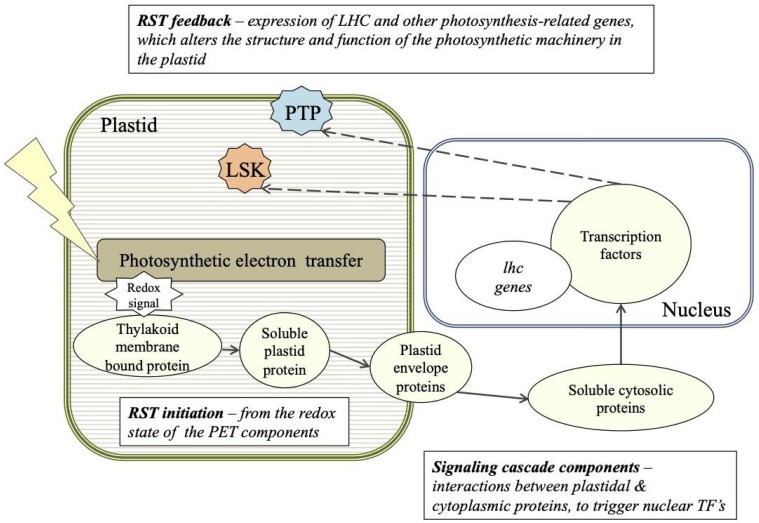
Unlike most higher plants, unicellular algae can acclimate to changes in irradiance on time scales of hours to a few days. The process involves an enigmatic signaling pathway originating in the plastid that leads to coordinated changes in plastid and nuclear gene expression. To deepen our understanding of this process, we conducted functional studies to examine how the model diatom, acclimates to low light and sought to identify the molecules responsible for the phenomenon. We show that two transformants with altered expression of two putative signal transduction molecules, a light-specific soluble kinase and a plastid transmembrane protein, that appears to be regulated by a long noncoding natural antisense transcript, arising from the opposite strand, are physiologically incapable of photoacclimation. Based on these results, we propose a working model of the retrograde feedback in the signaling and regulation of photoacclimation in a marine diatom.
与大多数高等植物不同,单细胞藻类可以在数小时到数天的时间内适应光照强度的变化。这个过程涉及到一个神秘的信号通路,该通路起源于质体,导致质体和核基因表达的协调变化。为了更深入地了解这一过程,我们进行了功能研究,以研究模型硅藻如何适应低光环境,并试图确定负责这一现象的分子。我们表明,两个转化体中两个假定信号转导分子的表达发生改变,一个是光特异性可溶性激酶,另一个是质体跨膜蛋白,似乎受到一个长非编码自然反义转录本的调控,该转录本来自相反的链,在生理上无法进行光适应。基于这些结果,我们提出了一个海洋硅藻中光适应信号转导和调控的逆行反馈工作模型。