Department of Physics, University of Washington, Seattle, WA 98195.
Computational Neuroscience Center, University of Washington, Seattle, WA 98195.
Proc Natl Acad Sci U S A. 2023 Mar 14;120(11):e2210439120. doi: 10.1073/pnas.2210439120. Epub 2023 Mar 10.
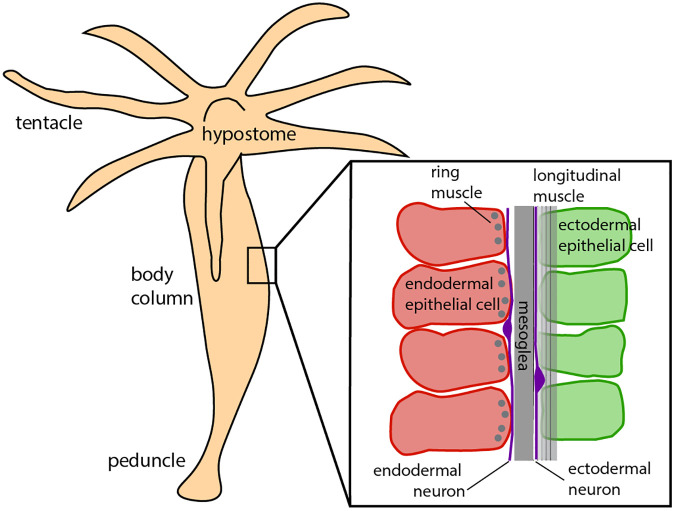
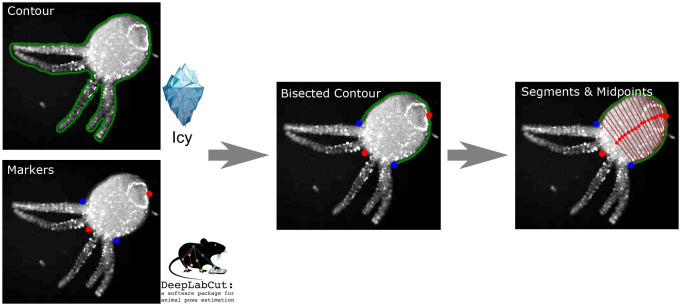
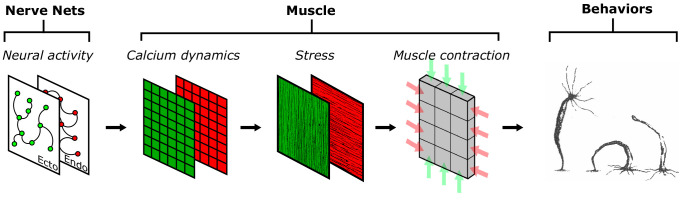
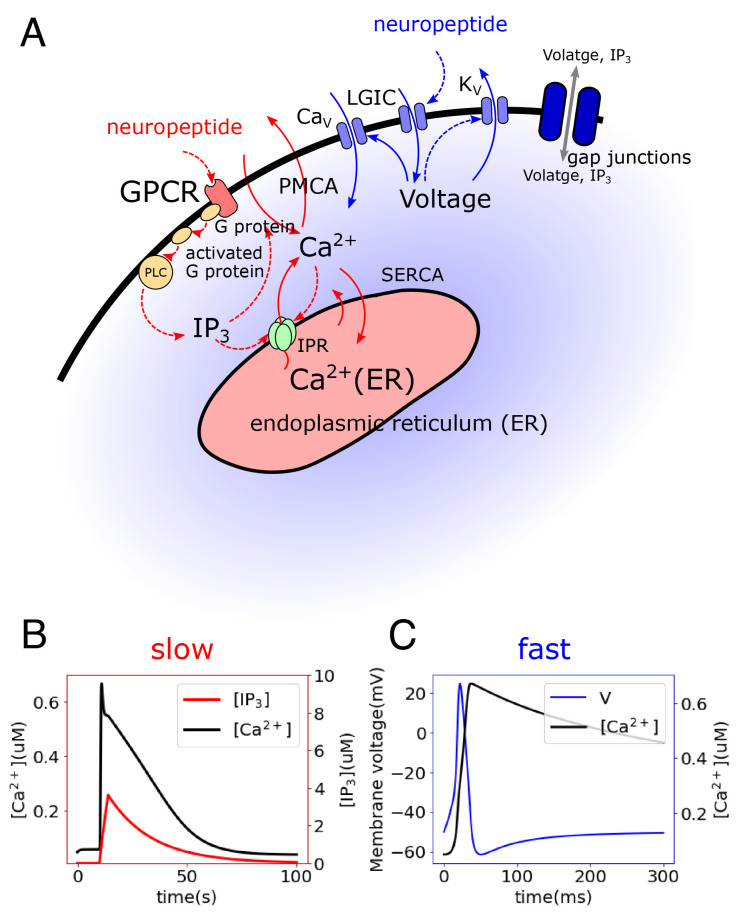
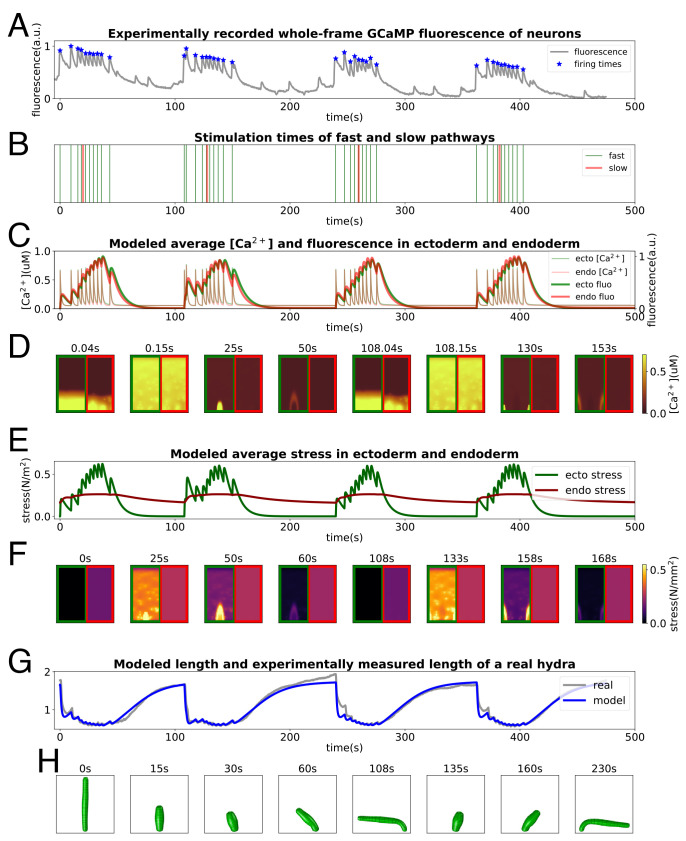
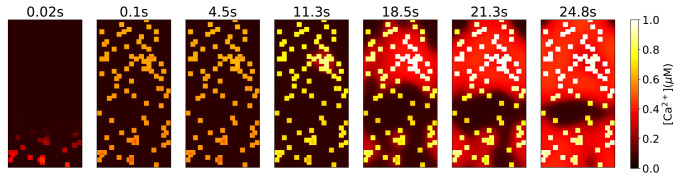
How does neural activity drive muscles to produce behavior? The recent development of genetic lines in that allow complete calcium imaging of both neuronal and muscle activity, as well as systematic machine learning quantification of behaviors, makes this small cnidarian an ideal model system to understand and model the complete transformation from neural firing to body movements. To achieve this, we have built a neuromechanical model of 's fluid-filled hydrostatic skeleton, showing how drive by neuronal activity activates distinct patterns of muscle activity and body column biomechanics. Our model is based on experimental measurements of neuronal and muscle activity and assumes gap junctional coupling among muscle cells and calcium-dependent force generation by muscles. With these assumptions, we can robustly reproduce a basic set of 's behaviors. We can further explain puzzling experimental observations, including the dual timescale kinetics observed in muscle activation and the engagement of ectodermal and endodermal muscles in different behaviors. This work delineates the spatiotemporal control space of movement and can serve as a template for future efforts to systematically decipher the transformations in the neural basis of behavior.
神经活动如何驱动肌肉产生行为?最近开发的遗传谱系允许对神经元和肌肉活动进行完全钙成像,以及对行为进行系统的机器学习量化,使得这种小型刺胞动物成为一个理想的模型系统,可以理解和模拟从神经放电到身体运动的完整转变。为了实现这一目标,我们构建了一种充满流体的静水骨骼的神经力学模型,展示了神经元活动如何激活不同模式的肌肉活动和身体柱生物力学。我们的模型基于神经元和肌肉活动的实验测量,并假设肌肉细胞之间的缝隙连接耦合和肌肉的钙依赖性力产生。有了这些假设,我们可以稳健地再现一组基本的行为。我们可以进一步解释一些令人费解的实验观察结果,包括在肌肉激活中观察到的双时标动力学以及外胚层和内胚层肌肉在不同行为中的参与。这项工作描绘了 的运动时空控制空间,可以作为未来系统地解析行为的神经基础转变的模板。