Martínez-López Joaquín, De la Cruz Javier, Gil-Manso Rodrigo, Alegre Adrián, Ortiz Javier, Llamas Pilar, Martínez Yolanda, Hernández-Rivas José-Ángel, González-Gascón Isabel, Benavente Celina, Estival Monteliu Pablo, Jiménez-Yuste Víctor, Canales Miguel, Bastos Mariana, Kwon Mi, Valenciano Susana, Callejas-Charavia Marta, López-Jiménez Javier, Herrera Pilar, Duarte Rafael, Núñez Martín-Buitrago Lucía, Sanchez Godoy Pedro, Jacome Yerovi Cristina, Martínez-Barranco Pilar, García Roa María, Escolano Escobar Cristian, Matilla Arturo, Rosado Sierra Belén, Aláez-Usón María Concepción, Quiroz-Cervantes Keina, Martínez-Chamorro Carmen, Pérez-Oteyza Jaime, Martos-Martinez Rafael, Herráez Regina, González-Santillana Clara, Del Campo Juan Francisco, Alonso Arancha, de la Fuente Adolfo, Pascual Adriana, Bustelos-Rodriguez Rosalía, Sebrango Ana, Ruiz Elena, Marcheco-Pupo Eriel Alexis, Grande Carlos, Cedillo Ángel, Lumbreras Carlos, Arroyo Barea Andrés, Casas-Rojo José Manuel, Calbacho Maria, Diez-Martín José Luis, García-Suárez Julio
Hematology Department, Hospital Universitario 12 de Octubre, imas12, Universidad Complutense, CNIO-ISCIII, CIBERONC, 28041 Madrid, Spain.
Research Institute, Hospital Universitario 12 de Octubre, imas12, 28041 Madrid, Spain.
Cancers (Basel). 2023 Feb 27;15(5):1497. doi: 10.3390/cancers15051497.
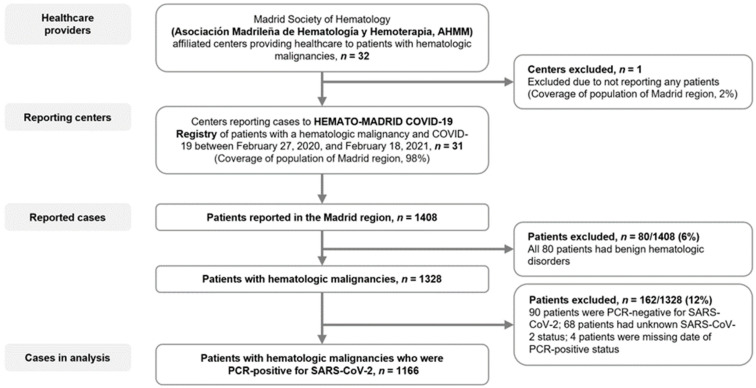
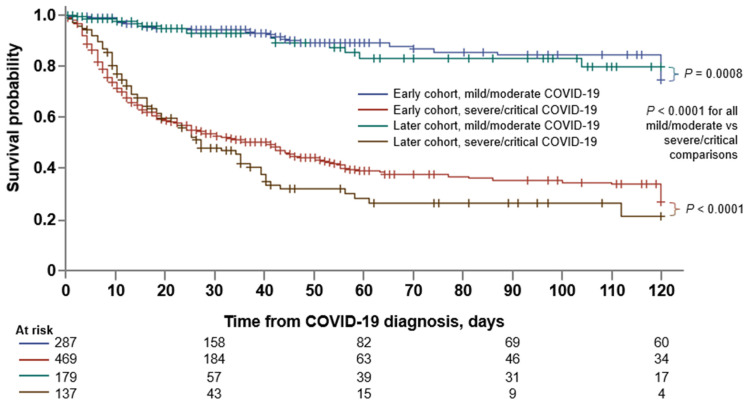
Mortality rates for COVID-19 have declined over time in the general population, but data in patients with hematologic malignancies are contradictory. We identified independent prognostic factors for COVID-19 severity and survival in unvaccinated patients with hematologic malignancies, compared mortality rates over time and versus non-cancer inpatients, and investigated post COVID-19 condition. Data were analyzed from 1166 consecutive, eligible patients with hematologic malignancies from the population-based HEMATO-MADRID registry, Spain, with COVID-19 prior to vaccination roll-out, stratified into early (February-June 2020; = 769 (66%)) and later (July 2020-February 2021; = 397 (34%)) cohorts. Propensity-score matched non-cancer patients were identified from the SEMI-COVID registry. A lower proportion of patients were hospitalized in the later waves (54.2%) compared to the earlier (88.6%), OR 0.15, 95%CI 0.11-0.20. The proportion of hospitalized patients admitted to the ICU was higher in the later cohort (103/215, 47.9%) compared with the early cohort (170/681, 25.0%, 2.77; 2.01-3.82). The reduced 30-day mortality between early and later cohorts of non-cancer inpatients (29.6% vs. 12.6%, OR 0.34; 0.22-0.53) was not paralleled in inpatients with hematologic malignancies (32.3% vs. 34.8%, OR 1.12; 0.81-1.5). Among evaluable patients, 27.3% had post COVID-19 condition. These findings will help inform evidence-based preventive and therapeutic strategies for patients with hematologic malignancies and COVID-19 diagnosis.
在普通人群中,新冠病毒病(COVID-19)的死亡率随时间有所下降,但血液系统恶性肿瘤患者的数据却相互矛盾。我们确定了未接种疫苗的血液系统恶性肿瘤患者中COVID-19严重程度和生存的独立预后因素,比较了不同时间以及与非癌症住院患者相比的死亡率,并调查了COVID-19后的状况。对来自西班牙基于人群的HEMATO-MADRID登记处的1166例连续符合条件的血液系统恶性肿瘤患者的数据进行了分析,这些患者在疫苗推出之前感染了COVID-19,分为早期(2020年2月至6月;n = 769例(66%))和晚期(2020年7月至2021年2月;n = 397例(34%))队列。从SEMI-COVID登记处确定了倾向评分匹配的非癌症患者。与早期(88.6%)相比,晚期波次中住院患者的比例较低(54.2%),比值比为0.15,95%置信区间为0.11 - 0.20。晚期队列中入住重症监护病房(ICU)的住院患者比例(103/215,47.9%)高于早期队列(170/681,25.0%,比值比为2.77;2.01 - 3.82)。非癌症住院患者早期和晚期队列之间30天死亡率降低(29.6%对12.6%,比值比为0.34;0.22 - 0.53),而血液系统恶性肿瘤住院患者并未出现类似情况(32.3%对34.8%,比值比为1.12;0.81 - 1.5)。在可评估的患者中,27.3%有COVID-19后状况。这些发现将有助于为血液系统恶性肿瘤和COVID-19诊断患者制定循证预防和治疗策略提供信息。