Neuroepidemiology Department, The Cyprus Institute of Neurology and Genetics, Nicosia 2371, Cyprus.
Department of Primary Care and Population Health, University of Nicosia Medical School, Nicosia 2371, Cyprus.
Nutrients. 2023 Feb 23;15(5):1136. doi: 10.3390/nu15051136.
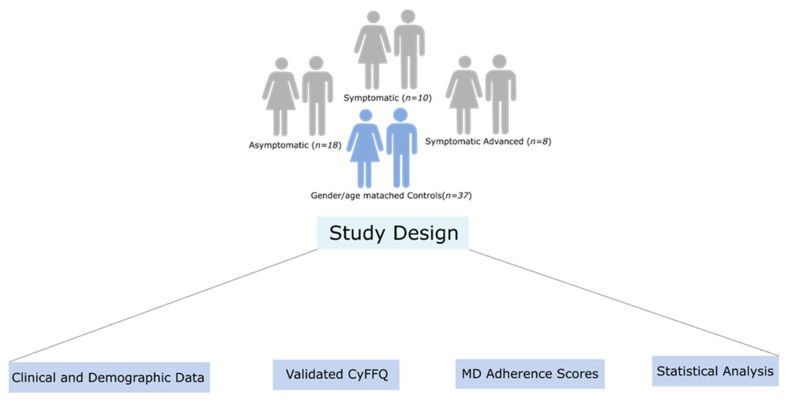
Huntington's disease (HD) is a rare progressive neurodegenerative disease characterised by autosomal dominant inheritance. The past decade saw a growing interest in the associations between the Mediterranean Diet (MD) and HD risk and outcomes. The aim of this case-control study was to assess the dietary intake and habits of Cypriot HD patients, comparing them to gender and age-matched controls, using the Cyprus Food Frequency Questionnaire (CyFFQ) and to assess adherence to the MD by disease outcomes. The method relied on the validated CyFFQ semi-quantitative questionnaire to assess energy, macro- and micronutrient intake over the past year in = 36 cases and = 37 controls. The MedDiet Score and the MEDAS score were used to assess adherence to the MD. Patients were grouped based on symptomatology such as movement and cognitive and behavioral impairment. The two-sample Wilcoxon rank-sum (Mann-Whitney) test was used to compare cases vs. controls. Statistically significant results were obtained for energy intake (kcal/day) (median (IQR): 4592 (3376) vs. 2488 (1917); = 0.002) from cases and controls. Energy intake (kcal/day) (median (IQR): 3751 (1894) vs. 2488 (1917); = 0.044) was also found to be significantly different between asymptomatic HD patients and controls. Symptomatic patients were also different from controls in terms of energy intake (kcal/day) (median (IQR): 5571 (2907) vs. 2488 (1917); = 0.001); % energy monounsaturated fatty acids (median (IQR): 13.4 (5.2) vs. 15.5 (5.7); = 0.0261) and several micronutrients. A significant difference between asymptomatic and symptomatic HD patients was seen in the MedDiet score (median (IQR): 31.1 (6.1) vs. 33.1 (8.1); = 0.024) and a significant difference was observed between asymptomatic HD patient and controls (median (IQR): 5.5 (3.0) vs. 8.2 (2.0); = 0.014) in the MEDAS score. This study confirmed previous findings that HD cases have a significantly higher energy intake than controls, revealing differences in macro and micronutrients and adherence to the MD by both patients and controls and by HD symptom severity. These findings are important as they are an effort to guide nutritional education within this population group and further understand diet-disease associations.
亨廷顿病 (HD) 是一种罕见的进行性神经退行性疾病,其特征为常染色体显性遗传。过去十年,人们对地中海饮食 (MD) 与 HD 风险和结果之间的关联越来越感兴趣。本病例对照研究的目的是使用塞浦路斯食物频率问卷 (CyFFQ) 评估塞浦路斯 HD 患者的饮食摄入和习惯,并将其与性别和年龄匹配的对照组进行比较,并根据疾病结果评估对 MD 的依从性。该方法依赖于经过验证的 CyFFQ 半定量问卷,以评估过去一年中 = 36 例病例和 = 37 例对照的能量、宏量和微量营养素摄入。使用 MedDiet 评分和 MEDAS 评分来评估对 MD 的依从性。根据运动和认知及行为障碍等症状将患者分为不同组。使用两样本 Wilcoxon 秩和 (Mann-Whitney) 检验比较病例与对照组。获得了与病例和对照组相比,能量摄入 (kcal/天) (中位数 (IQR):4592 (3376) vs. 2488 (1917); = 0.002) 的统计学显著结果。还发现无症状 HD 患者与对照组之间的能量摄入 (kcal/天) (中位数 (IQR):3751 (1894) vs. 2488 (1917); = 0.044) 也有显著差异。症状性患者与对照组之间的能量摄入 (kcal/天) (中位数 (IQR):5571 (2907) vs. 2488 (1917); = 0.001) 也存在显著差异;%单不饱和脂肪酸能量 (中位数 (IQR):13.4 (5.2) vs. 15.5 (5.7); = 0.0261) 和几种微量营养素。无症状和症状性 HD 患者之间的 MedDiet 评分 (中位数 (IQR):31.1 (6.1) vs. 33.1 (8.1); = 0.024) 存在显著差异,无症状 HD 患者与对照组之间的 MEDAS 评分 (中位数 (IQR):5.5 (3.0) vs. 8.2 (2.0); = 0.014) 也存在显著差异。本研究证实了先前的发现,即 HD 病例的能量摄入明显高于对照组,揭示了病例和对照组以及 HD 症状严重程度的宏量和微量营养素以及对 MD 的依从性的差异。这些发现很重要,因为它们旨在指导该人群的营养教育,并进一步了解饮食与疾病的关联。