Department of Clinical Dietetics, Faculty of Health Sciences, Medical University of Warsaw, E Ciołka 27, 01-445 Warsaw, Poland.
Department of Internal Medicine, Nephrology and Dialysis, Military Institute of Medicine, Szaserów 128, 04-141 Warsaw, Poland.
Nutrients. 2023 Feb 28;15(5):1237. doi: 10.3390/nu15051237.
Dialysis is the most commonly used renal replacement therapy in patients with end-stage renal disease. The mortality rate of hemodialysis patients is 15-20%, with cardiovascular complications being the most common. There is an association between the severity of atherosclerosis and both the development of protein-calorie malnutrition and inflammatory mediators. The aim of this study was to assess the relationship between biochemical markers of nutritional status, body composition and survival in hemodialysis patients.
Fifty-three hemodialysis patients were included in the study. Serum albumin, prealbumin, and IL-6 levels were measured, as well as body weight, body mass index, fat content and muscle mass. The five-year survival of patients was calculated using Kaplan-Meier estimators. The long-rank test was used for univariate comparison of survival curves, and the Cox proportional hazards model was used for multivariate analysis of survival predictors.
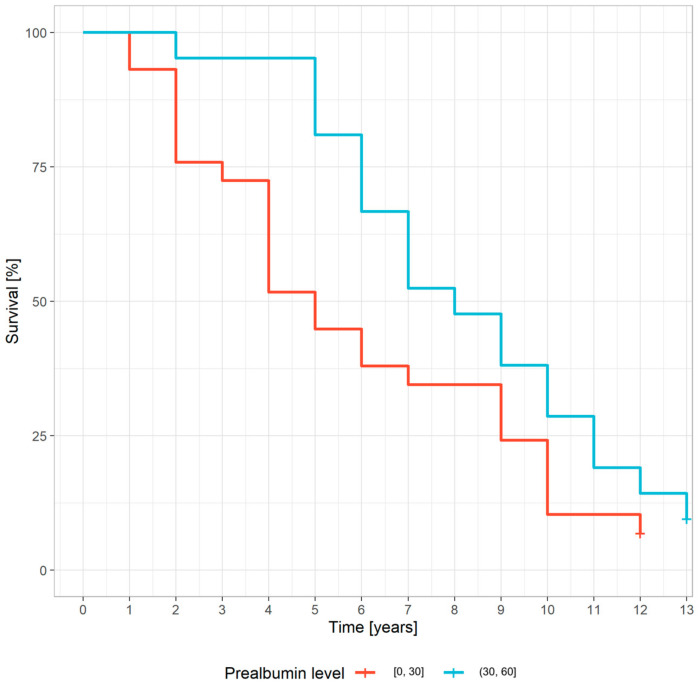
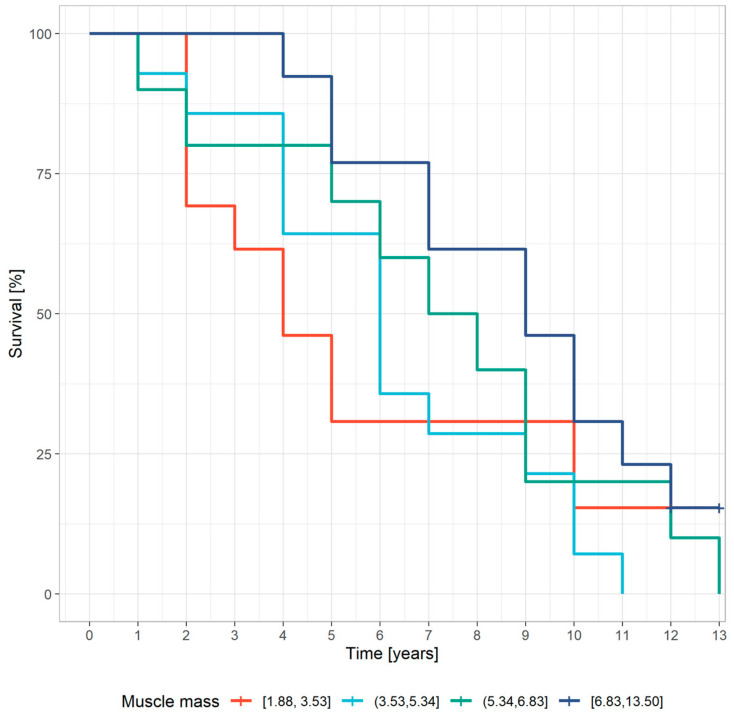
There were 47 deaths, 34 of which were due to cardiovascular disease. The hazard ratio (HR) for age in the middle-aged group (55-65 years) was 1.28 (confidence interval [CI] 0.58, 2.79) and 5.43 (CI 2.1, 14.07; statistically significant) for the oldest age group (over 65 years). A prealbumin level above 30 mg/dl was associated with an HR of 0.45 (CI 0.24, 0.84). Serum prealbumin (odds ratio [OR] = 5.23; CI 1.41, 19.43; = 0.013) and muscle mass (OR = 7.5; CI 1.31, 43.03; = 0.024) were significant predictors of all-cause mortality.
Prealbumin level and muscle mass were associated with increased mortality risk. Identification of these factors may improve the survival of hemodialysis patients.
透析是终末期肾病患者最常用的肾脏替代疗法。血液透析患者的死亡率为 15-20%,心血管并发症最为常见。动脉粥样硬化的严重程度与蛋白质-热量营养不良和炎症介质的发展有关。本研究旨在评估血液透析患者营养状况、身体成分和生存的生化标志物之间的关系。
本研究纳入了 53 名血液透析患者。测量血清白蛋白、前白蛋白和 IL-6 水平,以及体重、体重指数、脂肪含量和肌肉量。使用 Kaplan-Meier 估计器计算患者的五年生存率。使用单变量比较生存曲线的 Long-rank 检验和 Cox 比例风险模型进行生存预测因素的多变量分析。
共有 47 例死亡,其中 34 例死于心血管疾病。中年组(55-65 岁)年龄的危险比(HR)为 1.28(95%置信区间 [CI] 0.58, 2.79),最年长组(超过 65 岁)的 HR 为 5.43(CI 2.1, 14.07;具有统计学意义)。前白蛋白水平高于 30mg/dl 与 HR 为 0.45(95%CI 0.24, 0.84)相关。血清前白蛋白(优势比 [OR] = 5.23;95%CI 1.41, 19.43; = 0.013)和肌肉量(OR = 7.5;95%CI 1.31, 43.03; = 0.024)是全因死亡率的显著预测因子。
前白蛋白水平和肌肉量与死亡率风险增加相关。识别这些因素可能会提高血液透析患者的生存率。