Colelli Giulia, Barzaghi Leonardo, Paoletti Matteo, Monforte Mauro, Bergsland Niels, Manco Giulia, Deligianni Xeni, Santini Francesco, Ricci Enzo, Tasca Giorgio, Mira Antonietta, Figini Silvia, Pichiecchio Anna
Department of Mathematics, University of Pavia, Pavia, Italy.
Neuroradiology Department, Advanced Imaging and Radiomics Center, IRCCS Mondino Foundation, Pavia, Italy.
Front Neurol. 2023 Feb 24;14:1105276. doi: 10.3389/fneur.2023.1105276. eCollection 2023.
Quantitative Muscle MRI (qMRI) is a valuable and non-invasive tool to assess disease involvement and progression in neuromuscular disorders being able to detect even subtle changes in muscle pathology. The aim of this study is to evaluate the feasibility of using a conventional short-tau inversion recovery (STIR) sequence to predict fat fraction (FF) and water T2 (wT2) in skeletal muscle introducing a radiomic workflow with standardized feature extraction combined with machine learning algorithms.
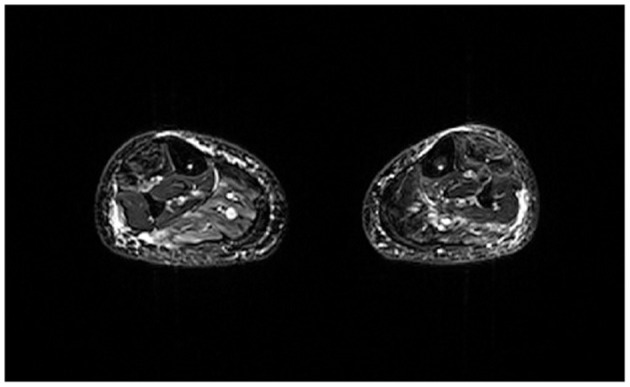
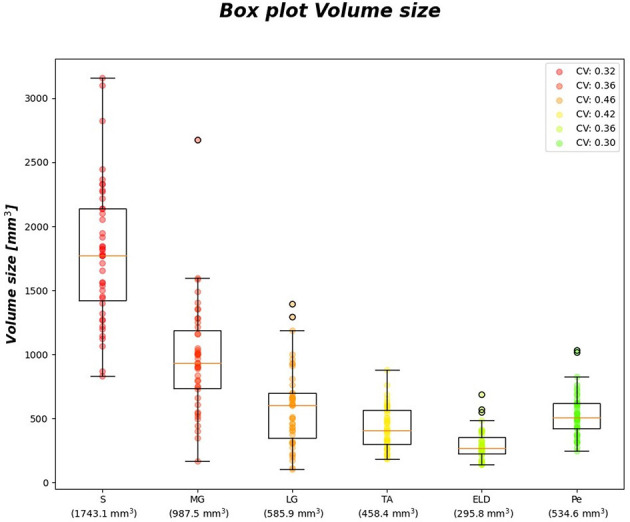
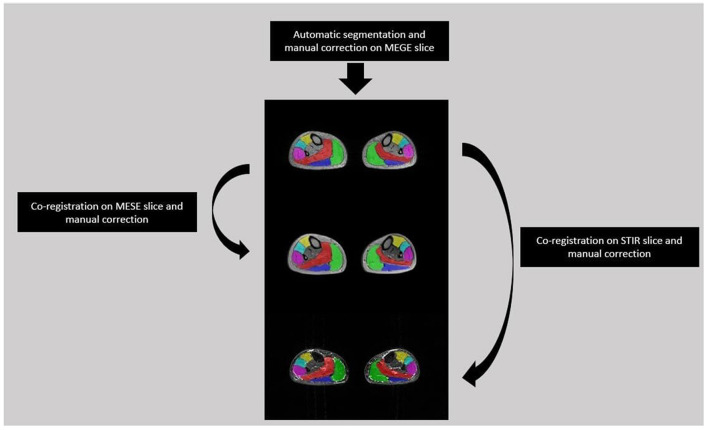
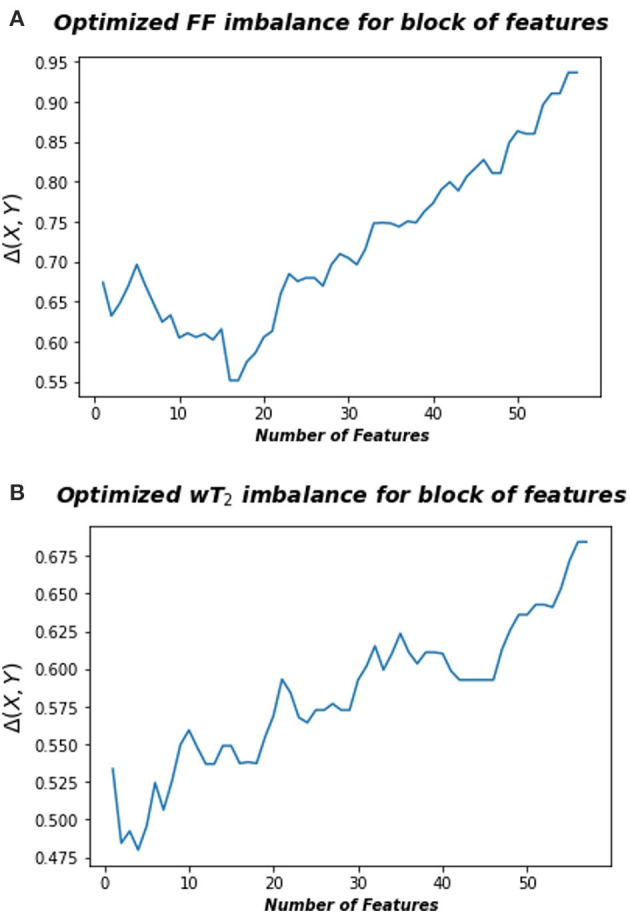
Twenty-five patients with facioscapulohumeral muscular dystrophy (FSHD) were scanned at calf level using conventional STIR sequence and qMRI techniques. We applied and compared three different radiomics workflows (), combined with seven Machine Learning regression algorithms (linear, ridge and lasso regression, tree, random forest, k-nearest neighbor and support vector machine), on conventional STIR images to predict FF and wT2 for six calf muscles.
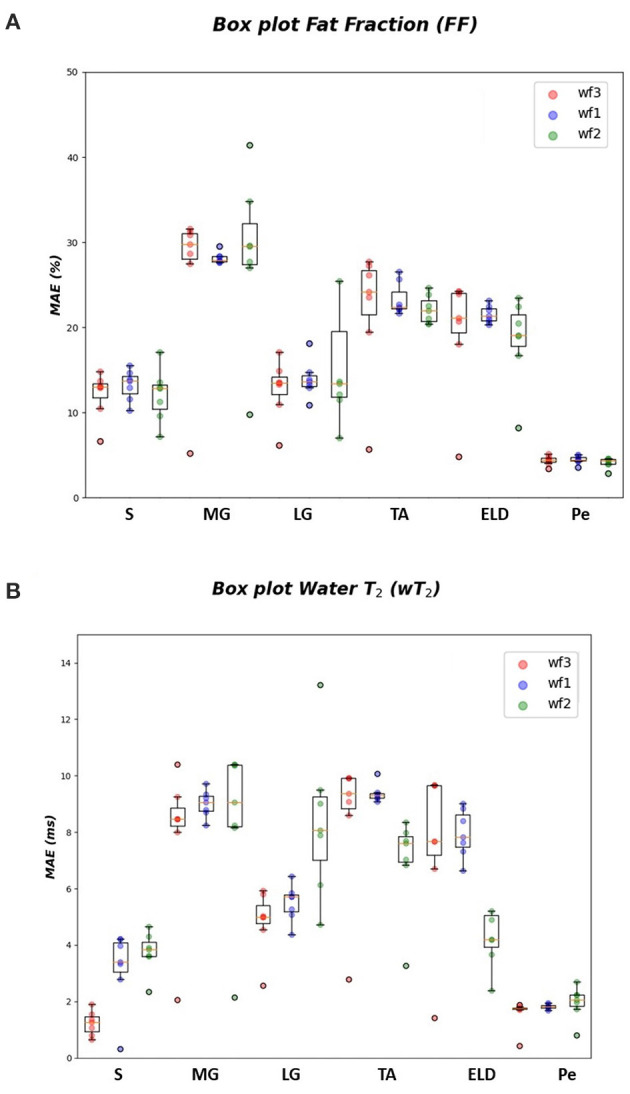
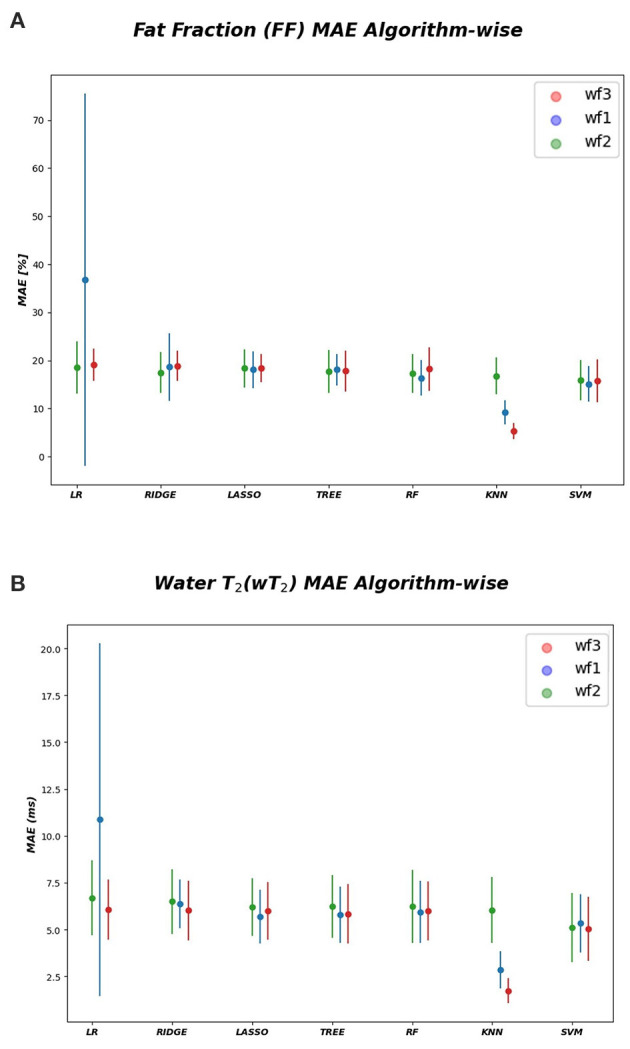
The combination of WF3 and K-nearest neighbor resulted to be the best predictor model of qMRI parameters with a mean absolute error about ± 5 for FF and ± 1.8 for wT2.
This pilot study demonstrated the possibility to predict qMRI parameters in a cohort of FSHD subjects starting from conventional STIR sequence.
定量肌肉磁共振成像(qMRI)是一种有价值的非侵入性工具,可用于评估神经肌肉疾病的疾病累及情况和进展,甚至能够检测出肌肉病理学中的细微变化。本研究的目的是评估使用传统的短反转时间反转恢复(STIR)序列预测骨骼肌脂肪分数(FF)和水T2(wT2)的可行性,引入一种具有标准化特征提取并结合机器学习算法的放射组学工作流程。
对25例面肩肱型肌营养不良症(FSHD)患者的小腿水平进行常规STIR序列和qMRI技术扫描。我们在常规STIR图像上应用并比较了三种不同的放射组学工作流程,并结合七种机器学习回归算法(线性、岭回归和套索回归、树、随机森林、k近邻和支持向量机),以预测六块小腿肌肉的FF和wT2。
WF3和k近邻的组合是qMRI参数的最佳预测模型,FF的平均绝对误差约为±5,wT2的平均绝对误差约为±1.8。
这项初步研究证明了从传统STIR序列开始预测FSHD受试者队列中qMRI参数的可能性。