Escasura Marian Irene C, Navarro Jose C
Stroke Service, Institute of Neurological Sciences, St. Luke's Medical Center, Quezon City, Philippines.
Department of Neurology, Jose R Reyes Memorial Medical Center, Manila, City, Philippines.
eNeurologicalSci. 2023 Feb 20;31:100450. doi: 10.1016/j.ensci.2023.100450. eCollection 2023 Jun.
Watershed infarcts denote ischemic lesions involving the distal territories of two major arteries. For years, hypotheses on its pathophysiological mechanisms have been proposed. Yet, the cause is still widely debated. This study aimed to determine the mechanism of watershed strokes and compare their clinical outcomes to acute ischemic stroke from other causes and predict the factors affecting clinical outcomes in patients with watershed infarcts.
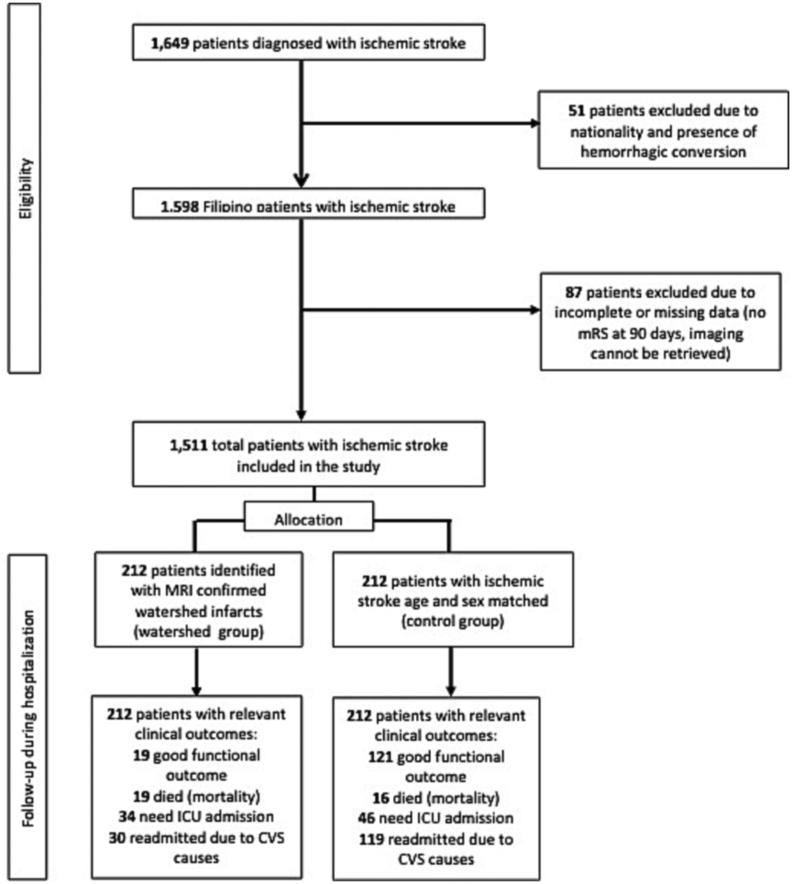
This single-center, comparative, six-years retrospective cohort study included patients with a diagnosis of Acute Ischemic Stroke. Patients were classified under watershed group or acute ischemic stroke based on their neuroimaging findings. Stroke mechanisms were determined between groups as well as the factors associated with clinical outcomes in watershed strokes.
Among the 424 patients included in the study, large artery atherosclerosis was seen in greater frequency in patients with watershed infarcts regardless of the type (EWIs: = 68, 73% vs IWIs: = 89, 75%). No differences observed in the clinical outcomes between groups. Multiple variable analysis showed that age, female sex, high NIHSS score and presence of underlying malignancy were associated with clinical outcomes.
Clinical outcomes between watershed infarcts and acute ischemic strokes were similar. Hemodynamic compromise in the setting of severe stenosis is the underlying mechanism for both types of watershed strokes thus, the goal of treatment is to maintain adequate perfusion. High baseline NIHSS score, increased age, female gender and underlying malignancy were all poor predictors of clinical outcomes in patients with watershed strokes.
分水岭梗死是指累及两条主要动脉远端区域的缺血性病变。多年来,人们提出了关于其病理生理机制的假说。然而,其病因仍存在广泛争议。本研究旨在确定分水岭脑卒的发病机制,将其临床结局与其他病因所致的急性缺血性脑卒中进行比较,并预测影响分水岭梗死患者临床结局的因素。
这项单中心、对照、为期六年的回顾性队列研究纳入了诊断为急性缺血性脑卒中的患者。根据神经影像学检查结果,将患者分为分水岭梗死组或急性缺血性脑卒中组。确定两组之间的卒中机制以及分水岭卒中临床结局的相关因素。
在纳入研究的424例患者中,无论类型如何(边缘带脑梗死:n = 68,73%;皮质下分水岭梗死:n = 89,75%),分水岭梗死患者中大动脉粥样硬化的发生率更高。两组之间的临床结局无差异。多变量分析显示,年龄、女性、美国国立卫生研究院卒中量表(NIHSS)评分高以及存在潜在恶性肿瘤与临床结局相关。
分水岭梗死和急性缺血性脑卒中的临床结局相似。严重狭窄情况下的血流动力学障碍是两种类型分水岭卒中的潜在机制,因此,治疗的目标是维持足够的灌注。基线NIHSS评分高、年龄增加、女性以及潜在恶性肿瘤都是分水岭卒中患者临床结局的不良预测因素。