Zeng Youjie, Cao Si, Yang Heng
Department of Anesthesiology, Third Xiangya Hospital, Central South University, Changsha, Hunan, China.
Department of Neurology, Third Xiangya Hospital, Central South University, Changsha, Hunan, China.
Front Psychiatry. 2023 Feb 22;14:1135923. doi: 10.3389/fpsyt.2023.1135923. eCollection 2023.
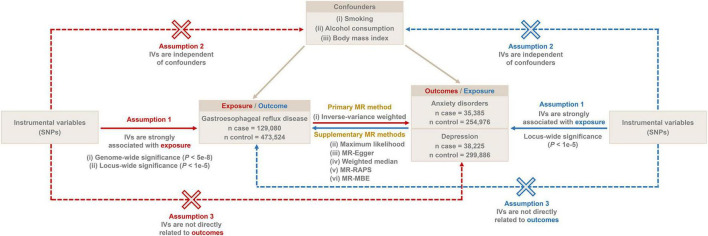
Observational studies have shown an association between gastroesophageal reflux disease (GERD) and anxiety disorders/depression. However, these evidences may be influenced by confounding factors. Therefore, our study aimed to determine the causal relationship between GERD and anxiety disorders/depression by conducting a bidirectional Mendelian randomization (MR) study.
We performed a bidirectional MR analysis using summary statistics from genome-wide association studies (GWAS) in European individuals. The inverse-variance weighted (IVW) method was used as the primary analytical method to assess causality. In addition, five additional MR methods [maximum likelihood, MR-Egger, weighted median, robust adjusted profile score (MR-RAPS), and mode-based estimate (MR-MBE)] were performed to supplement the IVW results. Furthermore, several sensitivity analyses were performed to assess heterogeneity, horizontal pleiotropy, and stability. Finally, a multivariable MR (MVMR) analysis was performed to determine the causal relationship by adjusting for potential confounders.
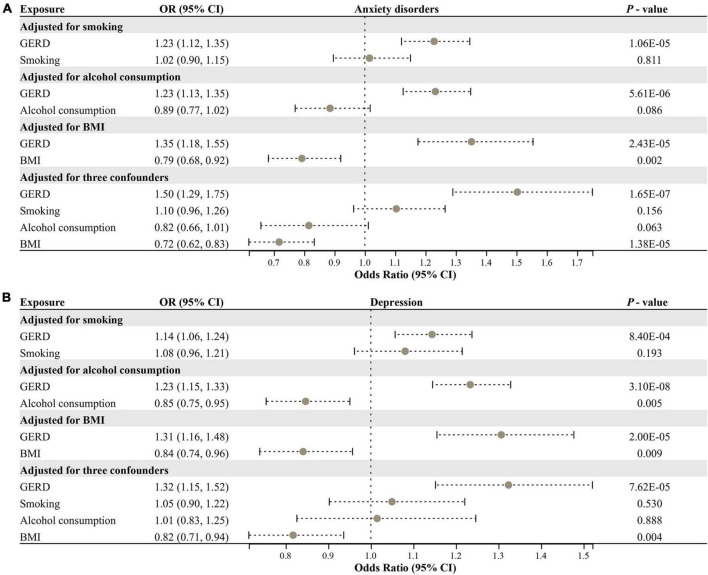
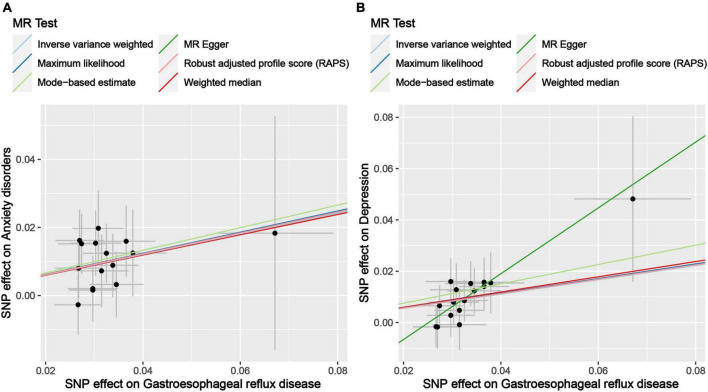
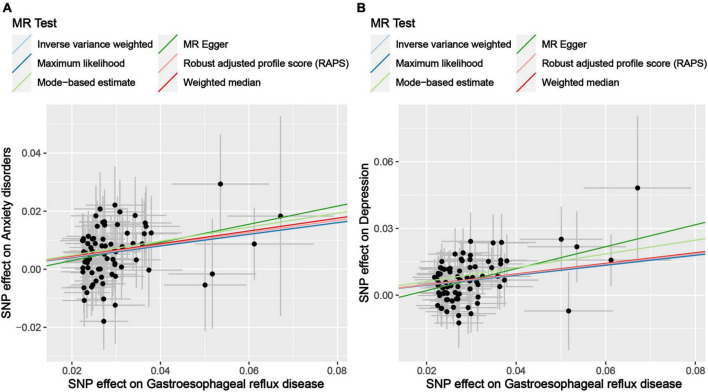
MR results of the IVW method indicated that GERD significantly increases the risk of anxiety disorders [odds ratio (OR) = 1.35, 95% confidence interval (CI) 1.15-1.59, = 2.25 × 10] and depression (OR = 1.32, 95% CI: 1.15-1.52, = 1.26 × 10). In addition, the MR results of maximum likelihood, MR-Egger, weighted median, MR-RAPS, and MR-MBE remained parallel to the IVW results. Furthermore, sensitivity analysis suggested that the results were robust, with no pleiotropy or heterogeneity detected. Nevertheless, reverse MR analysis showed that anxiety or depression did not increase GERD risk. Finally, MVMR analysis showed that the effect of GERD on increasing the risk of anxiety disorders/depression was independent of confounders.
This MR study supports a causal association between GERD and an increased risk of anxiety disorders and depression. Therefore, complementing symptomatic treatment of GERD with psychological assessment and necessary psychological support therapy may help reduce the risk of future anxiety disorders and depression.
观察性研究表明胃食管反流病(GERD)与焦虑症/抑郁症之间存在关联。然而,这些证据可能受到混杂因素的影响。因此,我们的研究旨在通过进行双向孟德尔随机化(MR)研究来确定GERD与焦虑症/抑郁症之间的因果关系。
我们使用欧洲人群全基因组关联研究(GWAS)的汇总统计数据进行双向MR分析。采用逆方差加权(IVW)方法作为评估因果关系的主要分析方法。此外,还进行了另外五种MR方法[最大似然法、MR-Egger法、加权中位数法、稳健调整轮廓评分法(MR-RAPS)和基于模式的估计法(MR-MBE)]以补充IVW结果。此外,还进行了多项敏感性分析以评估异质性、水平多效性和稳定性。最后,进行多变量MR(MVMR)分析以通过调整潜在混杂因素来确定因果关系。
IVW方法的MR结果表明,GERD显著增加焦虑症风险[比值比(OR)=1.35,95%置信区间(CI)1.15-1.59,P=2.25×10⁻⁵]和抑郁症风险(OR =1.32,95%CI:1.15-1.52,P=1.26×10⁻⁴)。此外,最大似然法、MR-Egger法、加权中位数法、MR-RAPS法和MR-MBE法的MR结果与IVW结果保持一致。此外,敏感性分析表明结果稳健,未检测到多效性或异质性。然而,反向MR分析表明焦虑或抑郁并未增加GERD风险。最后,MVMR分析表明GERD增加焦虑症/抑郁症风险的效应独立于混杂因素。
这项MR研究支持GERD与焦虑症和抑郁症风险增加之间存在因果关联。因此,用心理评估和必要的心理支持治疗补充GERD的对症治疗可能有助于降低未来患焦虑症和抑郁症的风险。