VHN Consulting Inc, Montreal, Canada.
Medical Affairs, Seqirus UK, Maidenhead, Berkshire, UK.
Hum Vaccin Immunother. 2023 Dec 31;19(1):2187592. doi: 10.1080/21645515.2023.2187592. Epub 2023 Mar 13.
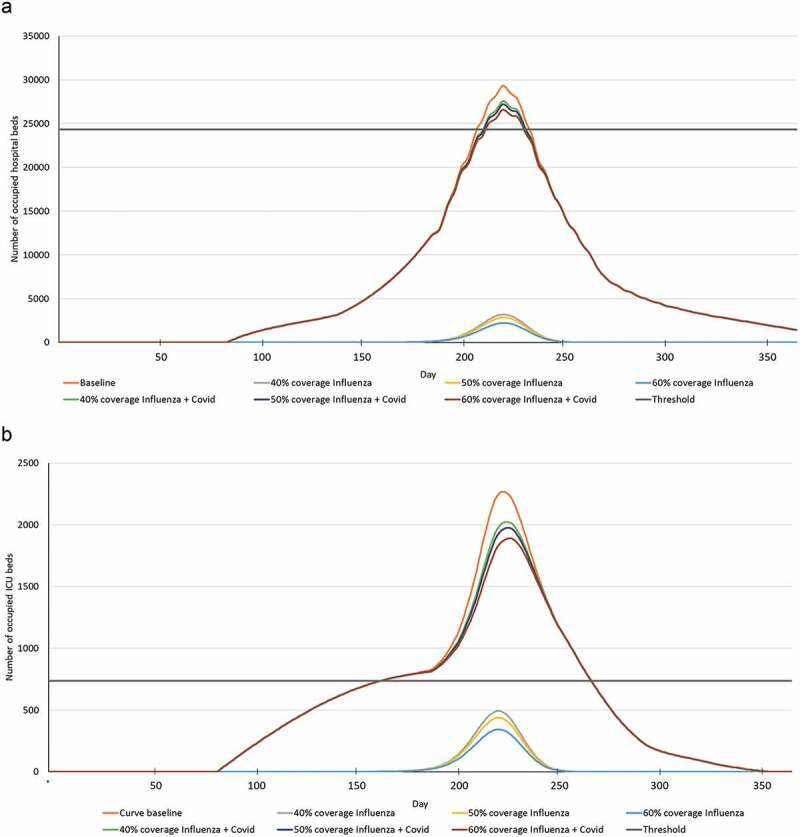
Co-circulation of influenza and SARS-CoV-2 has the potential to place considerable strain on health-care services. We estimate the cost-effectiveness and health-care resource utilization impacts of influenza vaccination of low-risk 50-64-y-olds in the United Kingdom (UK) against a background SARS-CoV-2 circulation. A dynamic susceptible-exposed-infected-recovered model was used to simulate influenza transmission, with varying rates of vaccine coverage in the low-risk 50-64 y age-group. Four scenarios were evaluated: no vaccination (baseline), 40%, 50%, and 60% coverage. For the 50% and 60% coverage, this rate was also applied to high-risk 50-64-y-olds, whereas 48.6% was used for the baseline and 40% coverage scenarios. Cost-effectiveness was estimated in terms of humanistic outcomes and incremental cost-effectiveness ratio (ICER), with discounting applied at 3%. Overall, influenza vaccination of 50-64-y-olds resulted in reductions in GP visits, hospitalizations, and deaths, with a reduction in influenza-related mortality of 34%, 41%, and 52% for 40%, 50%, and 60% coverage, respectively. All four scenarios resulted in acute and intensive care unit (ICU) bed occupancy levels above available capacity, although vaccination of low-risk 50-64-y-olds resulted in a 35-54% and 16-25% decrease in excess acute and ICU bed requirements, respectively. Vaccination of this group against influenza was highly cost-effective from the payer perspective, with ICERs of £2,200-£2,343/quality-adjusted life year across the coverage rates evaluated. In conclusion, in the UK, vaccination of low-risk 50-64-y-olds against influenza is cost-effective and can aid in alleviating bed shortages in a situation where influenza and SARS-CoV-2 are co-circulating.
流感和 SARS-CoV-2 的共同传播有可能给医疗保健服务带来巨大压力。我们评估了在 SARS-CoV-2 流行背景下,对英国(UK)低危 50-64 岁人群进行流感疫苗接种的成本效益和医疗资源利用影响。使用动态易感-暴露-感染-恢复模型来模拟流感传播,同时在低危 50-64 岁年龄组中,疫苗覆盖率存在不同的变化率。评估了四种情况:不接种疫苗(基线)、40%、50%和 60%的覆盖率。对于 50%和 60%的覆盖率,这一比率也适用于高危 50-64 岁人群,而对于基线和 40%的覆盖率情况,则使用 48.6%。成本效益是根据人文结果和增量成本效益比(ICER)来衡量的,贴现率为 3%。总体而言,对 50-64 岁人群进行流感疫苗接种可减少 GP 就诊、住院和死亡,40%、50%和 60%的覆盖率分别可使流感相关死亡率降低 34%、41%和 52%。所有四种情况都导致急性和重症监护病房(ICU)床位占用率高于可用容量,尽管对低危 50-64 岁人群进行疫苗接种可分别减少 35-54%和 16-25%的急性和 ICU 床位需求过剩。从支付者的角度来看,对该人群进行流感疫苗接种具有高度成本效益,在评估的覆盖范围内,增量成本效益比(ICER)为 2200-2343 英镑/质量调整生命年。总之,在英国,对低危 50-64 岁人群进行流感疫苗接种具有成本效益,并有助于缓解流感和 SARS-CoV-2 共同传播时的床位短缺问题。