Department of Science, University of Basilicata, Potenza, Italy.
Department of Pharmacy, School of Medicine and Surgery, University of Naples Federico II, Naples, Italy.
Redox Biol. 2023 Jun;62:102657. doi: 10.1016/j.redox.2023.102657. Epub 2023 Mar 4.
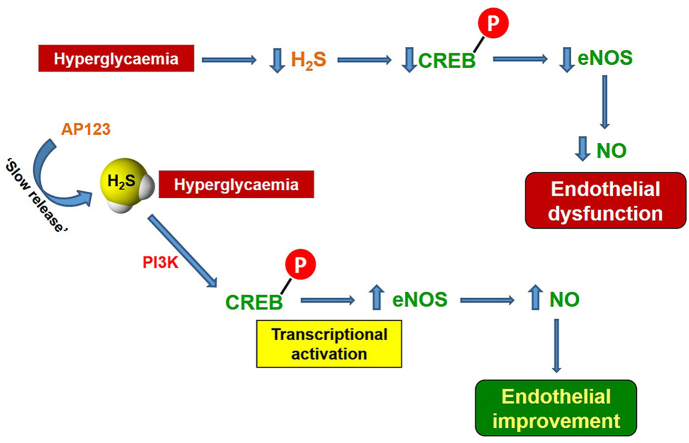
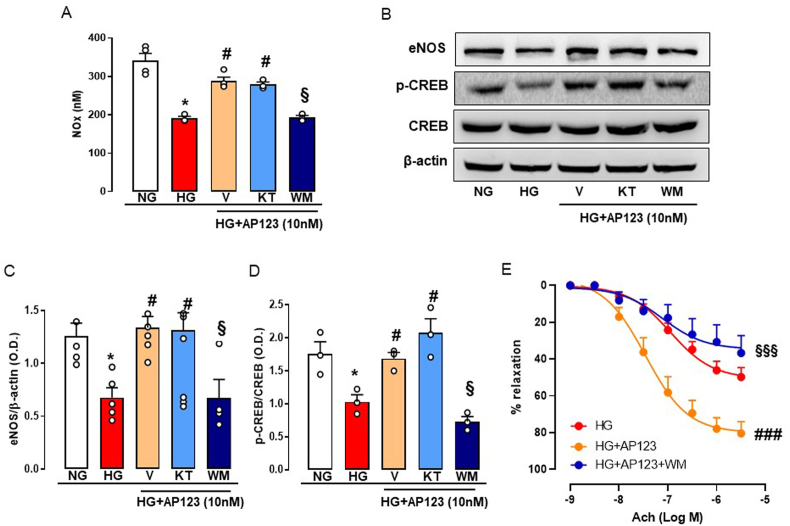
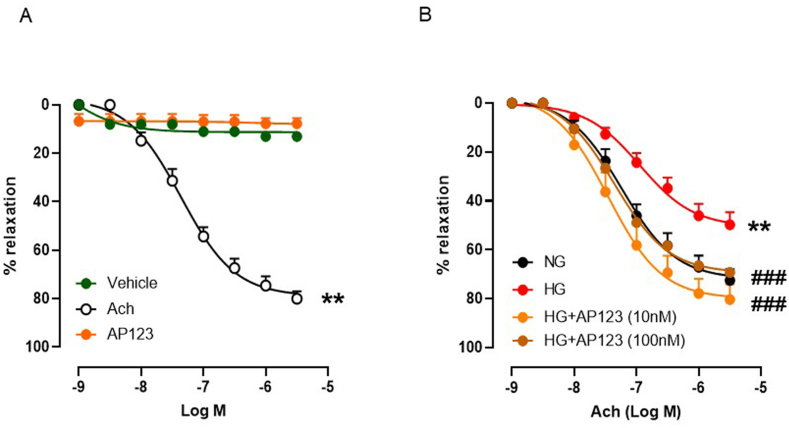
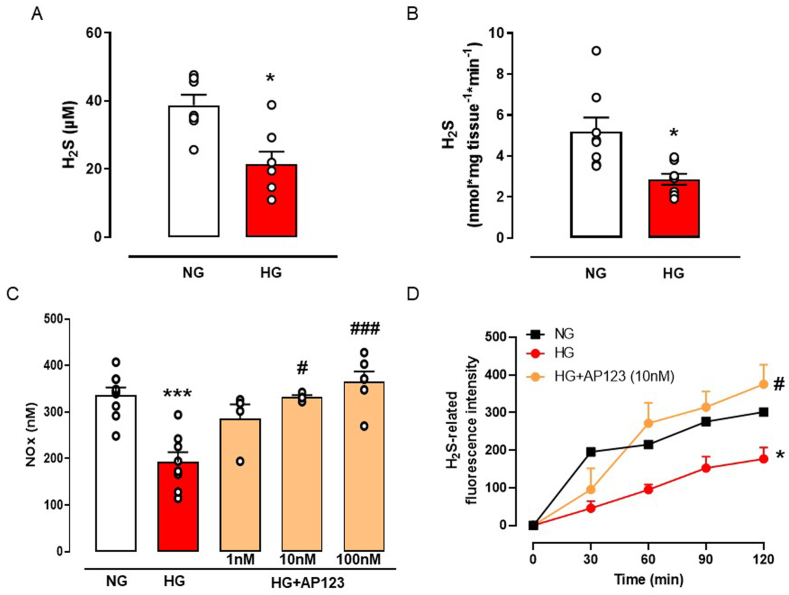
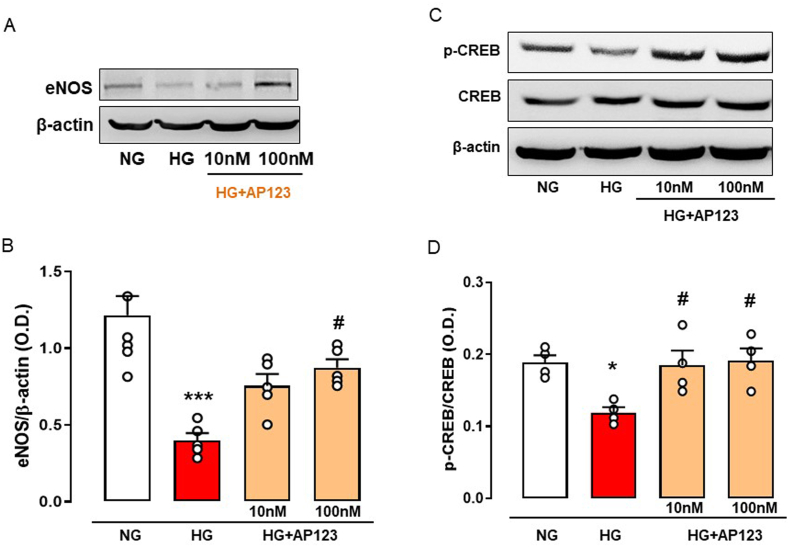
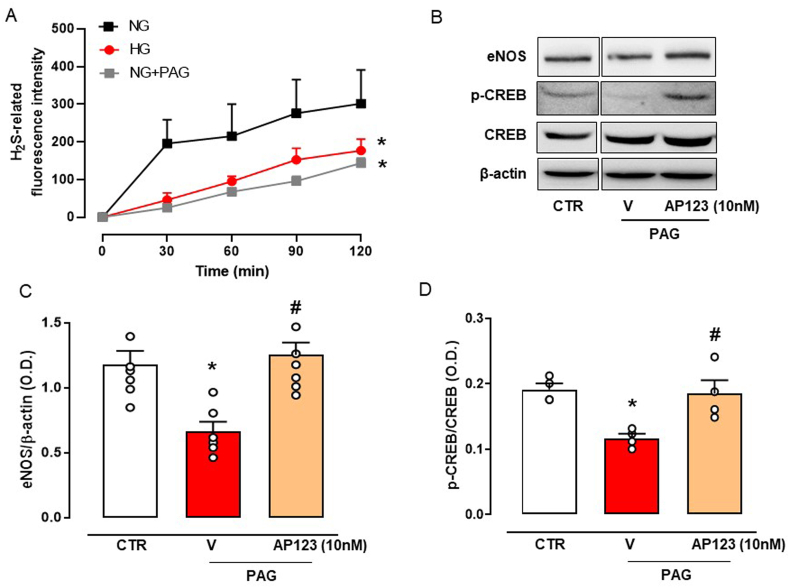
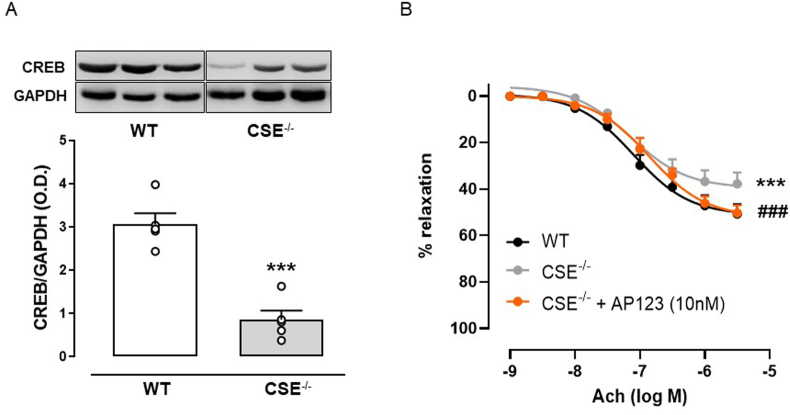
Diabetes is associated with severe vascular complications involving the impairment of endothelial nitric oxide synthase (eNOS) as well as cystathionine γ-lyase (CSE) activity. eNOS function is suppressed in hyperglycaemic conditions, resulting in reduced NO bioavailability, which is paralleled by reduced levels of hydrogen sulfide (HS). Here we have addressed the molecular basis of the interplay between the eNOS and CSE pathways. We tested the impact of HS replacement by using the mitochondrial-targeted HS donor AP123 in isolated vessels and cultured endothelial cells in high glucose (HG) environment, at concentrations not causing any vasoactive effect per se. Aorta exposed to HG displayed a marked reduction of acetylcholine (Ach)-induced vasorelaxation that was restored by the addition of AP123 (10 nM). In HG condition, bovine aortic endothelial cells (BAEC) showed reduced NO levels, downregulation of eNOS expression, and suppression of CREB activation (p-CREB). Similar results were obtained by treating BAEC with propargylglycine (PAG), an inhibitor of CSE. AP123 treatment rescued eNOS expression, as well as NO levels, and restored p-CREB expression in both the HG environment and the presence of PAG. This effect was mediated by a PI3K-dependent activity since wortmannin (PI3K inhibitor) blunted the rescuing effects operated by the HS donor. Experiments performed in the aorta of CSE mice confirmed that reduced levels of HS not only negatively affect the CREB pathway but also impair Ach-induced vasodilation, significantly ameliorated by AP123. We have demonstrated that the endothelial dysfunction due to HG involves HS/PI3K/CREB/eNOS route, thus highlighting a novel aspect of the HS/NO interplay in the vasoactive response.
糖尿病与严重的血管并发症有关,涉及内皮型一氧化氮合酶 (eNOS) 和胱硫醚 γ-裂解酶 (CSE) 活性的损伤。在高血糖条件下,eNOS 功能受到抑制,导致 NO 生物利用度降低,同时硫化氢 (HS) 水平降低。在这里,我们研究了 eNOS 和 CSE 途径之间相互作用的分子基础。我们使用线粒体靶向 HS 供体 AP123 在高糖 (HG) 环境中分离的血管和培养的内皮细胞中测试了 HS 替代的影响,其浓度本身不会引起任何血管活性作用。暴露于 HG 的主动脉显示出乙酰胆碱 (Ach) 诱导的血管舒张明显减少,而添加 AP123 (10 nM) 则可以恢复。在 HG 条件下,牛主动脉内皮细胞 (BAEC) 显示出 NO 水平降低、eNOS 表达下调和 CREB 激活 (p-CREB) 抑制。用丙炔甘氨酸 (PAG) 处理 BAEC 也可获得类似结果,PAG 是 CSE 的抑制剂。AP123 处理可恢复 eNOS 表达、NO 水平,并在 HG 环境和 PAG 存在下恢复 p-CREB 表达。这种作用是通过 PI3K 依赖性活性介导的,因为wortmannin(PI3K 抑制剂)削弱了 HS 供体的挽救作用。在 CSE 小鼠的主动脉中进行的实验证实,HS 水平降低不仅会对 CREB 途径产生负面影响,还会损害 Ach 诱导的血管舒张,AP123 可显著改善这种情况。我们已经证明,HG 引起的内皮功能障碍涉及 HS/PI3K/CREB/eNOS 途径,从而突出了 HS/NO 相互作用在血管活性反应中的一个新方面。