Division Health and Performance, Institute of Occupational, Social and Environmental Medicine, Goethe University Frankfurt, Frankfurt Am Main, Germany.
Department of Sports Medicine, Disease Prevention and Rehabilitation, Johannes Gutenberg University Mainz, Albert-Schweitzer-Straße 22, 55128, Mainz, Germany.
Sci Rep. 2023 Mar 13;13(1):4167. doi: 10.1038/s41598-023-30798-3.
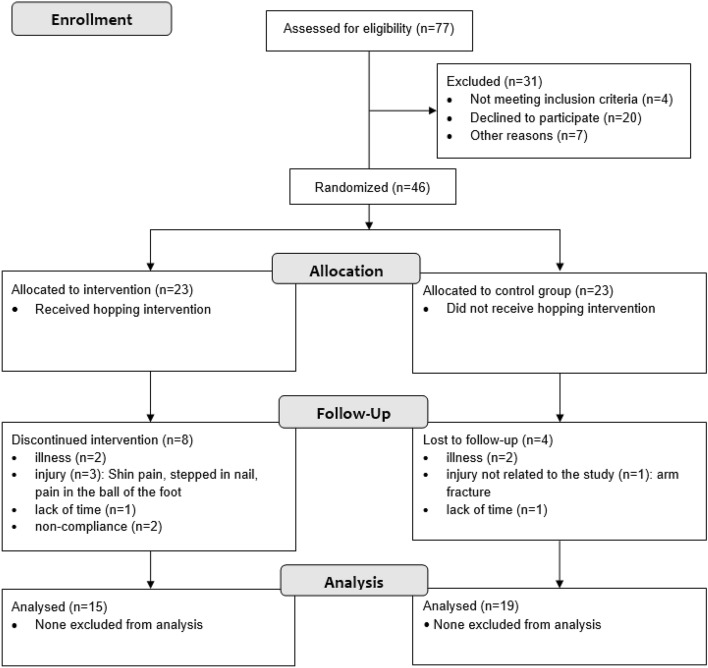
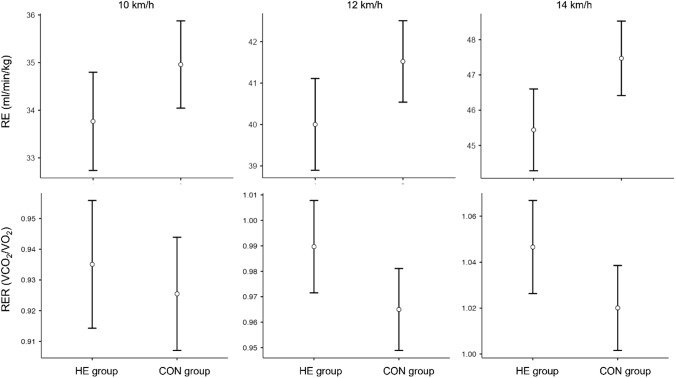
This study investigated the effects of a daily plyometric hopping intervention on running economy (RE) in amateur runners. In a randomized, controlled trial, thirty-four amateur runners (29 ± 7 years, 27 males) were allocated to a control or a hopping exercise group. During the six-week study, the exercise group performed 5 min of double-legged hopping exercise daily. To progressively increase loading, the number of hopping bouts (10 s each) was steadily increased while break duration between sets was decreased. Pre- and post-intervention, RE, peak oxygen uptake (VO), and respiratory exchange ratio (RER) were measured during 4-min stages at three running speeds (10, 12, and 14 km/h). ANCOVAs with baseline values and potential cofounders as cofactors were performed to identify differences between groups. ANCOVA revealed an effect of hopping on RE at 12 km/h (df = 1; F = 4.35; p < 0.05; η = 0.072) and 14 km/h (df = 1; F = 6.72; p < 0.05; η = 0.098), but not at 10 km/h (p > 0.05). Exercise did not affect VO (p > 0.05), but increased RER at 12 km/h (df = 1; F = 4.26; p < 0.05; η = 0.059) and 14 km/h (df = 1; F = 36.73; p < 0.001; η = 0.520). No difference in RER was observed at 10 km/h (p > 0.05). Daily hopping exercise is effective in improving RE at high running speeds in amateurs and thus can be considered a feasible complementary training program.Clinical trial registration German Register of Clinical Trials (DRKS00017373).
本研究旨在探讨每日增强式跳跃训练对业余跑者的跑步经济性(RE)的影响。采用随机对照试验设计,将 34 名业余跑者(29±7 岁,27 名男性)分为对照组和跳跃运动组。在为期六周的研究中,跳跃运动组每天进行 5 分钟的双腿跳跃练习。为了逐渐增加负荷,跳跃次数(每次 10 秒)稳步增加,而每组之间的休息时间则缩短。在干预前后,以 10、12 和 14km/h 的三个跑步速度进行 4 分钟阶段测量 RE、最大摄氧量(VO)和呼吸交换率(RER)。采用协方差分析(ANCOVA),以基线值和潜在混杂因素为协变量,比较两组之间的差异。ANCOVA 显示,跳跃运动对 12km/h(df=1;F=4.35;p<0.05;η=0.072)和 14km/h(df=1;F=6.72;p<0.05;η=0.098)的 RE 有影响,但对 10km/h 没有影响(p>0.05)。运动对 VO 没有影响(p>0.05),但增加了 12km/h(df=1;F=4.26;p<0.05;η=0.059)和 14km/h(df=1;F=36.73;p<0.001;η=0.520)的 RER。在 10km/h 时,RER 没有差异(p>0.05)。每日增强式跳跃训练可有效提高业余跑者在高速跑步时的 RE,因此可作为一种可行的补充训练方案。
临床试验注册号德国临床试验注册中心(DRKS00017373)。