Shour Abdul R, Anguzu Ronald, Zhou Yuhong, Muehlbauer Alice, Joseph Adedayo, Oladebo Tinuola, Puthoff David, Onitilo Adedayo A
Marshfield Clinic Cancer Care and Research Center, Clinical Research Institute, Marshfield, WI, USA.
Department of Oncology, Marshfield Clinic Health System, 1000 N Oak Ave, Marshfield, WI, 54449, USA.
Inj Epidemiol. 2023 Mar 13;10(1):14. doi: 10.1186/s40621-023-00425-w.
Firearm fatalities are a major public health concern, claiming the lives of 40,000 Americans each year. While firearm fatalities have pervasive effects, it is unclear how social determinants of health (SDOH) such as residential racial segregation, income inequality, and community resilience impact firearm fatalities. This study investigates the relationships between these SDOH and the likelihood of firearm fatalities.
County-level SDOH data from the Agency for Health Care Research and Quality for 2019 were analyzed, covering 72 Wisconsin counties. The dependent variable was the number of firearm fatalities in each county, used as a continuous variable. The independent variable was residential racial segregation (Dissimilarity Index), defined as the degree to which non-White and White residents were distributed across counties, ranging from 0 (complete integration) to 100 (complete segregation), and higher values indicate greater residential segregation (categorized as low, moderate, and high). Covariates were income inequality ranging from zero (perfect equality) to one (perfect inequality) categorized as low, moderate, and high, community resilience risk factors (low, moderate, and high risks), and rural-urban classifications. Descriptive/summary statistics, unadjusted and adjusted negative binomial regression adjusting for population weight, were performed using STATA/MPv.17.0; P-values ≤ 0.05 were considered statistically significant. ArcMap was used for Geographic Information System analysis.
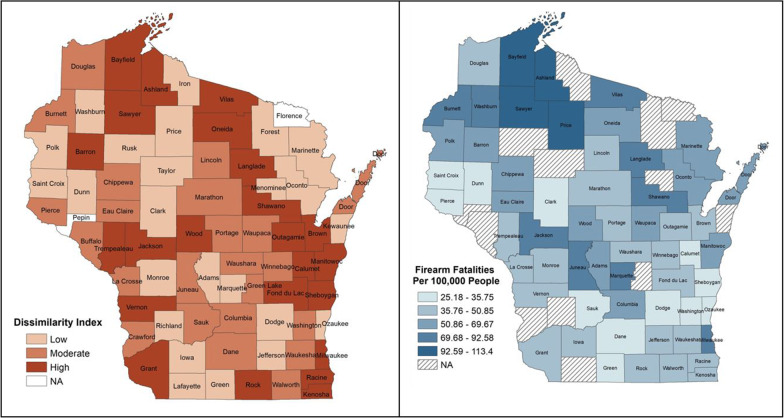
In 2019, there were 802 firearm fatalities. The adjusted model demonstrates that the risk of firearm fatalities was higher in areas with high residential racial segregation compared to low-segregated areas (IRR.:1.26, 95% CI:1.04-1.52) and higher in areas with high-income inequality compared to areas with low-income inequality (IRR.:1.18, 95% CI:1.00-1.40). Compared to areas with low-risk community resilience, the risk of firearm fatalities was higher in areas with moderate (IRR.:0.61, 95% CI:0.48-0.78), and in areas with high risk (IRR.:0.53, 95% CI:0.41-0.68). GIS analysis demonstrated that areas with high racial segregation also have high rates of firearm fatalities.
Areas with high residential racial segregation have a high rate of firearm fatalities. With high income inequality and low community resilience, the likelihood of firearm fatalities increases.
枪支致死是一个重大的公共卫生问题,每年导致4万美国人死亡。虽然枪支致死具有广泛影响,但尚不清楚诸如居住种族隔离、收入不平等和社区复原力等健康的社会决定因素(SDOH)如何影响枪支致死率。本研究调查了这些SDOH与枪支致死可能性之间的关系。
分析了医疗保健研究与质量局2019年的县级SDOH数据,涵盖威斯康星州的72个县。因变量是每个县的枪支致死人数,作为连续变量使用。自变量是居住种族隔离(差异指数),定义为非白人居民和白人居民在各县的分布程度,范围从0(完全融合)到100(完全隔离),值越高表明居住隔离程度越高(分为低、中、高)。协变量包括收入不平等(范围从零(完全平等)到一(完全不平等),分为低、中、高)、社区复原力风险因素(低、中、高风险)以及城乡分类。使用STATA/MPv.17.0进行描述性/汇总统计、未调整和调整后的负二项式回归,并对人口权重进行调整;P值≤0.05被认为具有统计学意义。使用ArcMap进行地理信息系统分析。
2019年,共有802起枪支致死事件。调整后的模型表明,与低隔离地区相比,居住种族隔离程度高的地区枪支致死风险更高(发病率比:1.26,95%置信区间:1.04 - 1.52),与低收入不平等地区相比,高收入不平等地区的枪支致死风险更高(发病率比:1.18,95%置信区间:1.00 - 1.40)。与社区复原力低风险地区相比,社区复原力中等(发病率比:0.61,95%置信区间:0.48 - 0.78)和高风险地区(发病率比:0.53,95%置信区间:0.41 - 0.