Department of Urology, Ren Ji Hospital, Shanghai Jiao Tong University School of Medicine, Shanghai, China.
Cancer Res Treat. 2023 Jul;55(3):969-977. doi: 10.4143/crt.2022.1557. Epub 2023 Mar 2.
In non-metastatic prostate cancer (nmPCa) setting, it is important to early identify the patients at risk of biochemical recurrence (BCR) for immediate postoperative intervention. Our study aimed to evaluate the potential clinical utility of circulating tumor DNA (ctDNA) for predicting disease recurrence.
This real-world observational study evaluated 161 cases of nmPCa undergoing next-generation sequencing at our institution. A total of 139 ctDNA samples and 31 biopsied tumor tissue underwent genomic profiling. The study endpoint was BCR after radical prostatectomy. Relationships between the ctDNA status and the biochemical progression-free survival (bPFS) were analyzed by log-rank test and multivariate Cox regression.
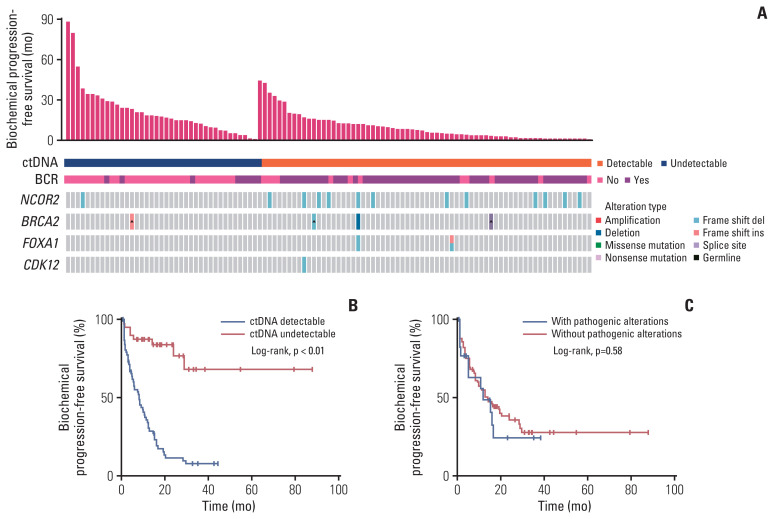
Of 161 enrolled patients, 19 (11.8%) harbored deleterious alterations in NCOR2, followed by BRCA2 (3.7%), ATR (2.5%), and CDK12 (2.5%). Of available pre-operative blood samples (n=139), ctDNA was detectable in 91 (65.5%). Until last follow-up, 56 of 68 patients (85.3%) with detectable ctDNA had achieved BCR, whereas only eight of 39 patients (20.5%) with undetectable ctDNA had achieved BCR. Patients who had undetectable ctDNA experienced significantly longer bPFS compared with those who had detectable ctDNA (not available vs. 8.2 months; hazard ratio, 0.14; p < 0.01). Pre-operative ctDNA status was a significant prognostic factor of disease recurrence.
Pre-operative ctDNA detection could identify patients at high risk of recurrence and has the potential to inform immediate postoperative interventions, but these approaches remain to be validated in prospective studies. ctDNA studies can provide insights into accurate monitoring and precise treatment rather than simply following routine clinical care.
在非转移性前列腺癌(nmPCa)患者中,早期识别有生化复发(BCR)风险的患者并进行术后干预至关重要。本研究旨在评估循环肿瘤 DNA(ctDNA)预测疾病复发的潜在临床应用价值。
本回顾性观察性研究评估了在我院接受下一代测序的 161 例 nmPCa 患者。共对 139 份 ctDNA 样本和 31 份活检肿瘤组织进行了基因组分析。研究终点为根治性前列腺切除术后 BCR。采用对数秩检验和多因素 Cox 回归分析 ctDNA 状态与生化无进展生存期(bPFS)之间的关系。
在纳入的 161 例患者中,19 例(11.8%)存在 NCOR2 有害改变,其次是 BRCA2(3.7%)、ATR(2.5%)和 CDK12(2.5%)。在可获得的术前血样(n=139)中,91 份(65.5%)可检测到 ctDNA。截至最后一次随访,91 份(65.5%)可检测到 ctDNA 的 68 例患者中,56 例(85.3%)发生了 BCR,而 39 例(20.5%)不可检测到 ctDNA 的患者中仅有 8 例(20.5%)发生了 BCR。ctDNA 阴性患者的 bPFS明显长于 ctDNA 阳性患者(未检测到 vs. 8.2 个月;风险比,0.14;p<0.01)。术前 ctDNA 状态是疾病复发的显著预后因素。
术前 ctDNA 检测可识别高复发风险的患者,并有可能为术后立即干预提供依据,但这些方法仍需在前瞻性研究中验证。ctDNA 研究可以提供准确监测和精准治疗的见解,而不仅仅是遵循常规临床护理。