Department of Surgery, Division of Surgical Oncology, University of California, San Diego, La Jolla, CA, USA.
Guardant Health, Inc, Redwood City, CA, USA.
Ann Surg Oncol. 2018 Aug;25(8):2400-2408. doi: 10.1245/s10434-018-6561-z. Epub 2018 Jun 14.
Next-generation sequencing (NGS) is a useful tool for detecting genomic alterations in circulating tumor DNA (ctDNA). To date, most ctDNA tests have been performed on patients with widely metastatic disease. Patients with peritoneal carcinomatosis (metastases) present unique prognostic and therapeutic challenges. We therefore explored preoperative ctDNA in patients with peritoneal metastases undergoing surgery.
Patients referred for surgical resection of peritoneal metastases underwent preoperative blood-derived ctDNA analysis (clinical-grade NGS [68-73 genes]). ctDNA was quantified as the percentage of altered circulating cell-free DNA (% cfDNA).
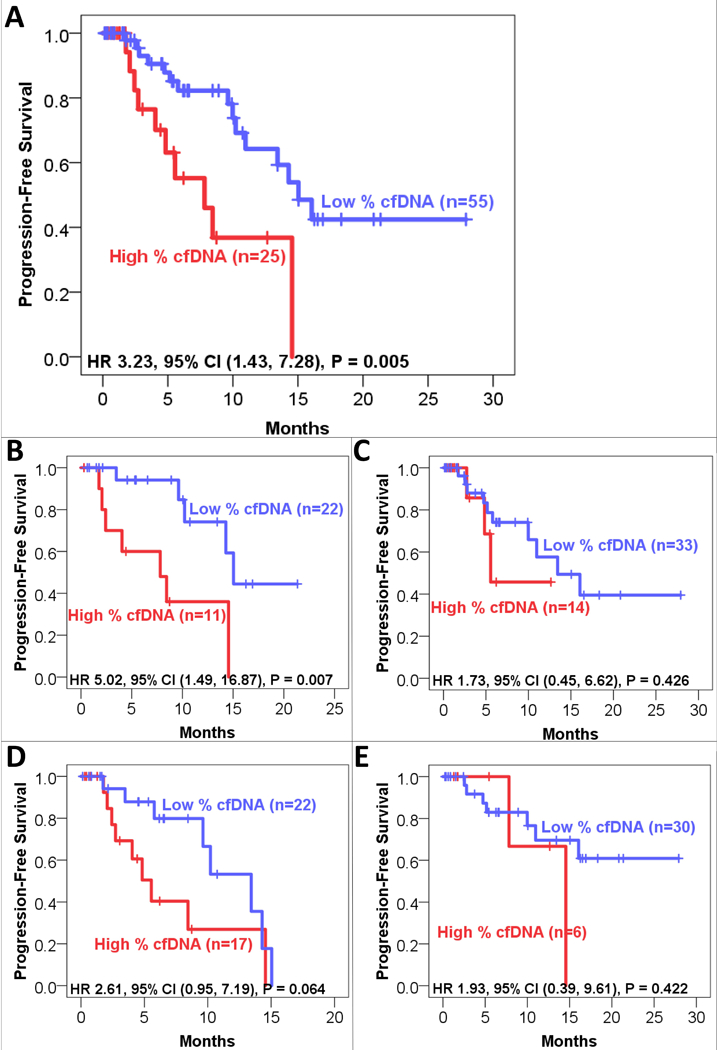
Eighty patients had ctDNA testing: 46 (57.5%) women; median age 55.5 years. The following diagnoses were included: 59 patients (73.8%), appendix cancer; 11 (13.8%), colorectal; five (6.3%), peritoneal mesothelioma; two (2.5%), small bowel; one (1.3%) each of cholangiocarcinoma, ovarian, and testicular cancer. Thirty-one patients (38.8%) had detectable preoperative ctDNA alterations, most frequently in the following genes: TP53 (25.8% of all alterations detected) and KRAS (11.3%). Among 15 patients with tissue DNA NGS, 33.3% also had ctDNA alterations (overall concordance = 96.7%). Patients with high ctDNA quantities (≥ 0.25% cfDNA, n = 25) had a shorter progression-free survival (PFS) than those with lower ctDNA quantities (n = 55; 7.8 vs. 15.0 months; hazard ratio 3.23, 95% confidence interval 1.43-7.28, p = 0.005 univariate, p = 0.044 multivariate).
A significant proportion of patients with peritoneal metastases referred for surgical intervention have detectable ctDNA alterations preoperatively. Patients with high levels of ctDNA have a worse prognosis independent of histologic grade.
下一代测序(NGS)是一种用于检测循环肿瘤 DNA(ctDNA)中基因组改变的有用工具。迄今为止,大多数 ctDNA 检测都是在广泛转移疾病的患者中进行的。患有腹膜癌病(转移)的患者具有独特的预后和治疗挑战。因此,我们探索了接受手术治疗的腹膜转移患者的术前 ctDNA。
接受腹膜转移切除术的患者接受术前血液衍生 ctDNA 分析(临床级 NGS[68-73 个基因])。ctDNA 作为改变的循环无细胞 DNA(% cfDNA)的百分比进行定量。
80 名患者进行了 ctDNA 检测:46 名(57.5%)女性;中位年龄 55.5 岁。包括以下诊断:59 名患者(73.8%),阑尾癌;11 名(13.8%),结直肠癌;5 名(6.3%),腹膜间皮瘤;2 名(2.5%),小肠;1 名(1.3%),胆管癌、卵巢癌和睾丸癌各 1 名。31 名患者(38.8%)术前可检测到 ctDNA 改变,最常见的基因是 TP53(所有检测到的改变的 25.8%)和 KRAS(11.3%)。在 15 名有组织 DNA NGS 的患者中,33.3%也有 ctDNA 改变(总体一致性为 96.7%)。ctDNA 量较高(≥0.25% cfDNA,n=25)的患者无进展生存期(PFS)短于 ctDNA 量较低的患者(n=55;7.8 与 15.0 个月;风险比 3.23,95%置信区间 1.43-7.28,p=0.005 单变量,p=0.044 多变量)。
接受手术干预的腹膜转移患者中有相当比例术前可检测到 ctDNA 改变。ctDNA 水平较高的患者具有独立于组织学分级的更差的预后。