Servicio de Análisis Clínicos, Hospital Universitario Dr. Peset-FISABIO, 46017, Valencia, Spain.
Servicio de Cirugía General y Aparato Digestivo, Hospital Universitario Dr. Peset-FISABIO, 46017, Valencia, Spain.
Redox Biol. 2023 Jun;62:102662. doi: 10.1016/j.redox.2023.102662. Epub 2023 Mar 8.
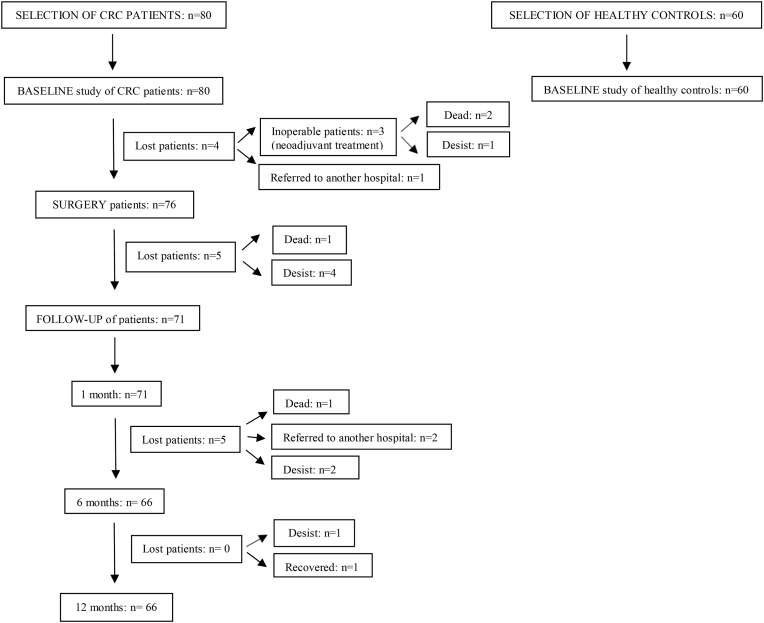
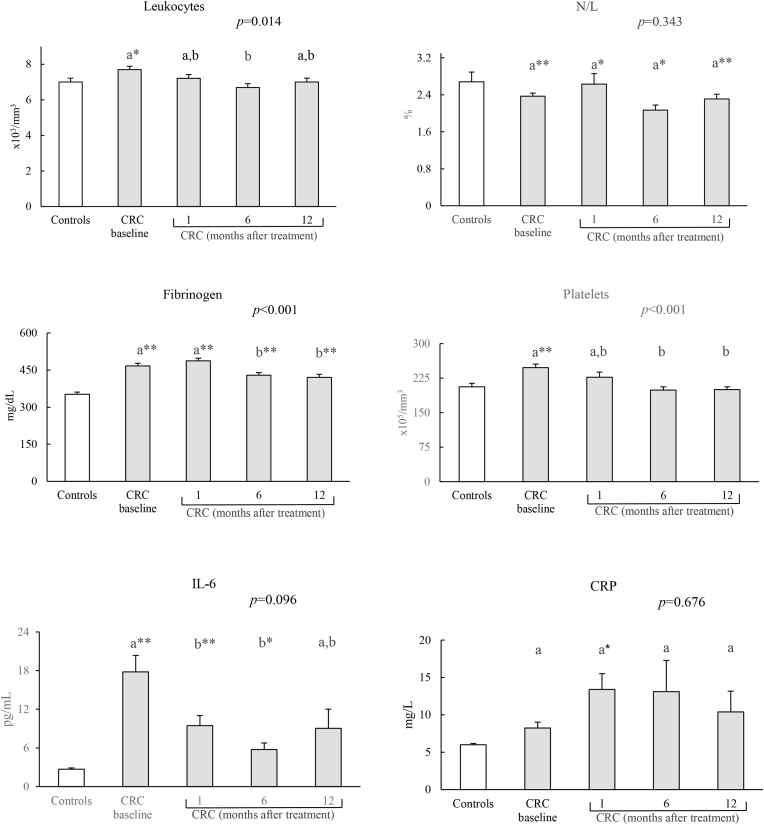
Oxidative stress (OS) and inflammation are known to play an important role in colorectal cancer (CRC). This study analyzed tumor, inflammatory and OS markers in CRC patients and in a control group. In addition, the evolution of these markers was evaluated after one-year of follow-up treatment. This was a longitudinal and prospective, observational study in 80 CRC patients who were candidates for tumor resection surgery and/or chemo-radiotherapy treatment and a healthy control group (n = 60). Subsequently, catalase (CAT), reduced glutathione (GSH), oxidized glutathione (GSSG) and GSSG/GSH ratio in serum and 8-oxo-7,8-dihydro-2'-deoxyguanosine (8-oxodG) and F2-IsoProstanes (F2-IsoPs) in urine at 1, 6 and 12 months after treatment was analyzed. Tumor markers (CEA and CA 19.9), as well as inflammatory markers-leukocytes, neutrophils, neutrophil/lymphocyte (N/L) index, platelets, fibrinogen, C-reactive protein (CRP), and interleukin 6 (IL6)- were also analyzed. As expected, levels of CEA and CA 19.9 and markers of inflammation, except CRP, were significantly higher in CRC compared to the control group. Regarding OS markers, a decrease in CAT and GSH and an increase in GSSG, GSSG/GSH ratio, 8-oxodG and F2-IsoPs were found in CRC patients compared to healthy controls at baseline. After treatment, an improvement of their inflammation profile was accompanied by a progressive recovery of antioxidant enzyme activities and the decline of oxidative byproducts both in serum and urine. Based on the results obtained, we propose the assay of urinary 8-oxodG and F2-IsoPs, as well as serum CAT, GSH, GSSG as a marker for the evaluation of OS and the clinical follow-up of CRC patients.
氧化应激 (OS) 和炎症被认为在结直肠癌 (CRC) 中发挥重要作用。本研究分析了 CRC 患者和对照组的肿瘤、炎症和 OS 标志物。此外,还评估了经过一年随访治疗后的这些标志物的演变情况。这是一项对 80 名 CRC 患者的纵向前瞻性观察性研究,这些患者是肿瘤切除术和/或放化疗治疗的候选者,以及一个健康对照组(n=60)。随后,分析了治疗后 1、6 和 12 个月血清中的过氧化氢酶 (CAT)、还原型谷胱甘肽 (GSH)、氧化型谷胱甘肽 (GSSG) 和 GSSG/GSH 比值以及尿液中的 8-氧代-7,8-二氢-2'-脱氧鸟苷 (8-oxodG) 和 F2-异前列腺素 (F2-IsoPs)。还分析了肿瘤标志物(CEA 和 CA 19.9)以及炎症标志物-白细胞、中性粒细胞、中性粒细胞/淋巴细胞 (N/L) 指数、血小板、纤维蛋白原、C 反应蛋白 (CRP) 和白细胞介素 6 (IL6)。正如预期的那样,与对照组相比,CRC 患者的 CEA 和 CA 19.9 以及除 CRP 外的炎症标志物水平显著升高。关于 OS 标志物,与健康对照组相比,CRC 患者的 CAT 和 GSH 水平降低,GSSG、GSSG/GSH 比值、8-oxodG 和 F2-IsoPs 水平升高。在治疗后,随着炎症谱的改善,抗氧化酶活性逐渐恢复,血清和尿液中的氧化产物水平下降。基于获得的结果,我们提出检测尿液中的 8-oxodG 和 F2-IsoPs 以及血清中的 CAT、GSH、GSSG,作为评估 OS 和 CRC 患者临床随访的标志物。