Brain Science Institute, Graduate School, Mongolian National University of Medical Sciences, Ulaanbaatar, Mongolia.
Brain and Mind Research Institute, Mongolian Academy of Sciences, Ulaanbaatar, Mongolia.
Nagoya J Med Sci. 2023 Feb;85(1):79-92. doi: 10.18999/nagjms.85.1.79.
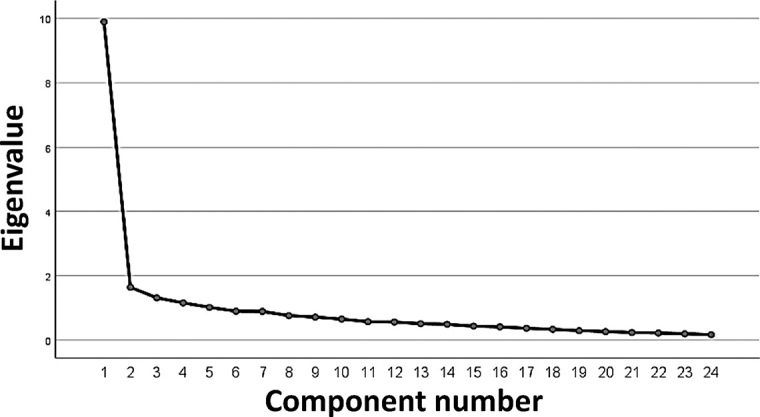
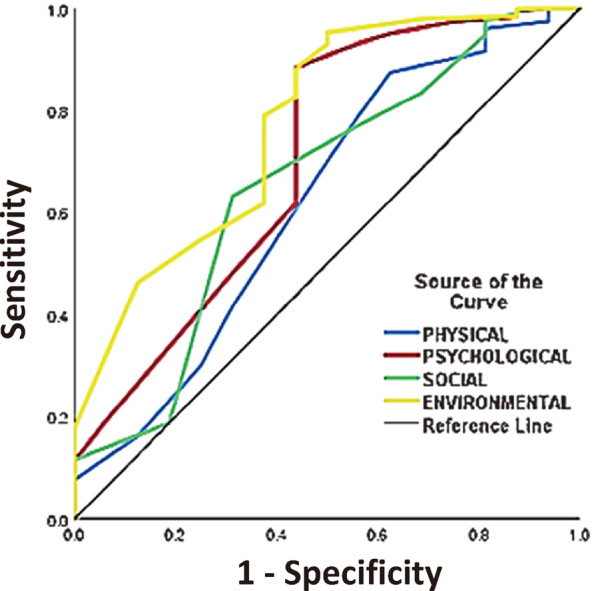
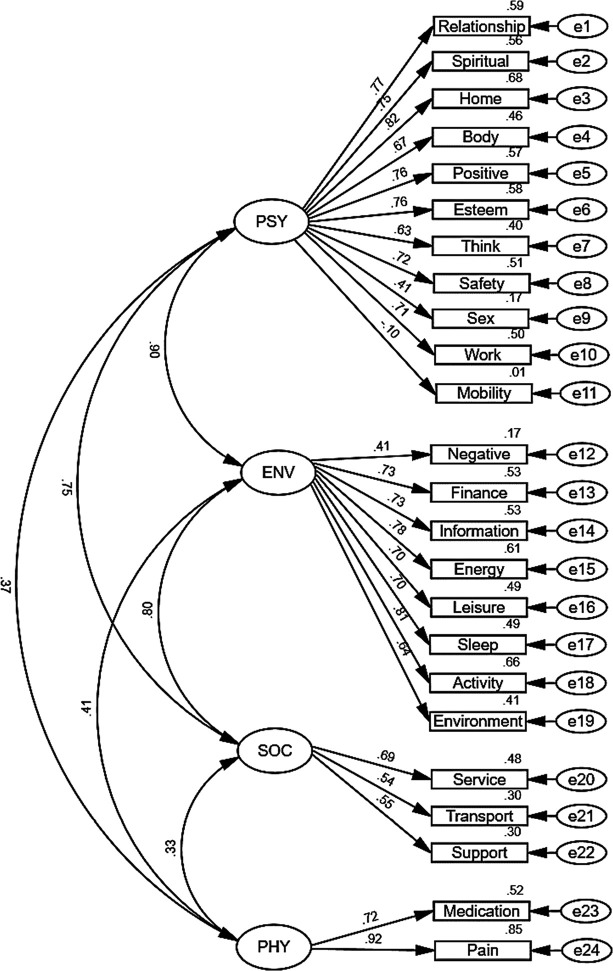
There is currently no validated tool to measure the quality of life (QOL) in the Mongolian language. This study aimed to validate the Mongolian version of the World Health Organization Quality of Life - Brief (WHOQOL-BREF) questionnaire for the general population of Mongolia. The subjects were 301 adults aged 18-65 years selected randomly by a computer from 30 centers in 8 districts of Ulaanbaatar, Mongolia, in 2020. Reliability was measured using Cronbach's α and intraclass correlation coefficients. Convergent, discriminant, and construct validities were examined using exploratory and confirmatory factor analyses for a four-domain factor structure. Among the participants, 56.1% were women, 32.9% held a bachelor's degree or higher, 48.8% were employed, and 61.8% were married. The overall Cronbach's α coefficient of the WHOQOL-BREF questionnaire was 0.804. Correlations between the component scores of the WHOQOL-BREF ranged from 0.581-0.822. All items showed higher item-total correlations with their corresponding domains than with other domains, except the mobility item from the physical domain. Discriminative validity was evident in physical and psychological domains. Exploratory and confirmatory factor analyses revealed a four-factorial structure consisting of 24 items that provided an acceptable fit to the data (RMSEA=0.084; CFI=0.860). In conclusion, the Mongolian version of the WHOQOL-BREF demonstrated evidence of good reliability and validity for assessing QOL in the general population of Mongolia. These findings indicate that it allows the comparison of QOL of adults in Mongolia with those in other countries.
目前尚无蒙语版的生活质量(QOL)评估工具。本研究旨在验证蒙语版世界卫生组织生活质量-简明问卷(WHOQOL-BREF)在蒙古国一般人群中的适用性。2020 年,从蒙古国 8 个地区 30 个中心中,通过计算机随机抽取了 301 名年龄在 18-65 岁的成年人作为研究对象。采用 Cronbach's α 和组内相关系数评估信度。采用探索性和验证性因子分析评估聚合、区分和结构效度,以确定四因素结构。参与者中,56.1%为女性,32.9%拥有学士或以上学历,48.8%有工作,61.8%已婚。WHOQOL-BREF 问卷的总体 Cronbach's α 系数为 0.804。WHOQOL-BREF 分量表得分之间的相关性在 0.581-0.822 之间。除物理领域的行动项目外,所有项目与相应领域的项目总分相关性均高于与其他领域的相关性。物理和心理领域的区分效度明显。探索性和验证性因子分析显示,存在一个由 24 个项目组成的四因素结构,数据拟合度可接受(RMSEA=0.084;CFI=0.860)。综上所述,蒙语版 WHOQOL-BREF 具有良好的信度和效度,可用于评估蒙古国一般人群的生活质量。这些发现表明,它可用于比较蒙古成年人的生活质量与其他国家成年人的生活质量。