Department of Population and Public Health Sciences, Keck School of Medicine, University of Southern California, Los Angeles, California, USA.
Nebraska Center for Research on Children, Youth, Families, and Schools, Lincoln, Nebraska, USA.
Subst Use Misuse. 2023;58(6):780-786. doi: 10.1080/10826084.2023.2188429. Epub 2023 Mar 16.
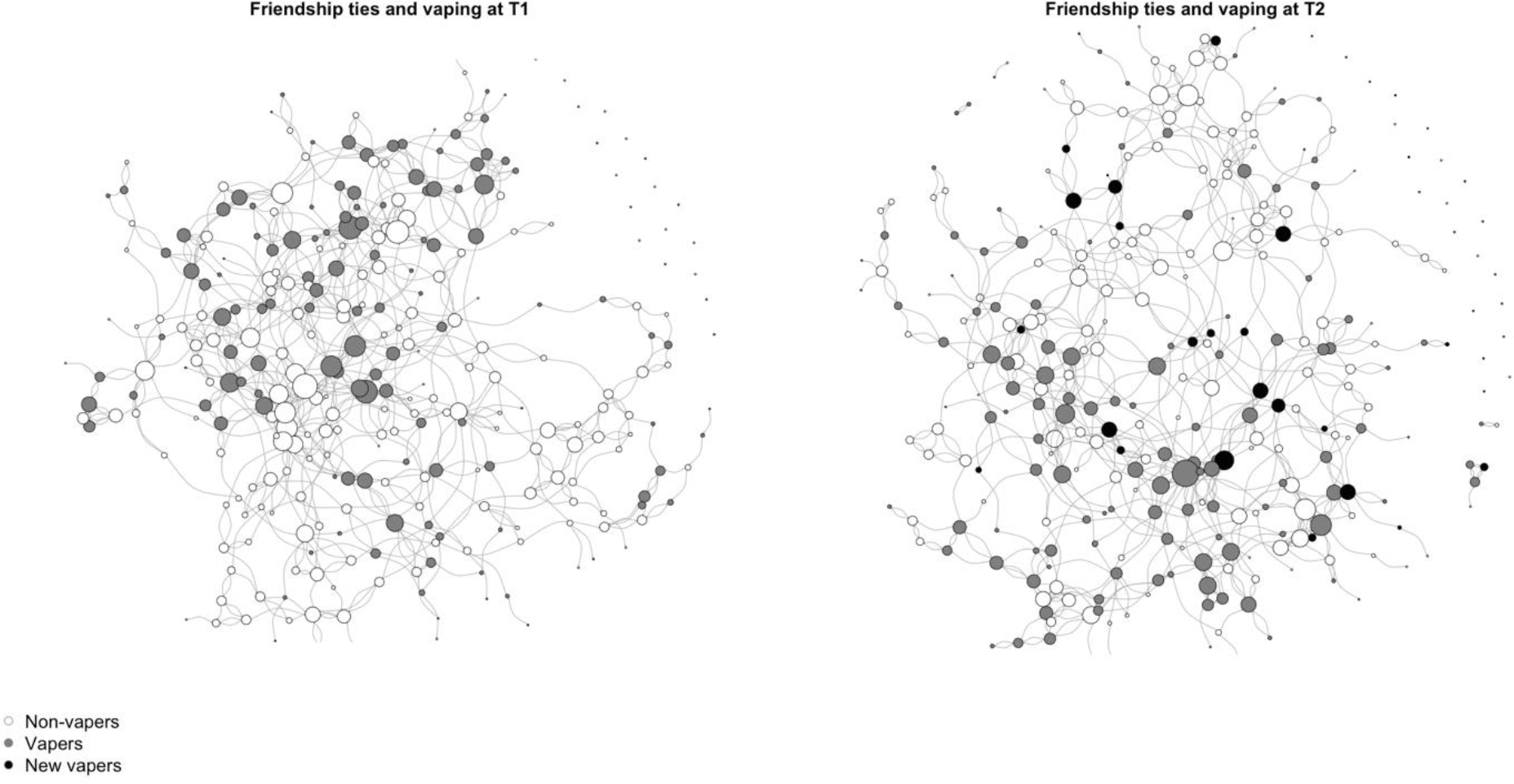
: Determine if individual adolescent vaping is associated with the vaping behavior of their school-based friendships; whether that association stems from peer influence or peer selection; and whether it varies by age. : Two wave longitudinal survey of 1,208 students in one Midwestern US school district. Students were asked if they ever vaped and to name their seven closest friends within the school district. A roster of all eligible students was pre-loaded into the survey to facilitate network data collection. Terms for network exposure, the proportion of vaping friends; and selection, the number of new friends who vape, were created. Logistic regression and Stochastic Actor Oriented Models were used to test both influence and selection effects. : A cross-sectional logistic regression model indicated that friend vaping was associated with individual vaping (AOR = 4.96, < 0.01); and lagged logistic models indicated that increased friend vaping was associated with individual vaping initiation (AOR = 1.72, < 0.05). Selecting new friends who vape was also associated with becoming a vaper (AOR = 1.25, < 0.01). Both influence and selection were present for those less than 14 years old. : This is the first study to use social network analysis to show that adolescents who vape or initiate vaping are more likely to do so if their friends vape, and/or they make new friends who vape. Prevention and cessation programs should address the role of friend influence and selection on e-cigarette use; particularly at younger ages.
: 确定青少年个体的 vaping 行为是否与其基于学校的朋友圈的 vaping 行为相关;这种关联是源于同伴影响还是同伴选择;以及这种关联是否因年龄而异。: 在一个美国中西部学区的 1208 名学生中进行了两次纵向调查。学生被问到他们是否曾经吸过烟,并被要求说出他们在学区内的七个最亲密的朋友的名字。所有符合条件的学生名单都预先加载到调查中,以方便网络数据收集。创建了网络暴露的术语,即吸电子烟的朋友比例;以及选择,即吸电子烟的新朋友数量。使用逻辑回归和随机主体定向模型来测试影响和选择效应。: 横截面逻辑回归模型表明,朋友吸电子烟与个体吸电子烟有关(AOR = 4.96, < 0.01);滞后逻辑模型表明,朋友吸电子烟的增加与个体吸电子烟的开始有关(AOR = 1.72, < 0.05)。选择吸电子烟的新朋友也与成为吸电子烟者有关(AOR = 1.25, < 0.01)。对于年龄小于 14 岁的人来说,影响和选择都存在。: 这是第一项使用社会网络分析来表明吸电子烟或开始吸电子烟的青少年,如果他们的朋友吸电子烟,或者他们结交了新的吸电子烟的朋友,那么他们更有可能吸电子烟。预防和戒烟计划应解决朋友影响和选择对电子烟使用的作用;特别是在年龄较小的时期。