Mishra Arunodaya Raj, Rani Pratibha, Saha Abhijit, Hezam Ibrahim M, Cavallaro Fausto, Chakrabortty Ripon K
Department of Mathematics, Government College Raigaon, Satna, MP-485441, India.
Department of Engineering Mathematics, Koneru Lakshmaiah Education Foundation, Vaddeswaram, Andhra Pradesh-522302, India.
Heliyon. 2023 Mar 7;9(3):e14244. doi: 10.1016/j.heliyon.2023.e14244. eCollection 2023 Mar.
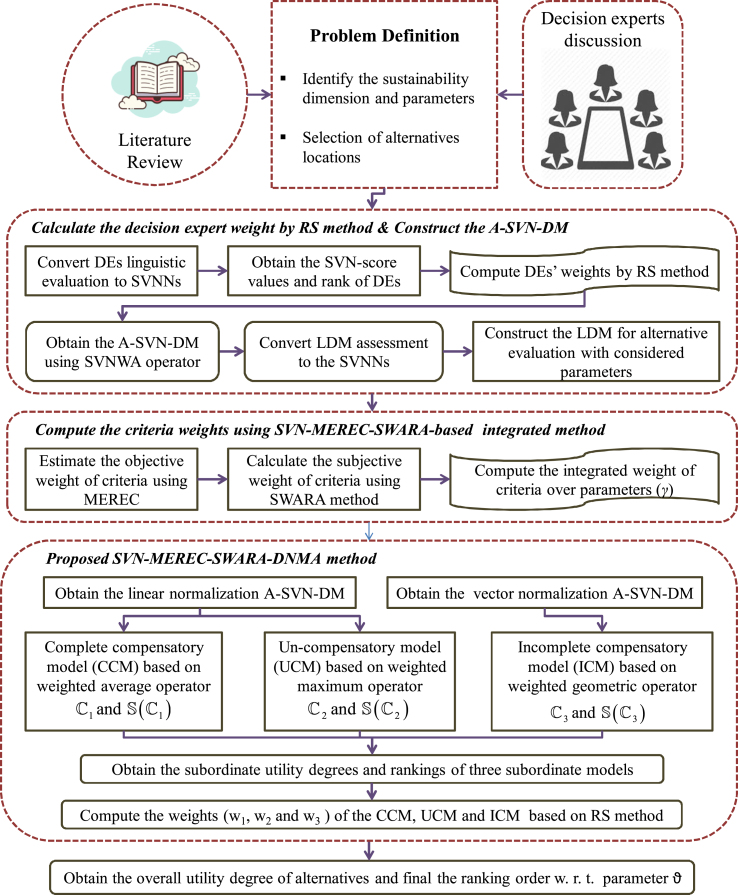
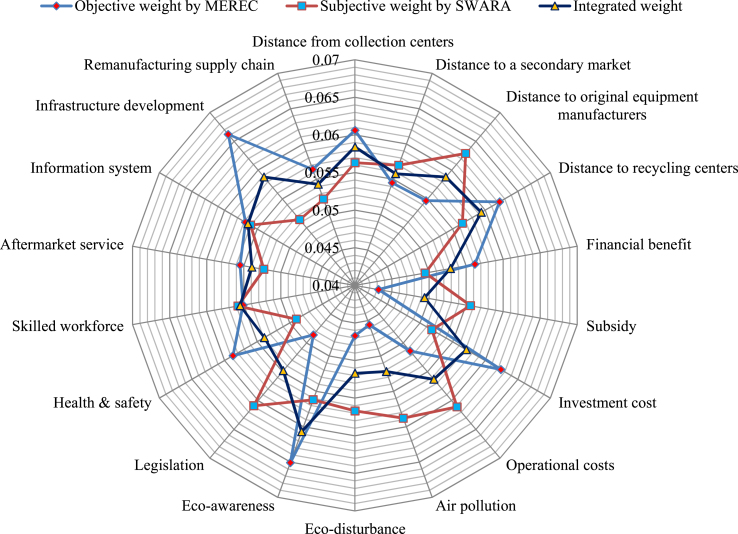
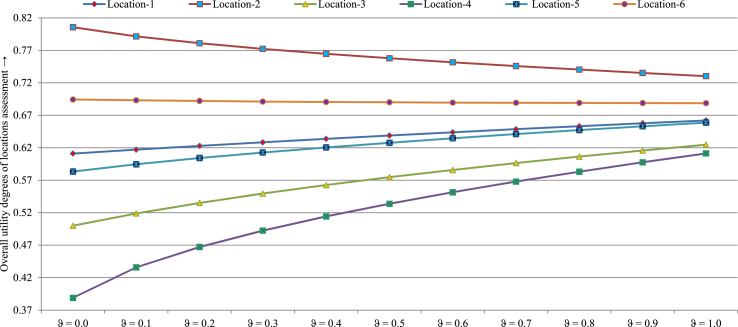
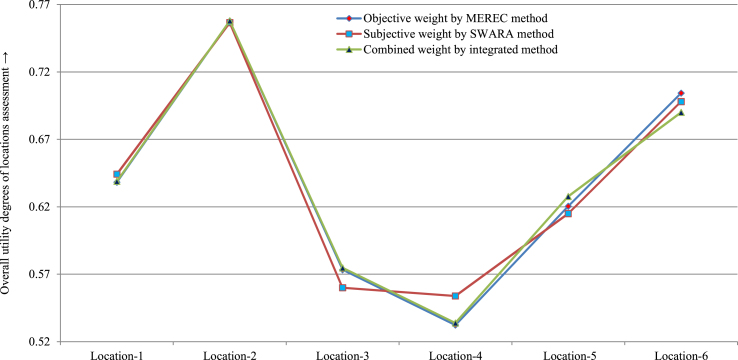
Lithium-ion battery (LiB), a leading residual energy resource for electric vehicles (EVs), involves a market presenting exponential growth with increasing global impetus towards electric mobility. To promote the sustainability perspective of the EVs industry, this paper introduces a hybridized decision support system to select the suitable location for a LiB manufacturing plant. In this study, single-valued neutrosophic sets (SVNSs) are considered to diminish the vagueness in decision-making opinions and evade flawed plant location assessments. This study divided into four phases. First, to combine the single-valued neutrosophic information, some Archimedean-Dombi operators are developed with their outstanding characteristics. Second, an innovative utilization of the Method based on the Removal Effects of Criteria (MEREC) and Stepwise Weight Assessment Ratio Analysis (SWARA) is discussed to obtain objective, subjective and integrated weights of criteria assessment with the least subjectivity and biasedness. Third, the Double Normalization-based Multi-Aggregation (DNMA) method is developed to prioritize the location options. Fourth, an illustrative study offers decision-making strategies for choosing a suitable location for a LiB manufacturing plant in a real-world setting. Our outcomes specify that Bangalore ( ), with an overall utility degree (0.7579), is the best plant location for LiB manufacturing. The consistency and robustness of the presented methodology are discussed with the comparative study and sensitivity investigation. This is the first study in the current literature that has proposed an integrated methodology on SVNSs to select the best LiB manufacturing plant location by estimating both the objective and subjective weights of criteria and by considering ambiguous, inconsistent, and inexact manufacturing-based information.
锂离子电池(LiB)是电动汽车(EV)的主要剩余能源,随着全球对电动出行的推动力度不断加大,其市场呈现指数级增长。为了从可持续性角度促进电动汽车行业发展,本文引入了一种混合决策支持系统,以选择适合锂离子电池制造工厂的选址。在本研究中,考虑使用单值中智集(SVNSs)来减少决策意见中的模糊性,并避免有缺陷的工厂选址评估。本研究分为四个阶段。首先,为了整合单值中智信息,开发了一些具有突出特性的阿基米德 - 多米比算子。其次,讨论了基于准则去除效应(MEREC)和逐步权重评估比率分析(SWARA)方法的创新应用,以获得具有最小主观性和偏差的准则评估的客观、主观和综合权重。第三,开发了基于双重归一化的多聚合(DNMA)方法对选址方案进行排序。第四,通过一个实例研究提供了在实际场景中选择适合锂离子电池制造工厂选址的决策策略。我们的结果表明,班加罗尔( )的总体效用度为0.7579,是最适合锂离子电池制造的工厂选址。通过比较研究和敏感性调查讨论了所提出方法的一致性和稳健性。这是当前文献中第一项提出基于单值中智集的综合方法,通过估计准则的客观和主观权重,并考虑基于制造的模糊、不一致和不精确信息来选择最佳锂离子电池制造工厂选址的研究。