Division of Cardiology, Department of Medicine, Nihon University School of Medicine, Japan.
Intern Med. 2023 Nov 1;62(21):3107-3117. doi: 10.2169/internalmedicine.1215-22. Epub 2023 Mar 15.
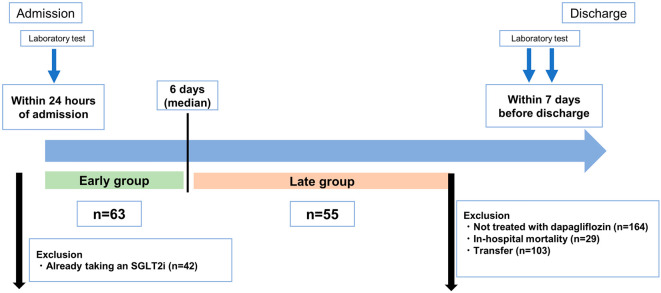
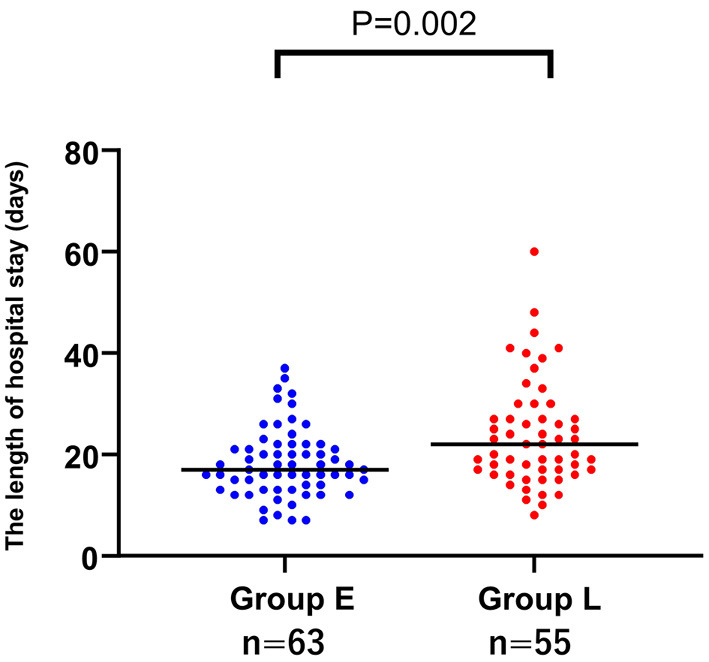
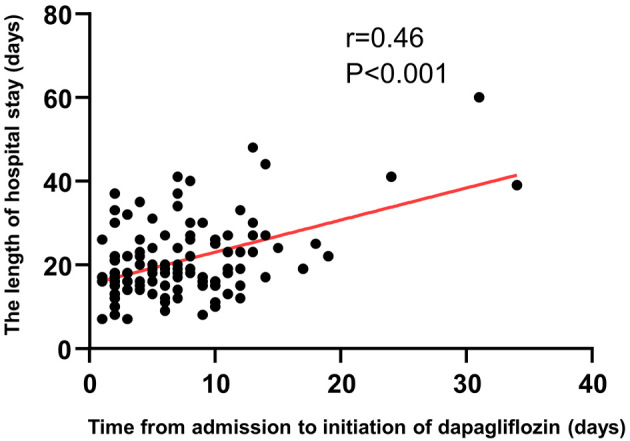
Objective Sodium-glucose co-transporter-2 inhibitors (SGLT2is), such as dapagliflozin, have a diuretic effect, and their early initiation to treat acute heart failure (AHF) may improve outcomes; however, the significance of the timing of starting dapagliflozin after hospital admission remains unclear. Methods We performed a post hoc analysis of a prospective, observational registry. Participants were divided into the early (E) group and late (L) group using the median time to the initiation of dapagliflozin (6 days) as the cut-off. We evaluated the relationship between the time to the initiation of dapagliflozin after hospital admission and patient characteristics and the length of the hospital stay. Patients Study subjects were 118 patients with AHF admitted between January 2021 and April 2022 who were started on dapagliflozin treatment (10 mg/day). Results Patients were divided into the E group (n=63) and L group (n=55). The HF severity as evaluated by the New York Heart Association class and the N-terminal pro-brain natriuretic peptide level was not significantly different between the groups. The time to the initiation of dapagliflozin and length of hospital stay showed a significant positive correlation (p<0.001, r=0.46). The hospital stay was significantly shorter in group E [median, 16.5 days; interquartile range (IQR): 13-22 days] than in group L (median, 22 days; IQR: 17-27 days; p=0.002). A multivariate logistic regression analysis showed that the early initiation of dapagliflozin was independently associated with a shorter hospital stay, even after multiple adjustments. Conclusion Early initiation of dapagliflozin after hospital admission is associated with a shorter hospital stay, suggesting it is a key factor for shortening hospital stays.
钠-葡萄糖协同转运蛋白 2 抑制剂(SGLT2i),如达格列净,具有利尿作用,早期用于治疗急性心力衰竭(AHF)可能改善结局;然而,入院后开始使用达格列净的时机的重要性仍不清楚。
我们对一项前瞻性观察性登记进行了事后分析。参与者根据开始使用达格列净的时间中位数(6 天)分为早期(E)组和晚期(L)组。我们评估了入院后开始使用达格列净的时间与患者特征和住院时间之间的关系。
2021 年 1 月至 2022 年 4 月期间因 AHF 入院并开始接受达格列净治疗(10mg/天)的 118 例患者。
患者分为 E 组(n=63)和 L 组(n=55)。两组的纽约心脏协会(NYHA)心功能分级和 N 末端脑利钠肽前体(NT-proBNP)水平无显著差异。开始使用达格列净的时间和住院时间呈显著正相关(p<0.001,r=0.46)。E 组的住院时间明显短于 L 组[中位数 16.5 天;四分位间距(IQR):13-22 天](p=0.002)。多变量逻辑回归分析显示,即使经过多次调整,早期开始使用达格列净与较短的住院时间独立相关。
入院后早期开始使用达格列净与较短的住院时间相关,提示这是缩短住院时间的关键因素。