Pal G P, Routal R V
Department of Anatomy, Government Medical College, Gujarat State, India.
J Anat. 1986 Oct;148:245-61.
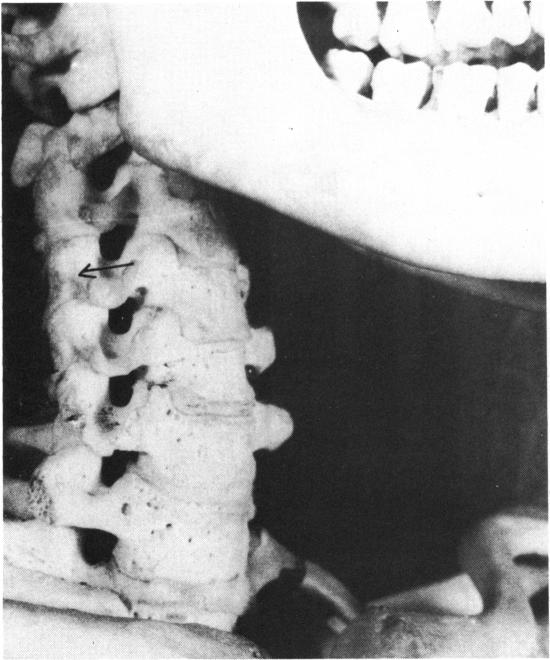
The role of the neural arch in weight transmission in the cervical and upper thoracic regions of the vertebral column has been investigated. Measurements at the levels of C2, C4, C6, C7, T1 and T5 vertebrae were made in 44 adult male vertebral columns. At each level, the area of the inferior surface of the body was compared with the area of the inferior articular facets, the pedicle index and the arch index; inclination of the pedicle in relation to the body was also measured. On the basis of these studies it was found that at C2 level the compressive force acting on the superior articular surfaces was transmitted to the inferior surface of the body and to the two inferior articular facets. From C2 to C7, compressive force is transmitted through three parallel columns - one anterior, formed by the bodies and intervertebral discs, and two posterior, formed by the articulations of the articular processes on either side. Due to the posterior curvature in the cervical region, the posterior columns here sustain more of the compressive force. From C7 level downwards, the compressive force is transmitted through two columns, i.e. one anterior formed by the bodies and intervertebral discs and one posterior formed by successive articulations of the laminae. Below C7 level, compressive force from the posterior column is partly transferred to the anterior column through the pedicles at T1 and T2. In the upper thoracic region, due to the anterior curvature, the main part of the compressive force is transmitted through the anterior column, which sustains even greater compressive force than is suggested by body area, with resulting increased stress.
已对神经弓在脊柱颈段和上胸段重量传递中的作用进行了研究。在44具成年男性脊柱上对C2、C4、C6、C7、T1和T5椎体水平进行了测量。在每个水平,将椎体下表面的面积与下关节面的面积、椎弓根指数和弓指数进行比较;还测量了椎弓根相对于椎体的倾斜度。基于这些研究发现,在C2水平,作用于上关节面的压缩力传递至椎体下表面和两个下关节面。从C2到C7,压缩力通过三根平行柱传递——一根在前,由椎体和椎间盘形成;两根在后,由两侧关节突的关节形成。由于颈段存在后凸,此处的后柱承受更多的压缩力。从C7水平向下,压缩力通过两根柱传递,即一根在前,由椎体和椎间盘形成;一根在后,由椎板的连续关节形成。在C7水平以下,后柱的压缩力部分通过T1和T2的椎弓根转移至前柱。在上胸段,由于前凸,压缩力的主要部分通过前柱传递,前柱承受的压缩力甚至比根据体表面积所提示的更大,从而导致应力增加。