Chiloiro Giuditta, Romano Angela, Mariani Silvia, Macchia Gabriella, Giannarelli Diana, Caravatta Luciana, Franco Pierfrancesco, Boldrini Luca, Arcelli Alessandra, Bacigalupo Almalina, Belgioia Liliana, Fontana Antonella, Meldolesi Elisa, Montesi Giampaolo, Niespolo Rita Marina, Palazzari Elisa, Piva Cristina, Valentini Vincenzo, Gambacorta Maria Antonietta
Department of Diagnostic Imaging, Radiation Oncology and Haematology, Fondazione Policlinico Universitario "A. Gemelli" IRCCS, Rome, Italy.
Catholic University of Sacred Heart, Rome, Italy.
Clin Transl Radiat Oncol. 2023 Jan 12;39:100579. doi: 10.1016/j.ctro.2023.100579. eCollection 2023 Mar.
Patients (pts) affected with locally advanced rectal cancer (LARC) may respond differently to neoadjuvant chemoradiotherapy (nCRT). The identification of reliable biomarkers able to predict oncological outcomes could help in the development of risk-adapted treatment strategies. It has been suggested that inflammation parameters may have a role in predicting tumor response to nCRT and survival outcomes and in rectal cancer, but no definitive conclusion can be drawn at present. The aim of the current study is to evaluate the role of baseline inflammatory markers as prognostic and predictive factors in a large multicentric Italian cohort of LARC pts.
Patients diagnosed with LARC from January 2002 to December 2019 in 9 Italian centers were retrospectively collected. Patients underwent long-course RT with chemotherapy based on fluoropyrimidine ± oxaliplatin followed by surgery. Inflammatory markers were retrieved based on a pre-treatment blood sample including HEI (hemo-eosinophils inflammation index), SII (systemic index of inflammation), NLR (neutrophil-to-lymphocyte ratio), PLR (platelet-to-lymphocyte ratio) and MLR (monocyte-to-lymphocyte ratio). Outcomes of interest were pathological complete response (pCR), disease-free survival (DFS), and overall survival (OS).
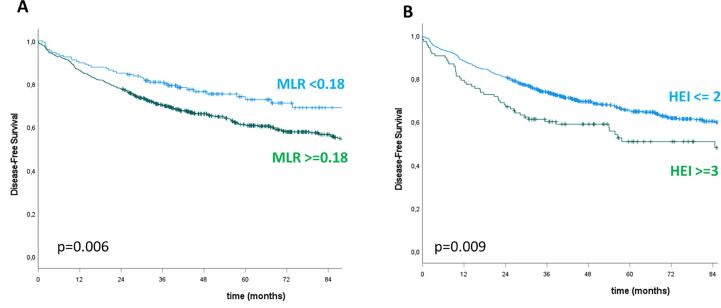
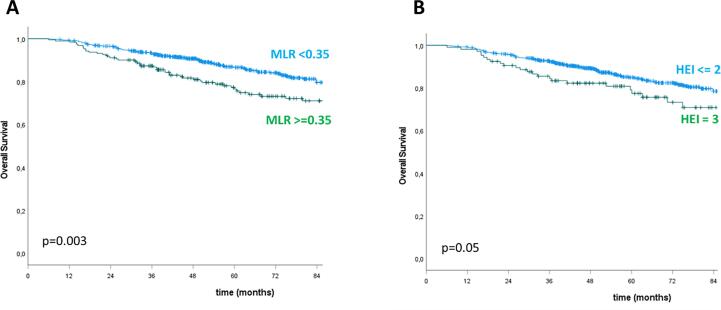
808 pts were analyzed. pCR rate was 22 %, 5yOS and 5yDFS were 84.0% and 63.1% respectively. Multivariate analysis identified that a NLR cut-off value >1.2 and SII cut-off value >500 could predict pCR (p = 0.05 and 0.009 respectively). In addition to age, extramesorectal nodes and RT dose, MLR >0.18 (p = 0.03) and HEI = 3 (p = 0.05) were independent prognostic factors for DFS. Finally, age, RT dose, MLR with a cut-off >0.35 (p = 0.028) and HEI = 3 (p = 0.045) were independent predictors of OS.
Higher values of baseline composite inflammatory markers can serve as predictors of lower pCR rates and worse survival outcomes in LARC patients undergoing nCRT. More reliable data from prospective studies could lead to the integration of these inexpensive and easy-to-derive tools into clinical practice.
局部晚期直肠癌(LARC)患者对新辅助放化疗(nCRT)的反应可能不同。识别能够预测肿瘤学结局的可靠生物标志物有助于制定风险适应性治疗策略。有人提出炎症参数可能在预测肿瘤对nCRT的反应和生存结局以及直肠癌方面发挥作用,但目前尚无定论。本研究的目的是评估基线炎症标志物在意大利一个大型多中心LARC患者队列中作为预后和预测因素的作用。
回顾性收集2002年1月至2019年12月在9个意大利中心诊断为LARC的患者。患者接受基于氟嘧啶±奥沙利铂的长程放疗联合化疗,随后进行手术。根据包括HEI(血红蛋白-嗜酸性粒细胞炎症指数)、SII(全身炎症指数)、NLR(中性粒细胞与淋巴细胞比值)、PLR(血小板与淋巴细胞比值)和MLR(单核细胞与淋巴细胞比值)的治疗前血样获取炎症标志物。感兴趣的结局为病理完全缓解(pCR)、无病生存期(DFS)和总生存期(OS)。
分析了808例患者。pCR率为22%,5年总生存率和5年无病生存率分别为84.0%和63.1%。多因素分析确定,NLR临界值>1.2和SII临界值>500可预测pCR(分别为p = 0.05和0.009)。除年龄、直肠外淋巴结和放疗剂量外,MLR>0.18(p = 0.03)和HEI = 3(p = 0.05)是DFS的独立预后因素。最后,年龄、放疗剂量、临界值>0.35的MLR(p = 0.028)和HEI = 3(p = 0.045)是OS的独立预测因素。
基线复合炎症标志物较高的值可作为接受nCRT的LARC患者pCR率较低和生存结局较差的预测指标。来自前瞻性研究的更可靠数据可能会将这些廉价且易于获取的工具整合到临床实践中。