Oncologic Department, IRCCS San Raffaele Scientific Institute Hospital, 20019, Milan, Italy.
Department of Oncology - Radiation Oncology, University of Turin School of Medicine, Via Genova 3, 10126, Turin, Italy.
J Gastrointest Cancer. 2023 Jun;54(2):662-671. doi: 10.1007/s12029-022-00850-y. Epub 2022 Aug 1.
Anal squamous cell carcinoma (SCC) and oropharyngeal cancer (OPC) are rare tumors associated with HPV infection. Bioumoral predictors of response to chemoradiation (CT-RT) are lacking in these settings. With the aim to find new biomarkers, we investigated the role of eosinophils in both HPV-positive anal SCC and HPV-related oropharyngeal cancer (OPC).
We retrieved clinical and laboratory data of patients with HPV-positive anal SCC treated with CT-RT in 5 institutions, and patients with locally advanced OPC SCC treated with CT-RT in 2 institutions. We examined the association between baseline eosinophil count (the best cutoff has been evaluated by ROC curve analysis: 100 × 10^9/L) and disease-free survival (DFS). Unadjusted and adjusted hazard ratios by baseline characteristics were calculated using the Cox proportional hazards model.
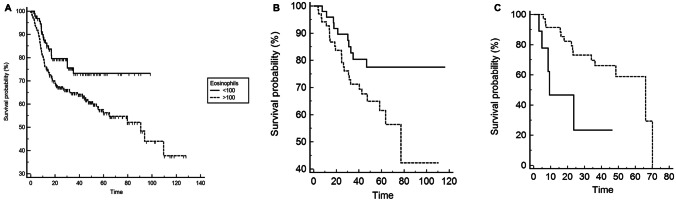
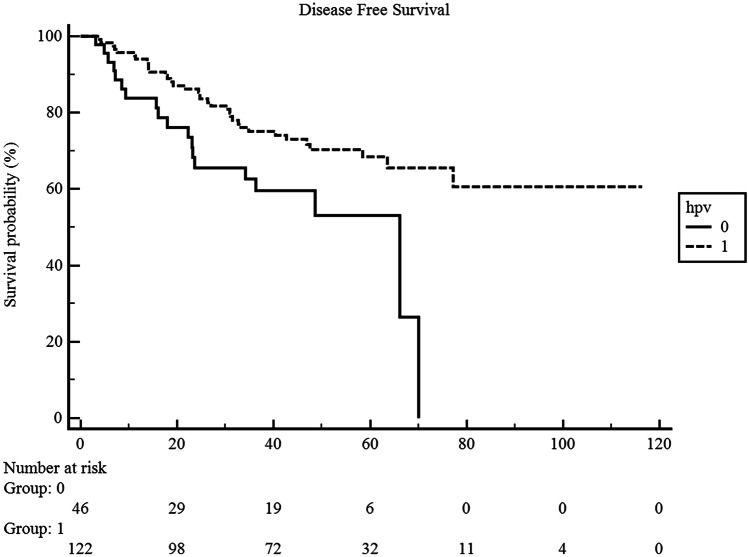
Three hundred four patients with HPV-positive anal SCCs and 168 patients with OPCs (122 HPV-positive, 46 HPV-negative diseases) were analyzed. In anal SCC, low eosinophil count (< 100 × 10^9/L) correlates to a better DFS (HR = 0.59; p = 0.0392); likewise, in HPV-positive OPC, low eosinophil count correlates to a better DFS (HR = 0.50; p = 0.0428). In HPV-negative OPC, low eosinophil count confers worse DFS compared to high eosinophil count (HR = 3.53; p = 0.0098). After adjustment for age and sex, eosinophils were confirmed to be independent prognostic factors for DFS (HR = 4.55; p = 0.0139).
Eosinophil count could be used as a prognostic factor in anal HPV-positive SCC. The worse prognosis showed in HPV-positive patients with high eosinophil count is likely to derive from an unfavorable interaction between the HPV-induced immunomodulation and eosinophils, which may hamper the curative effect of RT.
分析鳞状细胞癌(SCC)和口咽癌(OPC)是与 HPV 感染相关的罕见肿瘤。这些情况下缺乏对放化疗反应的生物标志物。为了寻找新的生物标志物,我们研究了嗜酸性粒细胞在 HPV 阳性肛门 SCC 和 HPV 相关口咽癌(OPC)中的作用。
我们检索了 5 家机构治疗 HPV 阳性肛门 SCC 的 CT-RT 患者和 2 家机构治疗局部晚期 OPC SCC 的 CT-RT 患者的临床和实验室数据。我们检查了基线嗜酸性粒细胞计数(最佳截断值通过 ROC 曲线分析评估:100×10^9/L)与无病生存(DFS)之间的关联。使用 Cox 比例风险模型计算未调整和按基线特征调整的风险比。
共分析了 304 例 HPV 阳性肛门 SCC 患者和 168 例 OPC 患者(122 例 HPV 阳性,46 例 HPV 阴性疾病)。在肛门 SCC 中,低嗜酸性粒细胞计数(<100×10^9/L)与更好的 DFS 相关(HR=0.59;p=0.0392);同样,在 HPV 阳性 OPC 中,低嗜酸性粒细胞计数与更好的 DFS 相关(HR=0.50;p=0.0428)。HPV 阴性 OPC 中,低嗜酸性粒细胞计数与高嗜酸性粒细胞计数相比,DFS 更差(HR=3.53;p=0.0098)。调整年龄和性别后,嗜酸性粒细胞被确认为 DFS 的独立预后因素(HR=4.55;p=0.0139)。
嗜酸性粒细胞计数可作为肛门 HPV 阳性 SCC 的预后因素。HPV 阳性患者中嗜酸性粒细胞计数较高的预后较差可能源于 HPV 诱导的免疫调节与嗜酸性粒细胞之间的不利相互作用,这可能会阻碍 RT 的疗效。