Lin Wen-Li, Nguyen Thi-Hoang-Yen, Lin Cheng-Yao, Wu Li-Min, Huang Wen-Tsung, Guo How-Ran
Center for Quality Management, Chi Mei Medical Center, Liouying, Tainan, Taiwan.
School of Nursing, Kaohsiung Medical University, Kaohsiung, Taiwan.
Front Oncol. 2023 Feb 20;12:1037796. doi: 10.3389/fonc.2022.1037796. eCollection 2022.
Despite prior attempts to evaluate the effects of sarcopenia on survival among patients with gynecologic cancer, the results of these studies have not been consistent. The present study evaluated the association between sarcopenia and survival among patients with gynecologic cancer by aggregating multiple studies.
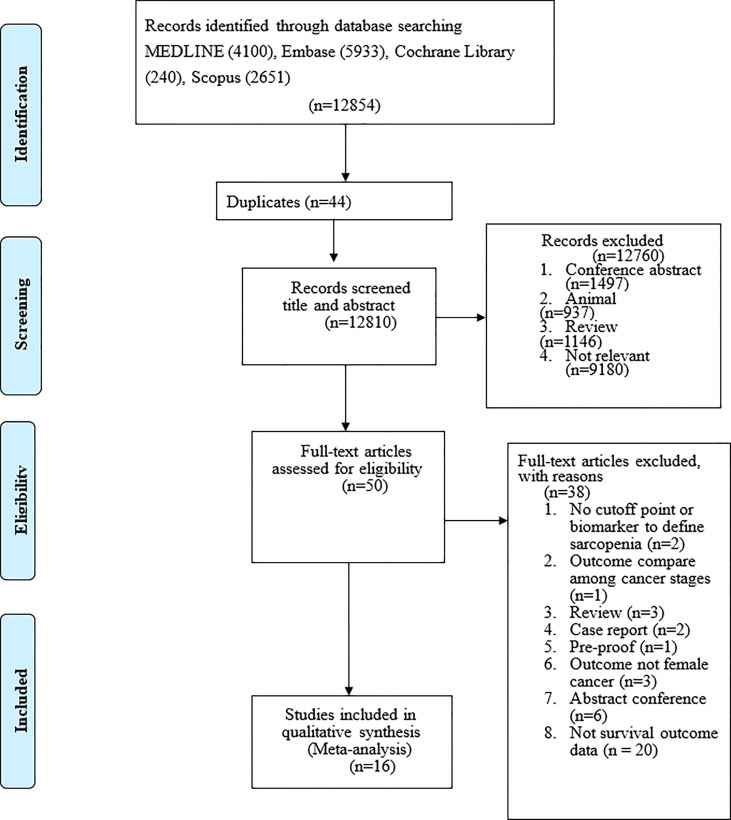
We performed a literature search using computerized databases and identified additional studies included in the bibliographies of retrieved articles. The quality of each study was evaluated using the Newcastle-Ottawa Scale, and meta-analyses were performed to evaluate overall survival (OS) and progression-free survival (PFS). We constructed a forest plot for each outcome and assessed publication bias using Begg's test. Heterogeneity was assessed using I statistics.
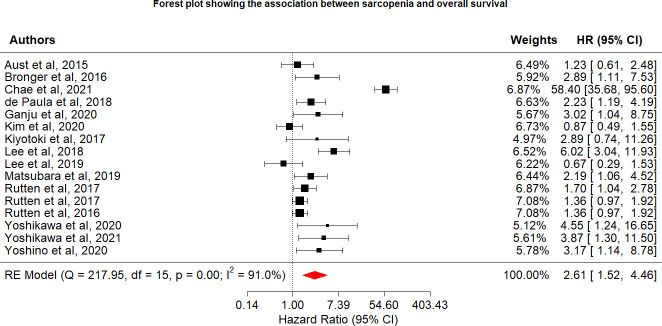
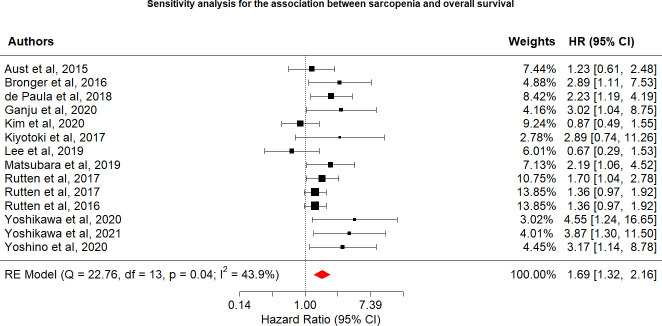
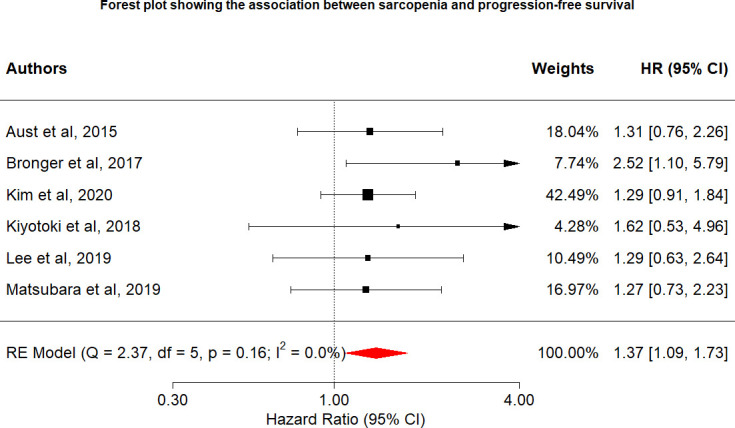
From the 5,933 initially identified articles, 16 studies describing 2,031 participants with a mean age of 60.34 years were included in the meta-analysis. We found that compared with patients with gynecologic cancer but without sarcopenia, patients with sarcopenia had worse OS, with a pooled hazard ratio (HR) of 2.61 (95% confidence interval [CI]:1.52-4.46), and worse PFS (HR: 1.37, 95% CI: 1.09-1.73). The quality of studies was generally good, and no publication bias was detected among studies for either OS or PFS. Although 4 of 12 studies were of fair quality, we conducted a sensitivity analysis excluding studies or fair quality and obtained similar results.
These meta-analysis results suggest that sarcopenia is associated with worse OS and PFS among patients with gynecologic cancer. The use of different case definitions appeared to be a major source of heterogeneity among the studies. Further studies remain necessary to confirm our findings, especially those examining OS and PFS, because publication bias was identified.
尽管此前曾尝试评估肌肉减少症对妇科癌症患者生存的影响,但这些研究结果并不一致。本研究通过汇总多项研究来评估肌肉减少症与妇科癌症患者生存之间的关联。
我们使用计算机数据库进行文献检索,并在检索到的文章参考文献中识别其他研究。使用纽卡斯尔-渥太华量表评估每项研究的质量,并进行荟萃分析以评估总生存期(OS)和无进展生存期(PFS)。我们为每个结果构建了森林图,并使用Begg检验评估发表偏倚。使用I统计量评估异质性。
在最初识别的5933篇文章中,16项描述了2031名平均年龄为60.34岁参与者的研究被纳入荟萃分析。我们发现,与无肌肉减少症的妇科癌症患者相比,有肌肉减少症的患者OS更差,合并风险比(HR)为2.61(95%置信区间[CI]:1.52 - 4.46),PFS也更差(HR:1.37,95%CI:1.09 - 1.73)。研究质量总体良好,OS或PFS的研究中均未检测到发表偏倚。尽管12项研究中有4项质量一般,但我们进行了敏感性分析,排除质量一般的研究后得到了相似的结果。
这些荟萃分析结果表明,肌肉减少症与妇科癌症患者较差的OS和PFS相关。使用不同的病例定义似乎是研究间异质性的主要来源。仍有必要进行进一步研究以证实我们的发现,特别是那些检查OS和PFS的研究,因为存在发表偏倚。