
内部审计作为评估兽医学院生物安全规则合规情况的一种工具。
Internal audits as a tool to assess the compliance with biosecurity rules in a veterinary faculty.
作者信息
Humblet Marie-France, Saegerman Claude
机构信息
Unit Biosafety, Biosecurity and Environmental Licenses, Department for Occupational Protection and Hygiene, University of Liège, Liège, Belgium.
Veterinary Science Epidemiology and Risk Analysis Research Unit (UREAR-ULiège), Fundamental and Applied Research for Animals and Health Center (FARAH), Department of Infectious and Parasitic Diseases, Faculty of Veterinary Medicine, University of Liège, Liège, Belgium.
出版信息
Front Vet Sci. 2023 Mar 2;10:960051. doi: 10.3389/fvets.2023.960051. eCollection 2023.
INTRODUCTION
The present paper proposes a tool to follow up the compliance of staff and students with biosecurity rules, as enforced in a veterinary faculty, i.e., animal clinics, teaching laboratories, dissection rooms, and educational pig herd and farm.
METHODS
Starting from a generic list of items gathered into several categories (personal dress and equipment, animal-related items, infrastructures, waste management, management of material/equipment and behavior), a checklist was created for each sector/activity mentioned above, based on the rules and procedures compiled in the Faculty biosecurity standard operating procedures. Checklists were created as Excel™ files. For each sector, several sheets were elaborated, i.e., one per specific activity: for example, the following sheets were created for the equine clinic: class 1-2 hospitalization (class 1 = non-infectious conditions; class 2 = infectious disease with a low or non-existent risk of transmission), class 3 hospitalization (class 3 = infectious disease with a moderate risk of transmission; these patients are suspected of having an infectious disease and being contagious for other patients and/or for humans) and consultation.
RESULTS
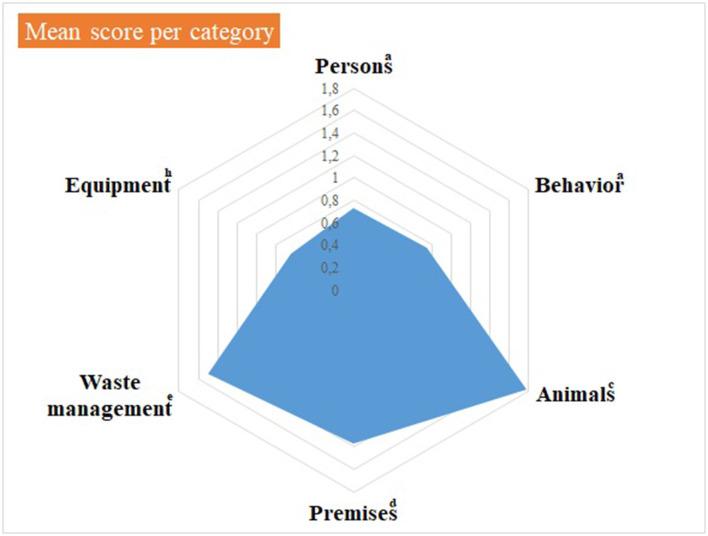
Class 4 area, which corresponds to the isolation unit and aims at housing patients suffering from infectious diseases with a significant risk of transmission (including notifiable conditions), was not audited at that period, as it was undergoing renovation works. The audit relied on observations performed by a unique observer to ensure standardization. Observed items were presented as yes/no and multiple-choice questions. A scale from 0 to 3 or 4 (depending on the item) allowed scoring each item, i.e., 0 corresponding to 100% compliance with the procedure and the highest score to the worst situation. A median and average global score was also estimated by category and by activity.
DISCUSSION
The methodology described in the present paper allows estimating the compliance with biosecurity standard operating procedures in a specific sector and/or for a given activity. The identification of criteria needing improvement is a key point: it helps prioritizing actions to be implemented and awareness raising among people concerned. Regular internal auditing is an essential part of a biosecurity plan, the frequency being conditioned by the risk linked to a specific activity or area (i.e., more frequent audits in risky situations).
引言
本文提出了一种工具,用于跟踪兽医学院(即动物诊所、教学实验室、解剖室以及教育用猪群和猪场)的工作人员和学生对生物安全规则的遵守情况。
方法
从收集到几个类别的通用项目清单出发,根据学院生物安全标准操作程序中汇编的规则和程序,为上述每个部门/活动创建了一份检查表。检查表以Excel™文件形式创建。对于每个部门,精心制作了几张工作表,即每个特定活动一张:例如,为马诊所创建了以下工作表:1-2级住院治疗(1级=非传染性疾病;2级=传播风险低或不存在的传染病)、3级住院治疗(3级=传播风险中等的传染病;这些患者疑似患有传染病且会传染给其他患者和/或人类)以及会诊。
结果
4级区域对应隔离单元,旨在收治具有重大传播风险(包括应通报疾病)的传染病患者,由于当时正在进行翻新工程,该区域未接受审计。审计依赖于一名唯一观察者进行的观察以确保标准化。观察到的项目以是/否和多项选择题形式呈现。一个从0到3或4的量表(取决于项目)用于对每个项目进行评分,即0对应100%符合程序,最高分对应最差情况。还按类别和活动估计了中位数和平均总体得分。
讨论
本文所述方法允许估计特定部门和/或给定活动对生物安全标准操作程序的遵守情况。确定需要改进的标准是关键:它有助于确定要实施的行动的优先级以及提高相关人员的认识。定期内部审计是生物安全计划的重要组成部分,审计频率取决于与特定活动或区域相关的风险(即,在高风险情况下审计更频繁)。



 Zotero 插件