Mozaffar Boshra, Ardavani Arash, Muzafar Hisham, Idris Iskandar
MRC-Versus Arthritis Centre for Musculoskeletal Ageing Research, National Institute for Health Research Nottingham Biomedical Research Centre, Clinical, Metabolic and Molecular Physiology, University of Nottingham, Royal Derby Hospital, Derby, UK.
Clinical Nutrition Department, Applied Medical Sciences, Jazan University, Jazan, Saudi Arabia.
J Nutr Metab. 2023 Mar 8;2023:6711071. doi: 10.1155/2023/6711071. eCollection 2023.
Food taste and flavour affect food choice and acceptance, which are essential to maintain good health and quality of life. Reduced circulating zinc levels have been shown to adversely affect the taste, but the efficacy of zinc supplementation to treat disorders of taste remains unclear. In this systematic review and meta-analysis, we aimed to examine the efficacy of zinc supplementation in the treatment of taste disorders.
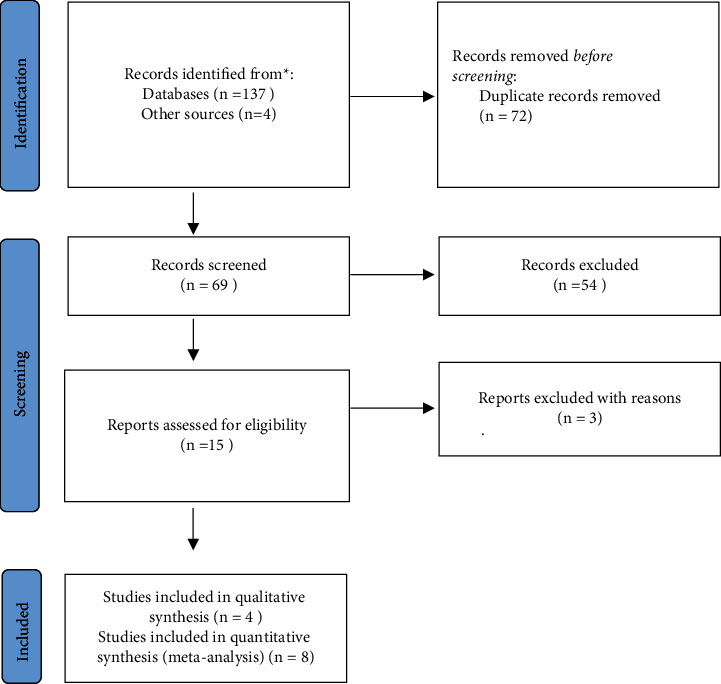
We searched four electronic bibliographical databases: Ovid MEDLINE, Ovid Embase, Ovid AMAD, and PubMed. Article bibliographies were also searched, which yielded additional relevant studies. There were no restrictions on the publication date to facilitate the collection and identification of all available and relevant articles published before 7 February 2021. We performed a systematic review and meta-analysis according to the PRISMA Statement. This review was registered at PROSPERO and given the identification number CRD42021228461.
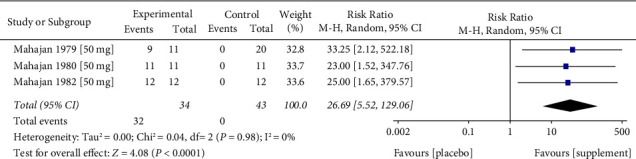
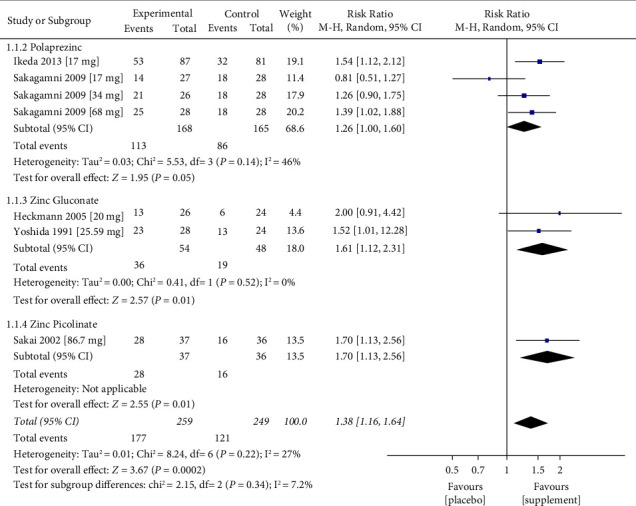
In total, we included 12 randomized controlled trials with 938 subjects. The intervention includes zinc (sulfate, gluconate, picolinate, polaprezinc, and acetate), and the pooled results of the meta-analysis of subjects with idiopathic and zinc-deficient taste disorder indicate that improvements in taste disorder occurred more frequently in the experimental group compared to the control group (RR = 1.38; 95% CI: 1.16, 1.64, =0.0002). Zinc supplementation appears to confer a greater improvement in taste perception amongst those with chronic renal disease using zinc acetate (overall RR = 26.69, 95% CI = 5.52-129.06, < 0.0001). The doses are equivalent to 17 mg-86.7 mg of elemental zinc for three to six months.
Zinc supplementation is an effective treatment for taste disorders in patients with zinc deficiency, idiopathic taste disorders, and in patients with taste disorders induced by chronic renal failure when given in high doses ranging from 68 to 86.7 mg/d for up to six months.
食物的味道和风味会影响食物的选择和接受程度,而这对于维持良好的健康状况和生活质量至关重要。已有研究表明,循环锌水平降低会对味觉产生不利影响,但补充锌对治疗味觉障碍的疗效仍不明确。在这项系统评价和荟萃分析中,我们旨在研究补充锌治疗味觉障碍的疗效。
我们检索了四个电子文献数据库:Ovid MEDLINE、Ovid Embase、Ovid AMAD和PubMed。还检索了文章的参考文献,从中获得了更多相关研究。对发表日期没有限制,以便收集和识别2021年2月7日前发表的所有可用且相关的文章。我们根据PRISMA声明进行了系统评价和荟萃分析。本评价已在PROSPERO注册,识别号为CRD42021228461。
我们总共纳入了12项随机对照试验,涉及938名受试者。干预措施包括锌(硫酸盐、葡萄糖酸盐、吡啶甲酸盐、聚普瑞锌和醋酸盐),对特发性和缺锌性味觉障碍受试者进行荟萃分析的汇总结果表明,与对照组相比,实验组味觉障碍改善的情况更常见(RR = 1.38;95% CI:1.16,1.64,P = 0.0002)。使用醋酸锌补充锌似乎能使慢性肾病患者的味觉感知有更大改善(总体RR = 26.69,95% CI = 5.52 - 129.06,P < 0.0001)。剂量相当于17毫克至86.7毫克元素锌,持续三至六个月。
对于锌缺乏、特发性味觉障碍以及慢性肾衰竭所致味觉障碍的患者,补充锌是一种有效的治疗方法,高剂量(68至86.7毫克/天)持续补充长达六个月。