de la Torre Hernandez Jose M, Veiga Fernandez Gabriela, Ben-Assa Eyal, Sainz Laso Fermin, Lee Dae-Hyun, Ruisanchez Villar Cristina, Lerena Piedad, Garcia Camarero Tamara, Cuesta Cosgaya Jose M, Fradejas-Sastre Victor, Benito Mercedes, Barrera Sergio, Garcia-Unzueta Maria T, Brown Jonathan, Gil Ongay Aritz, Zueco Javier, Vazquez de Prada Jose A, Edelman Elazer R
Division of Cardiology, Hospital Universitario Marqués de Valdecilla, Instituto de Investigación Valdecilla (IDIVAL), Santander, Spain.
Department of Cardiology, Medical School, University of Cantabria, Santander, Spain.
Front Cardiovasc Med. 2023 Mar 2;10:1118409. doi: 10.3389/fcvm.2023.1118409. eCollection 2023.
A non-negligible rate of patients undergoing transcatheter aortic valve replacement (TAVR) do not report symptomatic improvement or even die in the short-midterm. We sought to assess the degree of objective functional recovery after TAVR and its prognostic implications and to develop a predictive model.
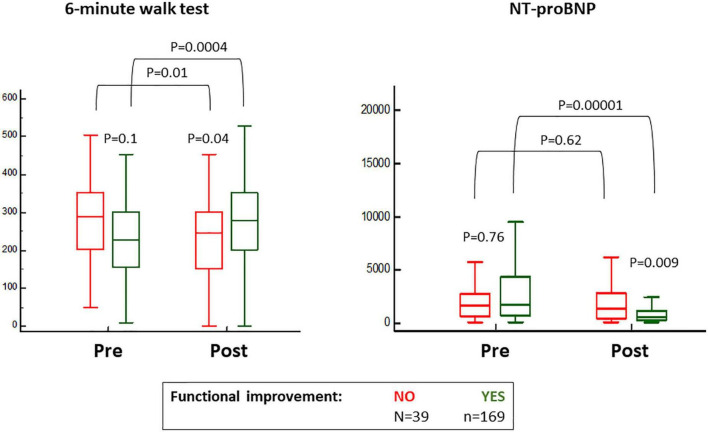
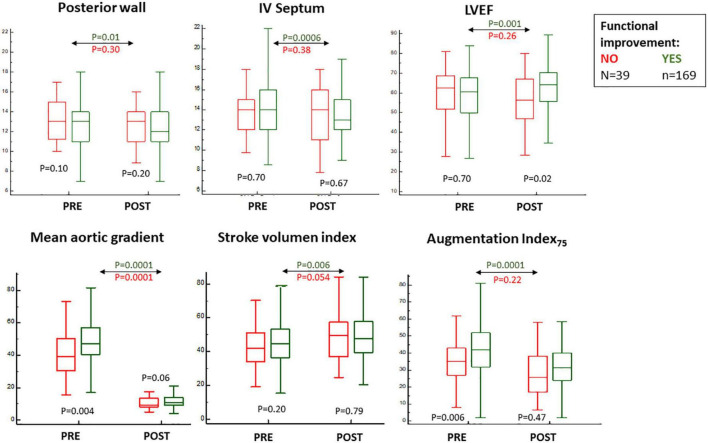
In a cohort of patients undergoing TAVR, a prospective evaluation of clinical, anatomical, and physiological parameters was conducted before and after the procedure. These parameters were derived from echocardiography, non-invasive analysis of arterial pulse waves, and cardiac tomography. Objective functional improvement 6 months after TAVR was assessed using a 6-min walk test and nitro-terminal pro-brain natriuretic peptide (NT-proBNP) levels. The derived predictive model was prospectively validated in a different cohort. A clinical follow-up was conducted at 2 years.
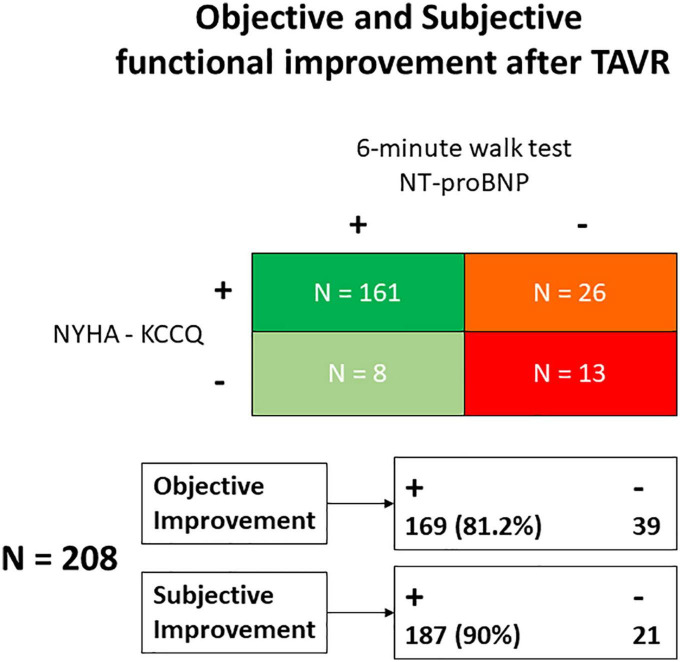
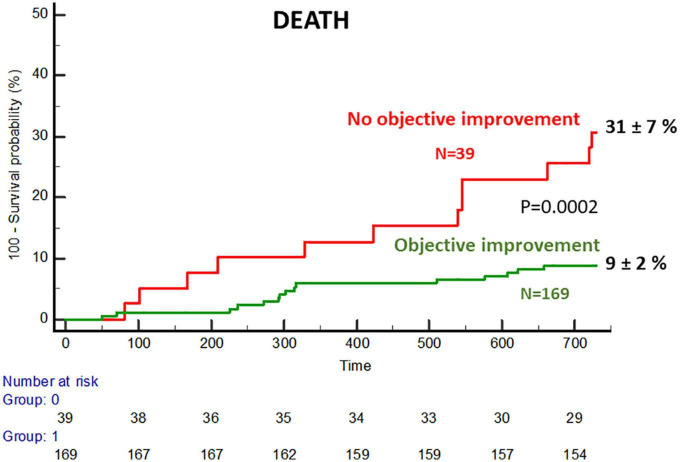
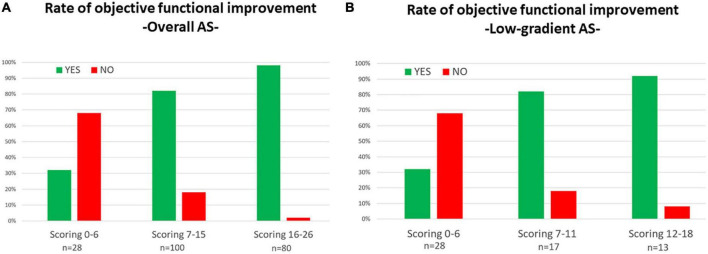
Among the 212 patients included, objective functional improvement was observed in 169 patients (80%) and subjective improvement in 187 (88%). Patients with objective functional improvement showed a much lower death rate at 2 years (9% vs. 31% = 0.0002). Independent predictors of improvement were as follows: mean aortic gradient of ≥40 mmHg, augmentation index of ≥45%, the posterior wall thickness of ≤12 mm, and absence of atrial fibrillation. A simple integer-based point score was developed (GAPA score), which showed an area under the curve of 0.81 for the overall cohort and 0.78 for the low-gradient subgroup. In a validation cohort of 216 patients, these values were 0.75 and 0.76, respectively.
A total of 80% of patients experienced objective functional improvement after TAVR, showing a significantly lower 2-year mortality rate. A predictive score was built that showed a good discriminative performance in overall and low-gradient populations.
接受经导管主动脉瓣置换术(TAVR)的患者中,有不可忽视的比例在短中期内未报告症状改善甚至死亡。我们试图评估TAVR术后客观功能恢复的程度及其预后意义,并建立一个预测模型。
在一组接受TAVR的患者中,对手术前后的临床、解剖和生理参数进行了前瞻性评估。这些参数来自超声心动图、动脉脉搏波的无创分析和心脏断层扫描。使用6分钟步行试验和N末端脑钠肽前体(NT-proBNP)水平评估TAVR术后6个月的客观功能改善情况。所推导的预测模型在另一组患者中进行了前瞻性验证。在2年时进行了临床随访。
在纳入的212例患者中,169例(80%)观察到客观功能改善,187例(88%)观察到主观改善。客观功能改善的患者在2年时的死亡率低得多(9%对31%,P = 0.0002)。改善的独立预测因素如下:平均主动脉梯度≥40 mmHg、增强指数≥45%、后壁厚度≤12 mm以及无房颤。开发了一个基于整数的简单评分(GAPA评分),总体队列的曲线下面积为0.81,低梯度亚组为0.78。在216例患者的验证队列中,这些值分别为0.75和0.76。
共有80%的患者在TAVR术后经历了客观功能改善,2年死亡率显著降低。建立了一个预测评分,在总体和低梯度人群中显示出良好的鉴别性能。