Brush Parker L, Santana Adrian, Toci Gregory R, Slotkin Eric, Solomon Michael, Jones Tristan, Saxena Arjun
Rothman Orthopaedic Institute at Thomas Jefferson University, Philadelphia, PA, USA.
Rutgers Robert Wood Johnson Medical School, New Brunswick, NJ, USA.
Arthroplast Today. 2023 Mar 7;20:101109. doi: 10.1016/j.artd.2023.101109. eCollection 2023 Apr.
Accurate acetabular cup orientation is associated with decreased revision rates and improved outcomes of primary total hip arthroplasty. This study assesses surgeon's ability to estimate both the acetabular component inclination and anteversion angles via intraoperative fluoroscopy (IF) images.
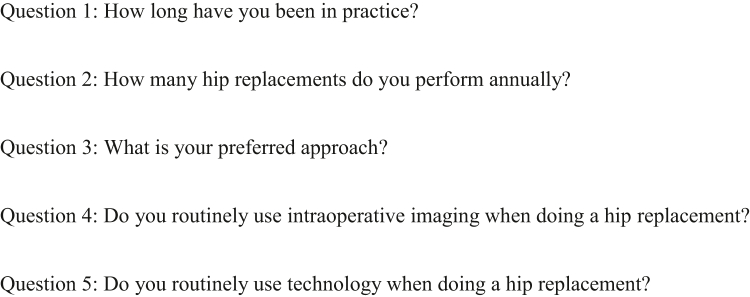
We surveyed orthopedic surgeons to estimate acetabular component inclination and anteversion based on 20 IF images of total hip arthroplasty through a direct anterior approach. Postoperative computed-tomography scans were used to calculate the true inclination and anteversion component angles. The absolute difference between the true and estimated values was calculated to determine the mean and standard deviation of the survey results. Interrater reliability was determined through interclass correlation coefficients.
A majority of surgeons preferred the direct anterior approach (83.3%) and utilized IF during surgery (70%). Surgeons surveyed were on average 5.9° away from the true value of inclination (standard deviation = 4.7) and 8.8° away from the true value of anteversion (standard deviation = 6.0). Respondents were within 5° of both inclination and anteversion in 19.7% of cases, and within 10° in 57.3% of cases. All surgeons were determined to have poor reliability in estimating anteversion (interclass correlation coefficient < 0.5). Only 2 surgeons were determined to have moderate reliability when estimating inclination.
Surgeons, when solely relying on IF for the estimation of anteversion and inclination, are unreliable. Utilization of other techniques in conjunction with IF would improve observer reliability.
准确的髋臼杯方向与初次全髋关节置换术翻修率降低和预后改善相关。本研究评估外科医生通过术中透视(IF)图像估计髋臼假体倾斜角和前倾角的能力。
我们对骨科医生进行了调查,让他们根据20张通过直接前路进行全髋关节置换术的IF图像来估计髋臼假体的倾斜角和前倾角。术后计算机断层扫描用于计算真实的倾斜角和前倾角。计算真实值与估计值之间的绝对差值,以确定调查结果的平均值和标准差。通过组内相关系数确定评分者间的可靠性。
大多数外科医生更喜欢直接前路(83.3%),并且在手术中使用了IF(70%)。接受调查的外科医生估计的倾斜角平均与真实值相差5.9°(标准差 = 4.7),前倾角平均与真实值相差8.8°(标准差 = 6.0)。在19.7%的病例中,受访者估计的倾斜角和前倾角与真实值的偏差在5°以内,在57.3%的病例中偏差在10°以内。所有外科医生在估计前倾角时的可靠性都很差(组内相关系数 < 0.5)。只有2名外科医生在估计倾斜角时被确定具有中等可靠性。
外科医生仅依靠IF来估计前倾角和倾斜角时,可靠性较差。结合使用其他技术与IF将提高观察者的可靠性。