Huang Kaizhao, Pei Shunjie, Sun Yi, Xu Xi, Fang Yangyang, Lai Meimei, Xiang Guangxin, Xu Feng, Zheng Xiaoqun
Second Affiliated Hospital and Yuying Children's Hospital, Wenzhou Medical University, Wenzhou, Zhejiang, China.
School of Laboratory Medicine and Life Sciences, Wenzhou Medical University, Wenzhou, Zhejiang, China.
Microbiol Spectr. 2023 Mar 20;11(2):e0461522. doi: 10.1128/spectrum.04615-22.
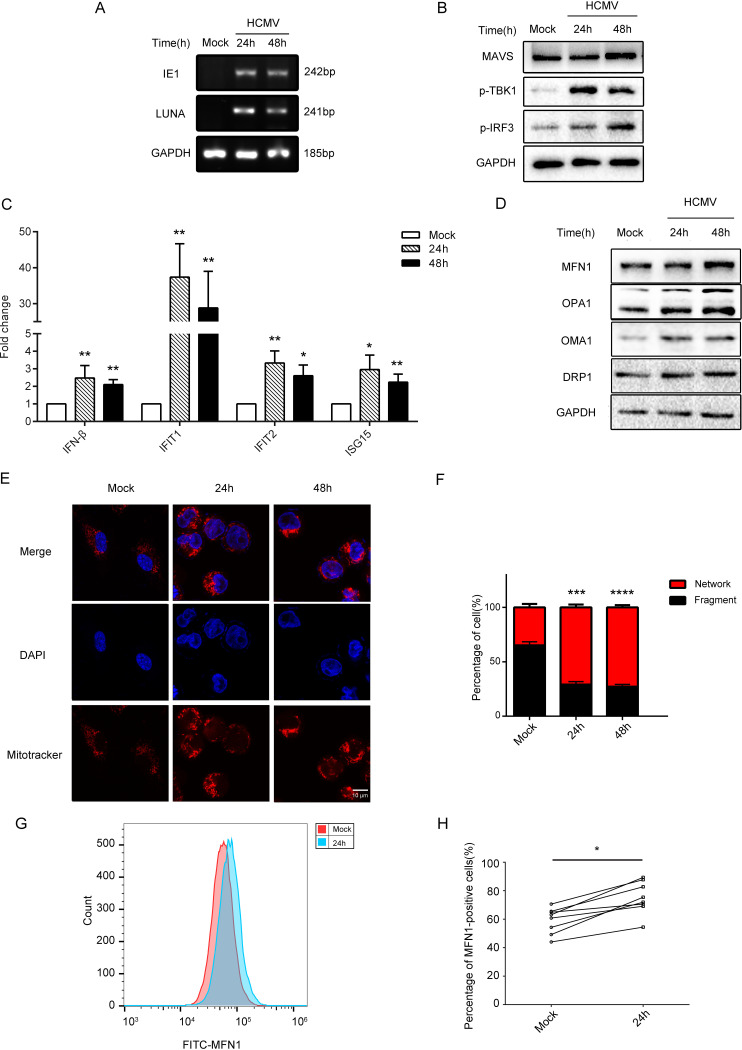
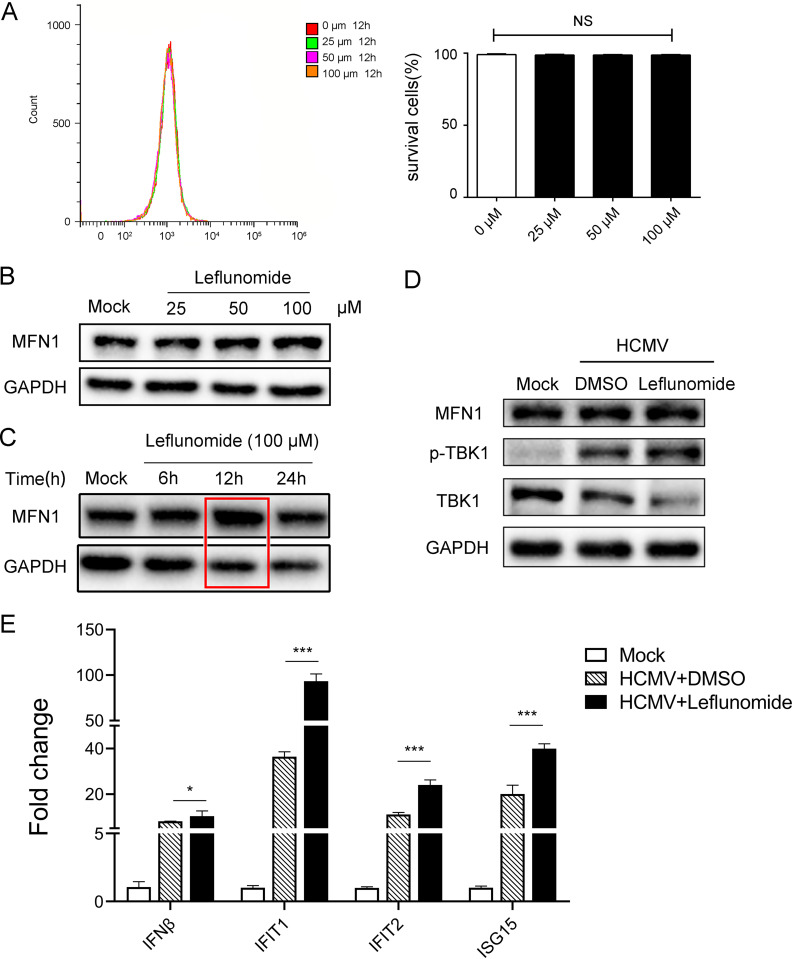
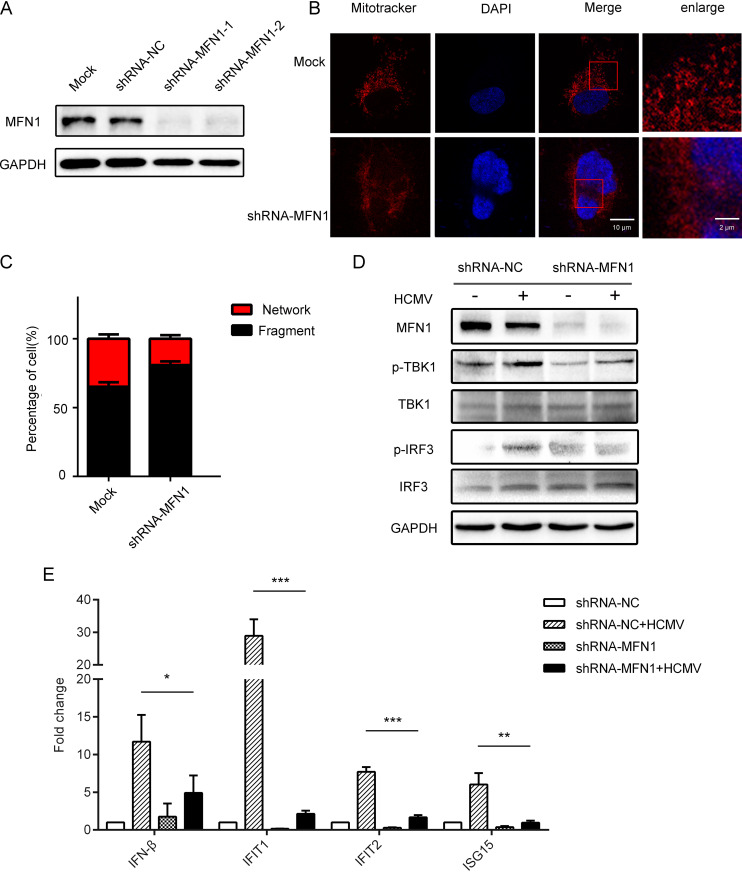
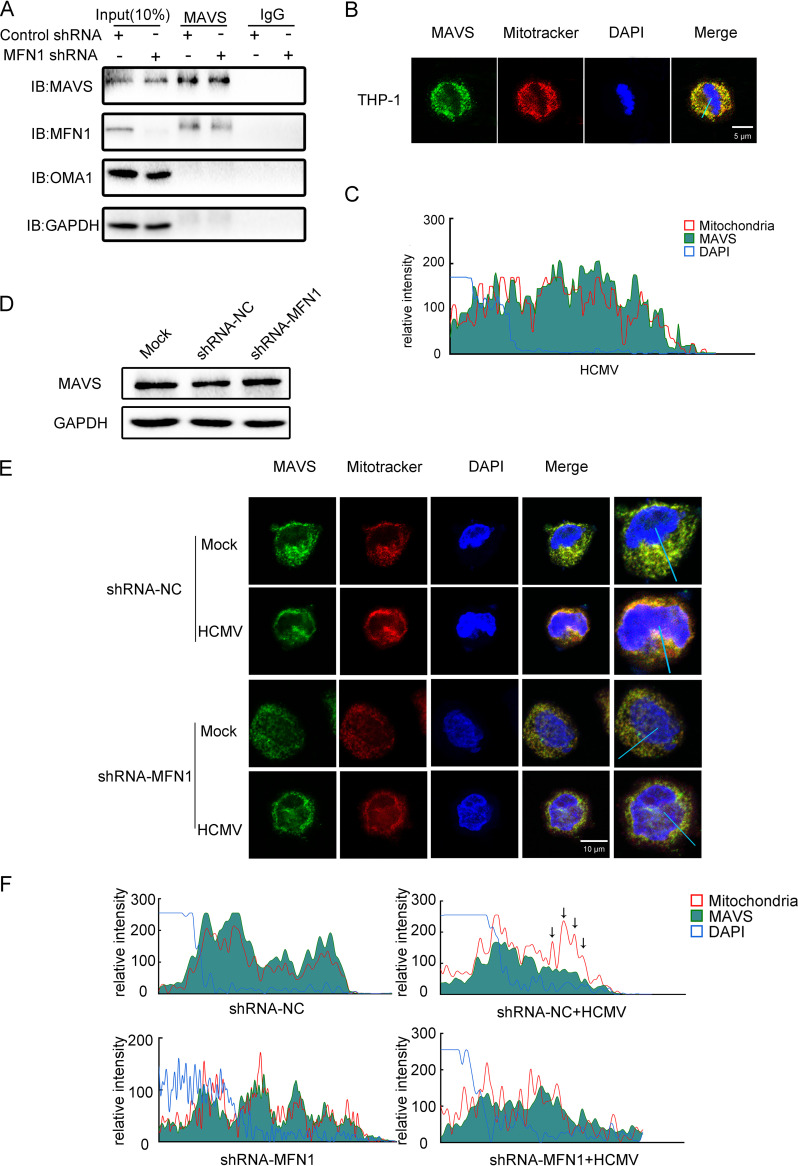
One of the most potent anti-human cytomegalovirus (HCMV) immune mechanisms possessed by host cells is type I interferon (IFN1), which induces the expression of IFN-stimulated genes (ISGs). During this process, mitochondria play an important role in the IFN1 response, and mitofusin 1 (MFN1) is a key regulator of mitochondrial fusion located on the outer mitochondrial membrane. However, the underlying mechanism of MFN1's promotion of IFN1 during HCMV infection still remains unknown. In this study, HCMV infection promoted IFN1 production and enhanced ISG expression. Meanwhile, it promoted the increase of mitochondrial fusion in THP-1 cells and peripheral blood mononuclear cells (PBMCs), especially the expression of MFN1. Phosphorylation of tank binding kinase 1 (p-TBK1), interferon regulatory factor 3 (p-IRF3), and ISGs was significantly decreased in MFN1 or mitochondrial antiviral signaling protein (MAVS)-knockdown THP-1 cells, and MFN1 was constitutively associated with MAVS, positively regulated mitochondrial fusion, and IFN1 production. Knockdown of MFN1 inhibited the MAVS redistribution without affecting the MAVS expression, whereas the HCMV-induced IFN1 production decreased. Conversely, leflunomide could induce the expression of MFN1, thereby producing IFN1 and stimulating the expression of ISG in leflunomide-treated THP-1 cells. These observations reveal that HCMV infection leads to MFN1-mediated redistribution of MAVS and then induces an antiviral response of IFN1 and that the MFN-agonist leflunomide promotes IFN1 responses and may serve as a potential anti-HCMV therapy. Human cytomegalovirus (HCMV) infection is ubiquitous and is often asymptomatic in healthy individuals, but it can cause great damage to newborns, AIDS patients, and other immune deficiency patients. In this study, we found that HCMV infection caused mitochondrial fusion, and expression of mitofusin 1 (MFN1), which is a protein associated with mitochondrial antiviral signaling protein (MAVS), positively regulates mitochondrial fusion and HCMV-induced IFN1 response. Knockdown of MFN1 or MAVS can inhibit the HCMV-induced IFN1 production. What is more, confocal laser-scanning microscope showed that knockdown of MFN1 inhibits the HCMV-induced redistribution of MAVS. Conversely, MFN1 agonist leflunomide could induce IFN1 production. In conclusion, we provide new insight into the relationship between MFN1 and IFN1 during HCMV infection and show that MFN1 may serve as a potential strategy against HCMV infection.
宿主细胞拥有的最有效的抗人巨细胞病毒(HCMV)免疫机制之一是I型干扰素(IFN1),它可诱导干扰素刺激基因(ISG)的表达。在此过程中,线粒体在IFN1反应中起重要作用,而线粒体融合蛋白1(MFN1)是位于线粒体外膜上的线粒体融合的关键调节因子。然而,在HCMV感染期间MFN1促进IFN1的潜在机制仍不清楚。在本研究中,HCMV感染促进了IFN1的产生并增强了ISG的表达。同时,它促进了THP-1细胞和外周血单核细胞(PBMC)中线粒体融合的增加,尤其是MFN1的表达。在MFN1或线粒体抗病毒信号蛋白(MAVS)敲低的THP-1细胞中,Tank结合激酶1(p-TBK1)、干扰素调节因子3(p-IRF3)和ISG的磷酸化显著降低,并且MFN1与MAVS持续相关,正向调节线粒体融合和IFN1的产生。敲低MFN1可抑制MAVS的重新分布而不影响MAVS的表达,而HCMV诱导的IFN1产生减少。相反,来氟米特可诱导MFN1的表达,从而在来氟米特处理的THP-1细胞中产生IFN1并刺激ISG的表达。这些观察结果表明,HCMV感染导致MFN1介导的MAVS重新分布,进而诱导IFN1的抗病毒反应,并且MFN激动剂来氟米特可促进IFN1反应,可能作为一种潜在的抗HCMV治疗方法。人巨细胞病毒(HCMV)感染很普遍,在健康个体中通常无症状,但它可对新生儿、艾滋病患者和其他免疫缺陷患者造成极大损害。在本研究中,我们发现HCMV感染导致线粒体融合,以及与线粒体抗病毒信号蛋白(MAVS)相关的线粒体融合蛋白1(MFN1)的表达,其正向调节线粒体融合和HCMV诱导的IFN1反应。敲低MFN1或MAVS可抑制HCMV诱导的IFN1产生。此外,共聚焦激光扫描显微镜显示敲低MFN1可抑制HCMV诱导的MAVS重新分布。相反,MFN1激动剂来氟米特可诱导IFN1产生。总之,我们为HCMV感染期间MFN1与IFN1之间的关系提供了新的见解,并表明MFN1可能作为一种潜在的抗HCMV感染策略。