UCL Institute of Health Informatics, University College London, London, UK.
UCL Institute of Ophthalmology, University College London, London, UK.
BMJ Open. 2023 Mar 20;13(3):e071043. doi: 10.1136/bmjopen-2022-071043.
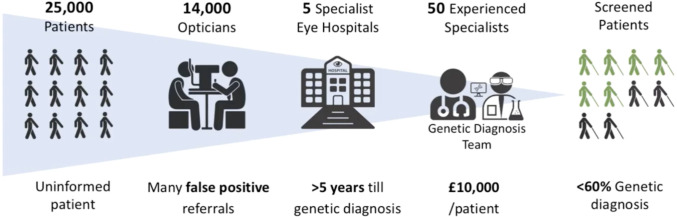
Inherited retinal diseases (IRD) are a leading cause of visual impairment and blindness in the working age population. Mutations in over 300 genes have been found to be associated with IRDs and identifying the affected gene in patients by molecular genetic testing is the first step towards effective care and patient management. However, genetic diagnosis is currently slow, expensive and not widely accessible. The aim of the current project is to address the evidence gap in IRD diagnosis with an AI algorithm, Eye2Gene, to accelerate and democratise the IRD diagnosis service.
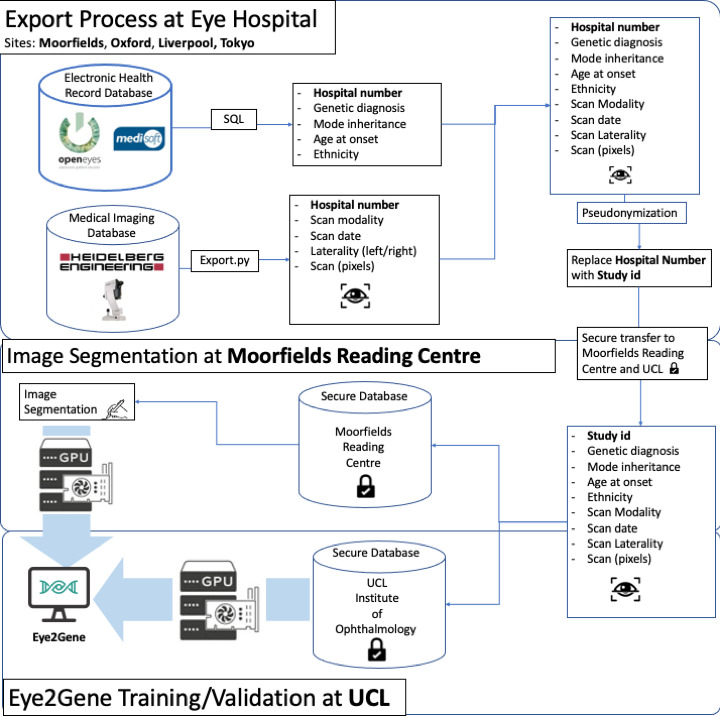
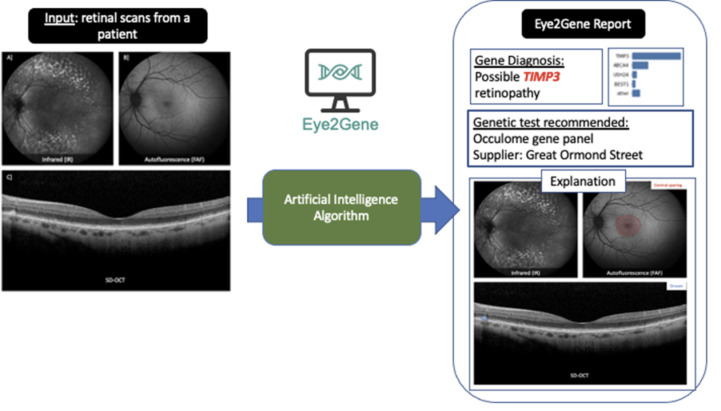
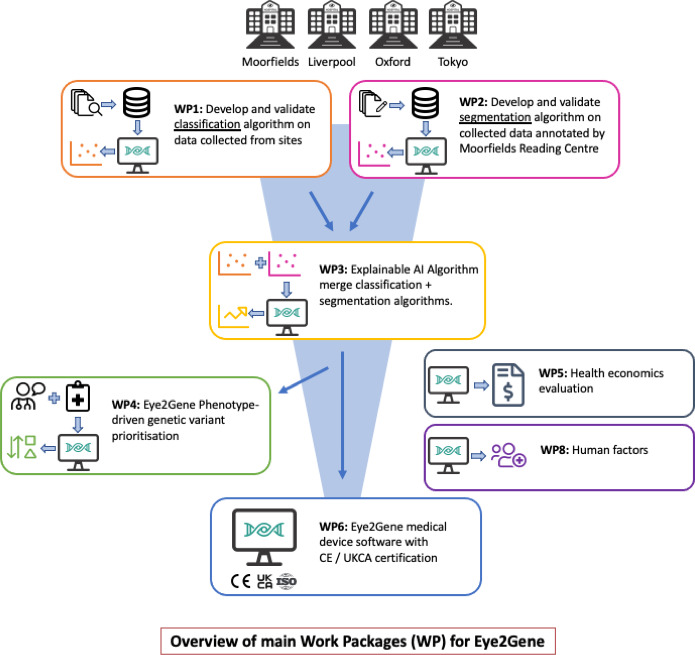
The data-only retrospective cohort study involves a target sample size of 10 000 participants, which has been derived based on the number of participants with IRD at three leading UK eye hospitals: Moorfields Eye Hospital (MEH), Oxford University Hospital (OUH) and Liverpool University Hospital (LUH), as well as a Japanese hospital, the Tokyo Medical Centre (TMC). Eye2Gene aims to predict causative genes from retinal images of patients with a diagnosis of IRD. For this purpose, 36 most common causative IRD genes have been selected to develop a training dataset for the software to have enough examples for training and validation for detection of each gene. The Eye2Gene algorithm is composed of multiple deep convolutional neural networks, which will be trained on MEH IRD datasets, and externally validated on OUH, LUH and TMC.
This research was approved by the IRB and the UK Health Research Authority (Research Ethics Committee reference 22/WA/0049) 'Eye2Gene: accelerating the diagnosis of IRDs' Integrated Research Application System (IRAS) project ID: 242050. All research adhered to the tenets of the Declaration of Helsinki. Findings will be reported in an open-access format.
遗传性视网膜疾病(IRD)是导致工作年龄段人群视力损害和失明的主要原因。已有 300 多个基因突变与 IRD 相关,通过分子遗传学检测确定患者的受影响基因是进行有效治疗和患者管理的第一步。然而,基因诊断目前速度缓慢、费用高昂且无法广泛普及。本项目旨在通过人工智能算法 Eye2Gene 解决 IRD 诊断中的证据空白,以加速和普及 IRD 诊断服务。
该纯数据回顾性队列研究的目标样本量为 10000 名参与者,这是根据三家英国领先的眼科医院(莫尔菲尔德眼科医院、牛津大学医院和利物浦大学医院)以及一家日本医院东京医疗中心的 IRD 患者数量推算得出的。Eye2Gene 旨在通过对 IRD 患者的视网膜图像预测致病基因。为此,选择了 36 个最常见的致病 IRD 基因,为软件开发一个训练数据集,以便有足够的样本进行训练和验证,以检测每个基因。Eye2Gene 算法由多个深度卷积神经网络组成,将在莫尔菲尔德眼科医院的 IRD 数据集上进行训练,并在牛津大学医院、利物浦大学医院和东京医疗中心进行外部验证。
本研究已获得伦理委员会和英国健康研究管理局的批准(研究伦理委员会参考号 22/WA/0049),项目名称为“Eye2Gene:加速 IRD 诊断”,综合研究应用系统(IRAS)项目 ID:242050。所有研究均遵循《赫尔辛基宣言》的原则。研究结果将以开放获取的形式报告。