UCL Institute of Ophthalmology, University College London, London, United Kingdom; Genetics Service, Moorfields Eye Hospital, London, United Kingdom.
UCL Institute of Ophthalmology, University College London, London, United Kingdom; Genetics Service, Moorfields Eye Hospital, London, United Kingdom; North East Thames Regional Genetics Service, Great Ormond Street Institute of Child Health, London, United Kingdom.
Ophthalmology. 2020 Oct;127(10):1384-1394. doi: 10.1016/j.ophtha.2020.04.008. Epub 2020 Apr 16.
In a large cohort of molecularly characterized inherited retinal disease (IRD) families, we investigated proportions with disease attributable to causative variants in each gene.
Retrospective study of electronic patient records.
Patients and relatives managed in the Genetics Service of Moorfields Eye Hospital in whom a molecular diagnosis had been identified.
Genetic screening used a combination of single-gene testing, gene panel testing, whole exome sequencing, and more recently, whole genome sequencing. For this study, genes listed in the Retinal Information Network online resource (https://sph.uth.edu/retnet/) were included. Transcript length was extracted for each gene (Ensembl, release 94).
We calculated proportions of families with IRD attributable to variants in each gene in the entire cohort, a cohort younger than 18 years, and a current cohort (at least 1 patient encounter between January 1, 2017, and August 2, 2019). Additionally, we explored correlation between numbers of families and gene transcript length.
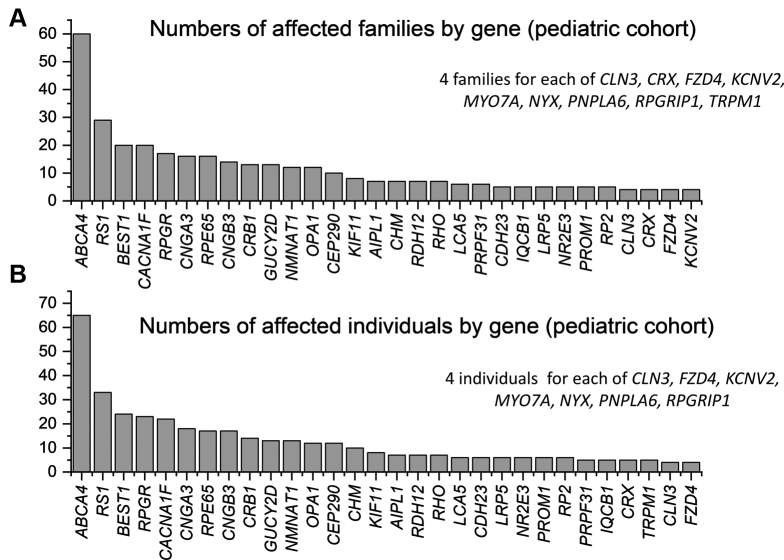
We identified 3195 families with a molecular diagnosis (variants in 135 genes), including 4236 affected individuals. The pediatric cohort comprised 452 individuals from 411 families (66 genes). The current cohort comprised 2614 families (131 genes; 3130 affected individuals). The 20 most frequently implicated genes overall (with prevalence rates per families) were as follows: ABCA4 (20.8%), USH2A (9.1%), RPGR (5.1%), PRPH2 (4.6%), BEST1 (3.9%), RS1 (3.5%), RP1 (3.3%), RHO (3.3%), CHM (2.7%), CRB1 (2.1%), PRPF31 (1.8%), MY07A (1.7%), OPA1 (1.6%), CNGB3 (1.4%), RPE65 (1.2%), EYS (1.2%), GUCY2D (1.2%), PROM1 (1.2%), CNGA3 (1.1%), and RDH12 (1.1%). These accounted for 71.8% of all molecularly diagnosed families. Spearman coefficients for correlation between numbers of families and transcript length were 0.20 (P = 0.025) overall and 0.27 (P = 0.017), -0.17 (P = 0.46), and 0.71 (P = 0.047) for genes in which variants exclusively cause recessive, dominant, or X-linked disease, respectively.
Our findings help to quantify the burden of IRD attributable to each gene. More than 70% of families showed pathogenic variants in 1 of 20 genes. Transcript length (relevant to gene delivery strategies) correlated significantly with numbers of affected families (but not for dominant disease).
在一大组分子特征明确的遗传性视网膜疾病(IRD)家族中,我们研究了每个基因中与疾病相关的致病变异的比例。
回顾性电子患者记录研究。
在 Moorfields 眼科医院遗传学服务中心管理的患者及其亲属,他们的分子诊断已确定。
遗传筛查采用单基因检测、基因组合检测、外显子组测序以及最近的全基因组测序相结合的方法。在这项研究中,包含了视网膜信息网络在线资源(https://sph.uth.edu/retnet/)中列出的基因。为每个基因提取转录本长度(Ensembl,版本 94)。
我们计算了整个队列、年龄小于 18 岁的队列和当前队列(至少在 2017 年 1 月 1 日至 2019 年 8 月 2 日期间有一次患者就诊)中每个基因的IRD 归因于变异的家族比例。此外,我们还探讨了家族数量与基因转录本长度之间的相关性。
我们鉴定了 3195 个具有分子诊断的家族(135 个基因中的变异),包括 4236 名受影响个体。儿科队列包括 411 个家庭的 452 名受影响个体(66 个基因)。当前队列包括 2614 个家庭(131 个基因;3130 名受影响个体)。总体上 20 个最常涉及的基因(按家庭患病率)如下:ABCA4(20.8%)、USH2A(9.1%)、RPGR(5.1%)、PRPH2(4.6%)、BEST1(3.9%)、RS1(3.5%)、RP1(3.3%)、RHO(3.3%)、CHM(2.7%)、CRB1(2.1%)、PRPF31(1.8%)、MY07A(1.7%)、OPA1(1.6%)、CNGB3(1.4%)、RPE65(1.2%)、EYS(1.2%)、GUCY2D(1.2%)、PROM1(1.2%)、CNGA3(1.1%)和 RDH12(1.1%)。这些基因占所有分子诊断家族的 71.8%。家族数量与转录本长度之间的 Spearman 系数为 0.20(P=0.025),整体为 0.27(P=0.017)、-0.17(P=0.46)和 0.71(P=0.047),分别为仅导致隐性、显性或 X 连锁疾病的基因。
我们的发现有助于量化每个基因归因于 IRD 的负担。超过 70%的家庭在 20 个基因中的 1 个基因中显示致病性变异。转录本长度(与基因传递策略相关)与受影响家庭的数量显著相关(但与显性疾病无关)。