Magoye Electine, Nägeli Lukas, Bühlmann Andreas, Hilber-Bodmer Maja, Keller Peter, Mühlethaler Konrad, Riat Arnaud, Schrenzel Jacques, Freimoser Florian M
Agroscope, Research Division Plant Protection, Nyon, Switzerland.
Agroscope, Research Division Food Microbial Systems, Wädenswil, Switzerland.
Microbiol Spectr. 2023 Mar 21;11(2):e0529922. doi: 10.1128/spectrum.05299-22.
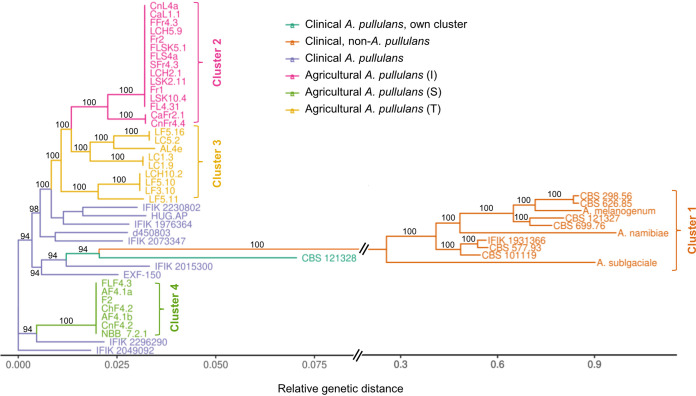
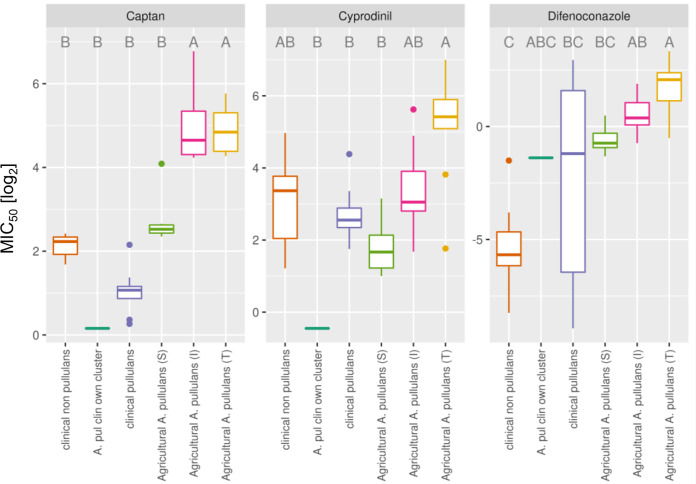
Fungicide applications in agriculture and medicine can promote the evolution of resistant, pathogenic fungi, which is a growing problem for disease management in both settings. Nonpathogenic mycobiota are also exposed to fungicides, may become tolerant, and could turn into agricultural or medical problems, for example, due to climate change or in immunocompromised individuals. However, quantitative data about fungicide sensitivity of environmental fungi is mostly lacking. species are widely distributed and frequently isolated yeast-like fungi. One species, , is used as a biocontrol agent, but is also encountered in clinical samples, regularly. Here, we compared 16 clinical and 30 agricultural isolates based on whole-genome data and by sensitivity testing with the 3 fungicides captan, cyprodinil, and difenoconazole. Our phylogenetic analyses determined that 7 of the 16 clinical isolates did not belong to the species . These isolates clustered with other species, including , a recently separated species that expresses virulence traits that are mostly lacking in . Interestingly, the clinical isolates were significantly more fungicide sensitive than many isolates from agricultural samples, which implies selection for fungicide tolerance of non-target fungi in agricultural ecosystems. Environmental microbiota are regularly found in clinical samples and can cause disease, in particular, in immunocompromised individuals. Organisms of the genus belonging to this group are highly abundant, and some species are even described as pathogens. Many isolates from agricultural samples are tolerant to different fungicides, and it seems inevitable that such strains will eventually appear in the clinics. Selection for fungicide tolerance would be particularly worrisome for species , which is also found in the environment and exhibits virulence traits. Based on our observation and the strains tested here, clinical isolates are still fungicide sensitive. We, therefore, suggest monitoring fungicide sensitivity in species, such as and , and to consider the development of fungicide tolerance in the evaluation process of fungicides.
农业和医学领域中杀菌剂的应用会促使耐药性致病真菌的进化,这在这两个领域的疾病管理中都是一个日益严重的问题。非致病性真菌群落也会接触到杀菌剂,可能会产生耐受性,并可能引发农业或医学问题,例如,由于气候变化或在免疫功能低下的个体中。然而,关于环境真菌对杀菌剂敏感性的定量数据大多缺乏。[具体物种名称]是广泛分布且经常分离得到的类酵母真菌。其中一个物种,[具体物种名称],被用作生物防治剂,但在临床样本中也经常出现。在这里,我们基于全基因组数据并通过对克菌丹、嘧菌环胺和苯醚甲环唑这三种杀菌剂的敏感性测试,比较了16株临床分离株和30株农业分离株。我们的系统发育分析确定,16株临床分离株中有7株不属于[具体物种名称]。这些分离株与其他[具体物种名称]聚类,包括[具体物种名称],这是一个最近分离出的物种,表达出在[具体物种名称]中大多缺乏的毒力特征。有趣的是,临床[具体物种名称]分离株对杀菌剂的敏感性明显高于许多农业样本分离株,这意味着农业生态系统中非靶标真菌对杀菌剂耐受性的选择。环境微生物群落经常在临床样本中被发现,并可能导致疾病,特别是在免疫功能低下的个体中。属于这一类群的[具体属名]生物数量众多,有些物种甚至被描述为病原体。许多来自农业样本的[具体物种名称]分离株对不同的杀菌剂具有耐受性,这些菌株最终出现在临床似乎是不可避免的。对[具体物种名称]进行杀菌剂耐受性选择尤其令人担忧,因为它也存在于环境中并表现出毒力特征。基于我们的观察和在此测试的菌株,临床[具体物种名称]分离株对杀菌剂仍然敏感。因此,我们建议监测[具体物种名称]等物种对杀菌剂的敏感性,并在杀菌剂评估过程中考虑其耐受性的发展。