Podgórska-Kryszczuk Izabela
Department of Analysis and Food Quality Assessment, University of Life Sciences in Lublin, Skromna 8, 20-704 Lublin, Poland.
Plants (Basel). 2023 Jan 4;12(2):236. doi: 10.3390/plants12020236.
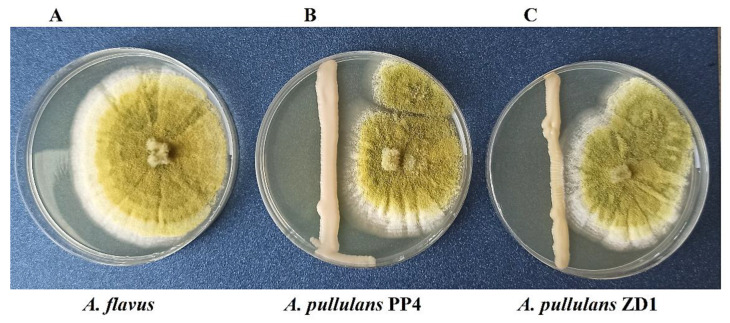
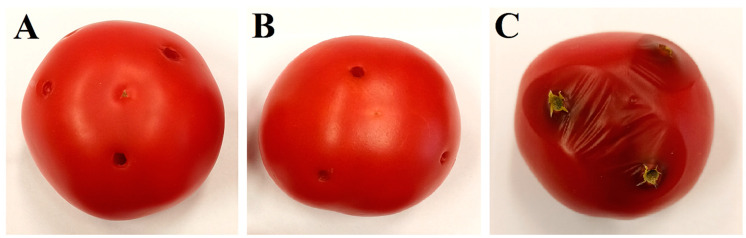
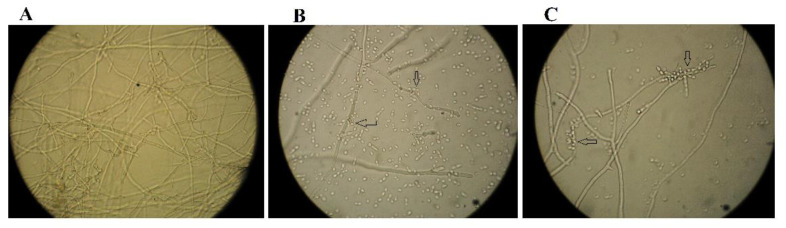
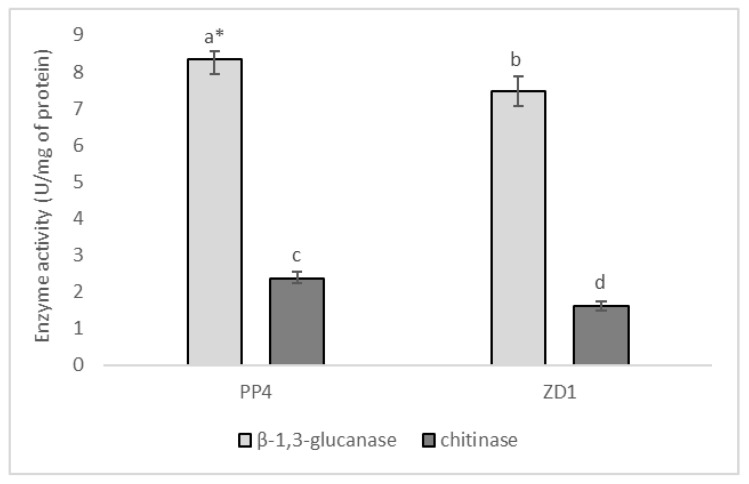
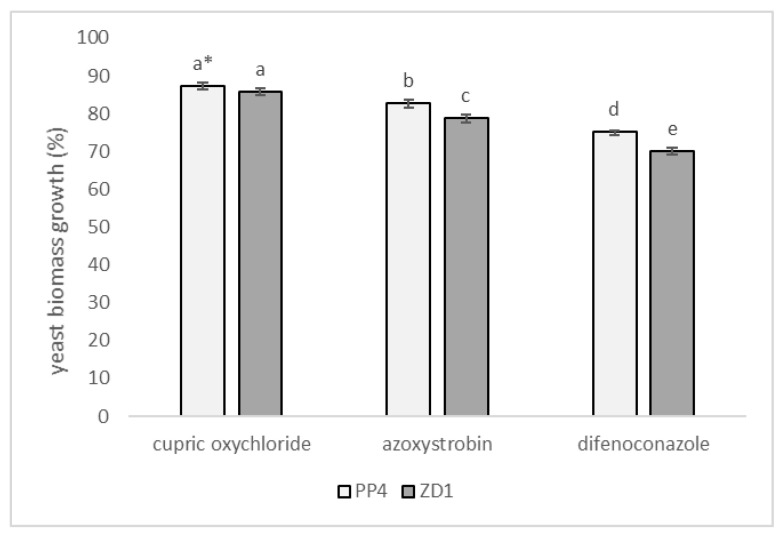
is an important pathogenic fungus affecting many crops and is one of the main sources of their aflatoxin contamination. The primary method of limiting this pathogen is using chemical fungicides, but researchers focus on searching for other effective agents for its control due to many disadvantages and limitations of these agrochemicals. The results obtained in the present study indicate the high potential of two yeast strains, PP4 and ZD1, in the biological control of Under in vitro conditions, mycelial growth was reduced by 53.61% and 63.05%, and spore germination was inhibited by 68.97% and 79.66% by ZD1 and PP4 strains, respectively. Both strains produced the lytic enzymes chitinase and β-1,3-glucanase after 5 days of cultivation with cell wall preparations (CWP) of in the medium as a carbon source. In addition, the tested yeasts showed the ability to grow over a wide range of temperatures (4-30 °C), pH (4-11), and salinity (0-12%) and showed tolerance to fungicides at concentrations corresponding to field conditions. Both isolates tested were highly tolerant to cupric oxychloride, showing biomass gains of 85.84% (ZD1) and 87.25% (PP4). Biomass growth in the presence of fungicides azoxystrobin was 78.71% (ZD1) and 82.65% (PP4), while in the presence of difenoconazole, it was 70.09% (ZD1) and 75.25% (PP4). The yeast strains were also tested for antagonistic effects against directly on tomato fruit. Both isolates acted effectively by reducing lesion diameter from 29.13 mm (control) to 8.04 mm (PP4) and 8.83 mm (ZD1).
是一种影响多种作物的重要致病真菌,也是其黄曲霉毒素污染的主要来源之一。限制这种病原体的主要方法是使用化学杀菌剂,但由于这些农用化学品存在许多缺点和局限性,研究人员专注于寻找其他有效的控制剂。本研究获得的结果表明,两种酵母菌株PP4和ZD1在生物防治方面具有很高的潜力。在体外条件下,ZD1和PP4菌株分别使菌丝体生长减少了53.61%和63.05%,孢子萌发受到68.97%和79.66%的抑制。在用的细胞壁制剂(CWP)作为碳源在培养基中培养5天后,两种菌株都产生了裂解酶几丁质酶和β-1,3-葡聚糖酶。此外,测试的酵母显示出在广泛的温度(4-30°C)、pH(4-11)和盐度(0-12%)范围内生长的能力,并对与田间条件相对应浓度的杀菌剂表现出耐受性。测试的两种分离株对氢氧化铜具有高度耐受性,生物量增加分别为85.84%(ZD1)和87.25%(PP4)。在杀菌剂嘧菌酯存在下生物量增长分别为78.71%(ZD1)和82.65%(PP4),而在苯醚甲环唑存在下,分别为70.09%(ZD1)和75.25%(PP4)。还测试了酵母菌株对直接在番茄果实上的拮抗作用。两种分离株都有效地发挥了作用,将病斑直径从29.13毫米(对照)减小到8.04毫米(PP4)和8.83毫米(ZD1)。