Department of Dermatology, Cliniques Universitaires Saint-Luc (UCLouvain), Avenue Hippocrate 10, 1200, Brussels, Belgium.
Adv Ther. 2023 May;40(5):2509-2514. doi: 10.1007/s12325-023-02490-5. Epub 2023 Mar 21.
The efficacy and safety of upadacitinib in atopic dermatitis have been defined in clinical trials, but long-term real-life experience, essential for clinical decision-making, is still limited. We aimed to assess the effectiveness and tolerance of upadacitinib in a real-life cohort of adults and adolescents with severe atopic dermatitis in whom previous systemic therapies largely failed.
Retrospective cohort study collecting data from adults and adolescents treated with upadacitinib 15 or 30 mg per day between July 2021 to August 2022. The outcomes for effectiveness were evaluated by the percentage of patients who achieved a validated Investigator's Global Assessment for atopic dermatitis (vIGA-AD) of 0 (clear) or 1 (almost clear) and/or an improvement of at least 75% on the Eczema Area and Severity Index (EASI 75) at the end of the follow-up. All treatment-emergent adverse events were collected.
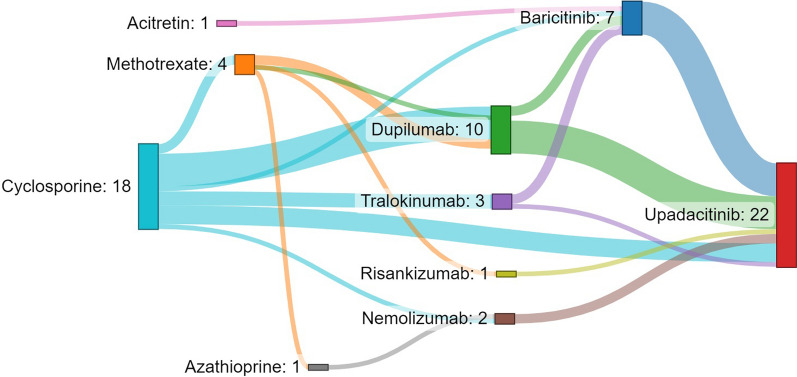
A total of 29 patients were included (22 adults and 7 adolescents), with a median follow-up of 54.4 weeks. At the end of the follow-up, 23 patients (79.3%) reached a vIGA-AD of 0/1, and 24 patients (82.7%) achieved EASI 75. Among patients treated with upadacitinib after initial failure of first- and/or second-line treatment with biologics or baricitinib, 5/7 patients (71.4%) reached a vIGA-AD score of 0/1. Disease control was slightly better in adults than in adolescents (81.8% vs 71.4% reached the efficacy endpoint, respectively). Response rate in patients with upadacitinib 15 mg seemed better than in clinical trials or network meta-analysis. Safety data were reassuring; lipid changes were the most frequent adverse event.
This real-life study confirms the effectiveness of upadacitinib, particularly for the treatment of atopic dermatitis recalcitrant to conventional systemic agents, biologics or baricitinib. Induced lipid changes require close follow-up.
乌帕替尼在特应性皮炎中的疗效和安全性已在临床试验中得到明确,但对于临床决策至关重要的长期真实世界经验仍然有限。我们旨在评估乌帕替尼在先前系统性治疗基本失败的重度特应性皮炎成人和青少年真实世界队列中的有效性和耐受性。
这是一项回顾性队列研究,收集了 2021 年 7 月至 2022 年 8 月期间接受乌帕替尼 15 或 30mg/天治疗的成人和青少年患者的数据。有效性的评估结果通过达到特应性皮炎研究者全球评估(vIGA-AD)为 0(清除)或 1(几乎清除)和/或在随访结束时 Eczema Area and Severity Index(EASI75)至少改善 75%的患者比例来评估。收集了所有治疗中出现的不良事件。
共纳入 29 例患者(22 例成人和 7 例青少年),中位随访时间为 54.4 周。随访结束时,23 例(79.3%)患者达到 vIGA-AD 0/1,24 例(82.7%)患者达到 EASI75。在因最初使用生物制剂或巴瑞替尼一线和/或二线治疗失败而接受乌帕替尼治疗的患者中,7 例(71.4%)患者达到 vIGA-AD 0/1。成人患者的疾病控制情况优于青少年(分别为 81.8%和 71.4%达到疗效终点)。与临床试验或网络荟萃分析相比,乌帕替尼 15mg 治疗的患者的应答率似乎更好。安全性数据令人安心;脂质变化是最常见的不良事件。
本真实世界研究证实了乌帕替尼的有效性,特别是对于治疗常规系统性药物、生物制剂或巴瑞替尼难治的特应性皮炎。诱导的脂质变化需要密切随访。