College of Science, Institute of Materials Physics and Chemistry, Nanjing Forestry University, Nanjing 210037, P. R. China.
Institute of Physics and Technology, Ural Federal University, Mira Str. 19, 620002 Yekaterinburg, Russia.
J Phys Chem Lett. 2023 Mar 30;14(12):3069-3076. doi: 10.1021/acs.jpclett.3c00113. Epub 2023 Mar 22.
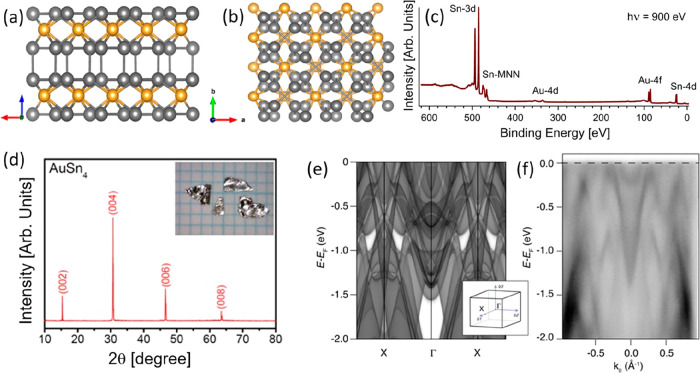
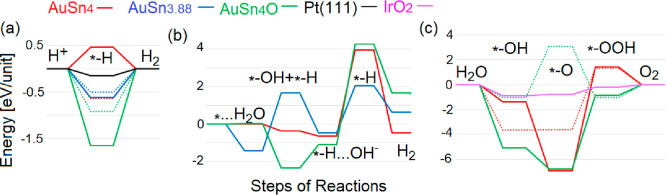
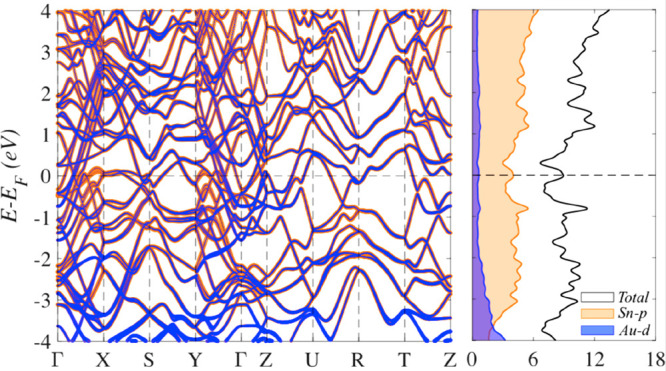
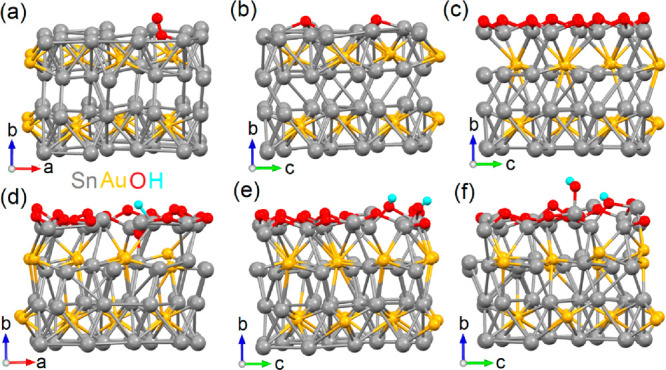
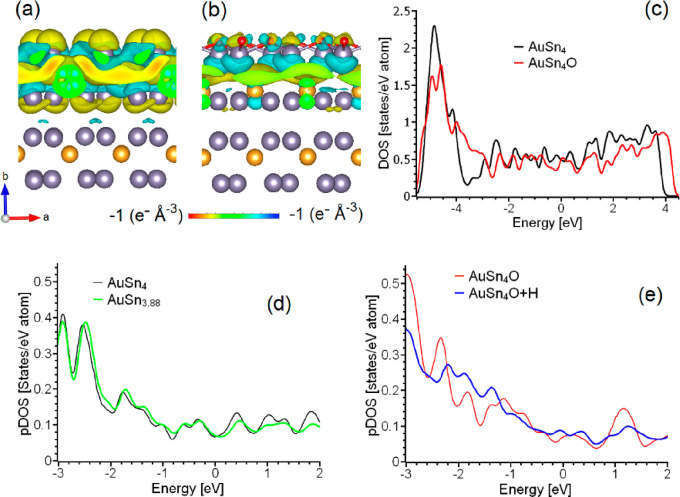
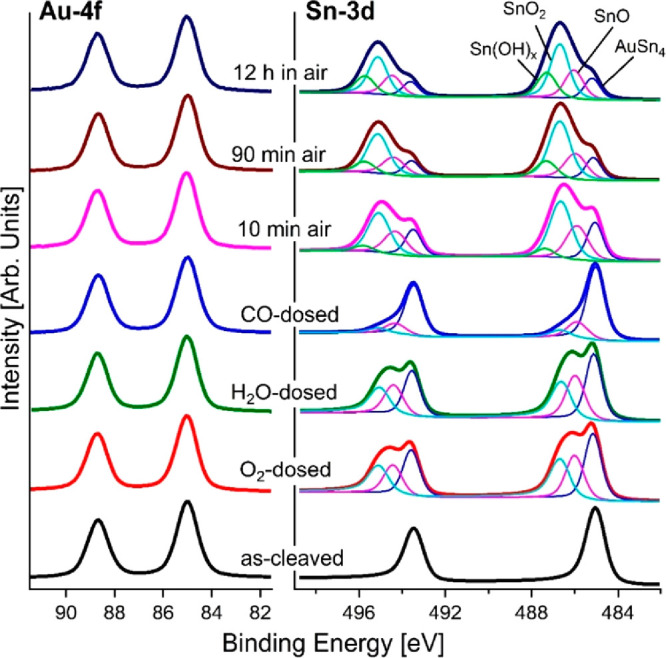
In recent years, the correlation between the existence of topological electronic states in materials and their catalytic activity has gained increasing attention, due to the exceptional electron conductivity and charge carrier mobility exhibited by quantum materials. However, the physicochemical mechanisms ruling catalysis with quantum materials are not fully understood. Here, we investigate the chemical reactivity, ambient stability, and catalytic activity of the topological nodal-line semimetal AuSn. Our findings reveal that the surface of AuSn is prone to oxidation, resulting in the formation of a nanometric SnO skin. This surface oxidation significantly enhances the material's performance as a catalyst for the hydrogen evolution reaction in acidic environments. We demonstrate that the peculiar atomic structure of oxidized AuSn enables the migration of hydrogen atoms through the Sn-O layer with a minimal energy barrier of only 0.19 eV. Furthermore, the Volmer step becomes exothermic in the presence of Sn vacancies or tin-oxide skin, as opposed to being hindered in the pristine sample, with energy values of -0.62 and -1.66 eV, respectively, compared to the +0.46 eV energy barrier in the pristine sample. Our model also suggests that oxidized AuSn can serve as a catalyst for the hydrogen evolution reaction in alkali media. Additionally, we evaluate the material's suitability for the carbon dioxide reduction reaction, finding that the presence of topologically protected electronic states enhances the migration of hydrogen atoms adsorbed on the catalyst to carbon dioxide.
近年来,由于量子材料具有出色的电子导电性和电荷载流子迁移率,材料中拓扑电子态的存在与其催化活性之间的相关性引起了越来越多的关注。然而,用量子材料进行催化的物理化学机制尚未完全理解。在这里,我们研究了拓扑节线半金属 AuSn 的化学反应活性、环境稳定性和催化活性。我们的研究结果表明,AuSn 的表面容易氧化,形成纳米级的 SnO 皮。这种表面氧化显著提高了材料在酸性环境中作为析氢反应催化剂的性能。我们证明,氧化后的 AuSn 的特殊原子结构使得氢原子能够通过 Sn-O 层迁移,其能量势垒仅为 0.19eV。此外,在存在 Sn 空位或锡氧化物皮的情况下,Volmer 步骤是放热的,而在原始样品中则受到阻碍,其能量值分别为-0.62eV 和-1.66eV,而原始样品中的能量势垒为+0.46eV。我们的模型还表明,氧化后的 AuSn 可用作碱性介质中析氢反应的催化剂。此外,我们评估了该材料用于二氧化碳还原反应的适用性,发现拓扑保护的电子态的存在增强了吸附在催化剂上的氢原子向二氧化碳的迁移。