Monash Hematology, Monash Health, Melbourne, VIC, Australia.
Blood Cancer Therapeutics Laboratory, Department of Medicine, School of Clinical Sciences at Monash Health, Faculty of Medicine, Nursing & Health Sciences, Monash University, VIC, Australia.
Blood Adv. 2023 Jul 25;7(14):3531-3539. doi: 10.1182/bloodadvances.2022009412.
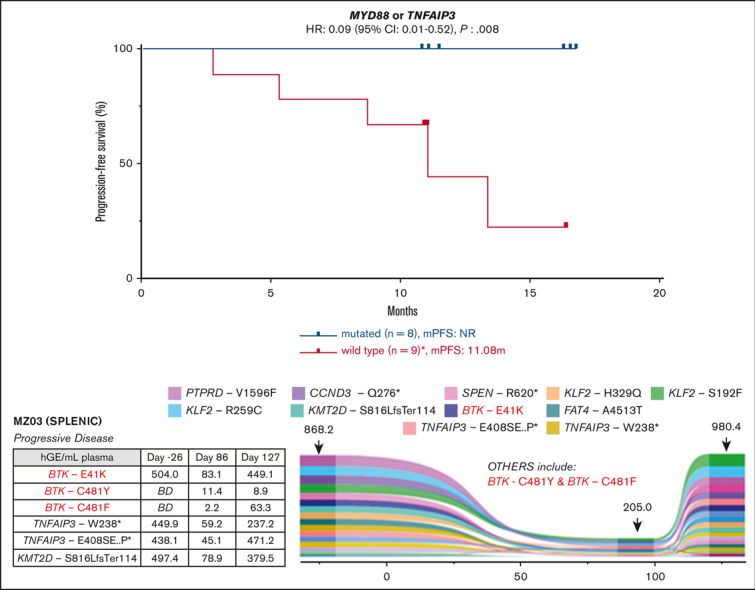
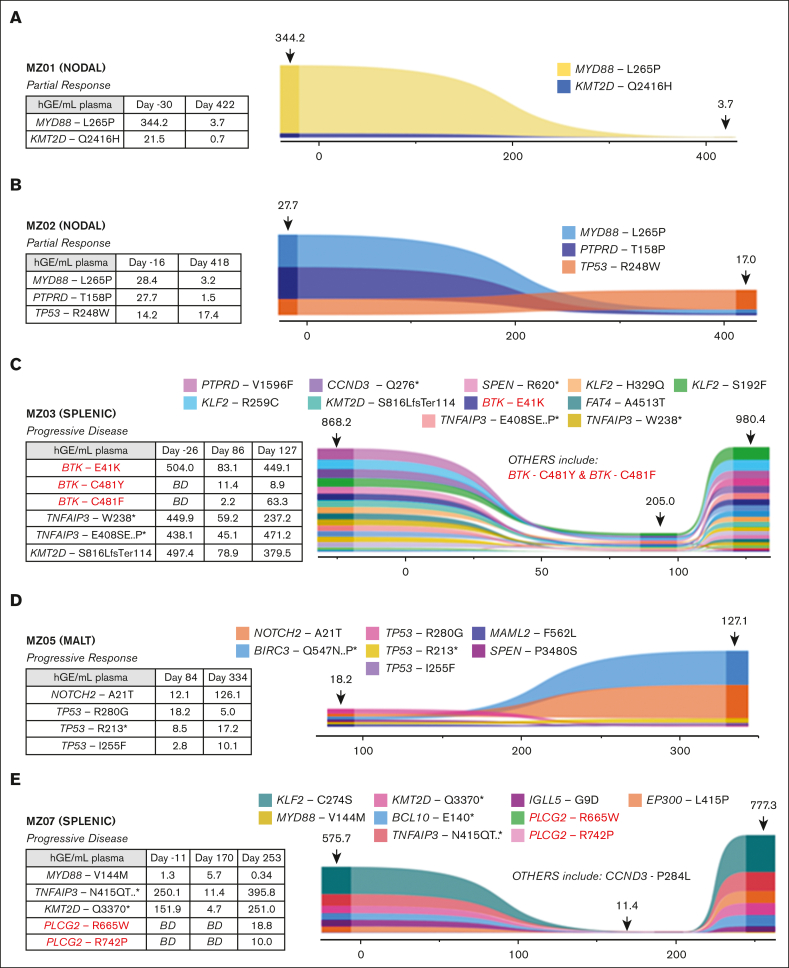
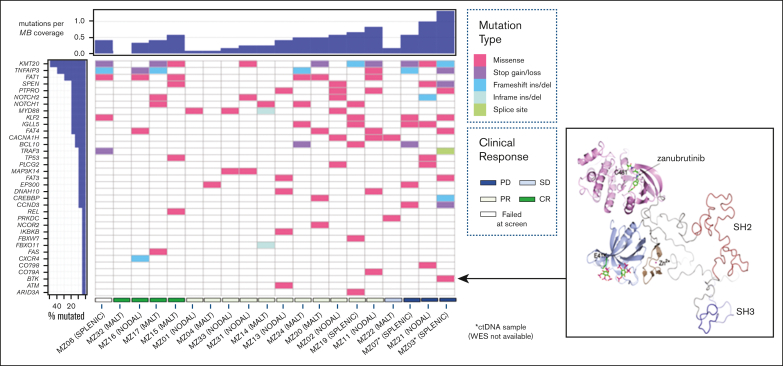
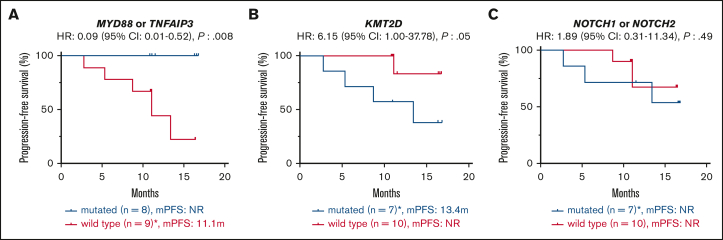
Using tissue whole exome sequencing (WES) and circulating tumor cell-free DNA (ctDNA), this Australasian Leukaemia & Lymphoma Group translational study sought to characterize primary and acquired molecular determinants of response and resistance of marginal zone lymphoma (MZL) to zanubrutinib for patients treated in the MAGNOLIA clinical trial. WES was performed on baseline tumor samples obtained from 18 patients. For 7 patients, ctDNA sequence was interrogated using a bespoke hybrid-capture next-generation sequencing assay for 48 targeted genes. Somatic mutations were correlated with objective response data and survival analysis using Fisher exact test and Kaplan-Meier (log-rank) method, respectively. Baseline WES identified mutations in 33 of 48 (69%) prioritized genes. NF-κB, NOTCH, or B-cell receptor (BCR) pathway genes were implicated in samples from 16 of 18 patients (89%). KMT2D mutations (n = 11) were most common, followed by FAT1 (n = 9), NOTCH1, NOTCH2, TNFAIP3 (n = 5), and MYD88 (n = 4) mutations. MYD88 or TNFAIP3 mutations correlated with improved progression-free survival (PFS). KMT2D mutations trended to worse PFS. Acquired resistance mutations PLCG2 (R665W/R742P) and BTK (C481Y/C481F) were detected in 2 patients whose disease progressed. A BTK E41K noncatalytic activating mutation was identified before treatment in 1 patient who was zanubrutinib-refractory. MYD88, TNFAIP3, and KMT2D mutations correlate with PFS in patients with relapsed/refractory MZL treated with zanubrutinib. Detection of acquired BTK and PLCG2 mutations in ctDNA while on therapy is feasible and may herald clinical disease progression. This trial was registered at https://anzctr.org.au/ as #ACTRN12619000024145.
利用组织全外显子组测序(WES)和循环肿瘤细胞游离 DNA(ctDNA),这项澳大拉西亚白血病和淋巴瘤组的转化研究旨在描述边缘区淋巴瘤(MZL)对zanubrutinib 治疗的原发性和获得性分子决定因素,该研究纳入了 MAGNOLIA 临床试验中的患者。对 18 名患者的基线肿瘤样本进行了 WES 检测。对 7 名患者的 ctDNA 序列进行了分析,使用了一种定制的混合捕获下一代测序方法,对 48 个靶向基因进行了检测。使用 Fisher 精确检验和 Kaplan-Meier(对数秩)方法分别将体细胞突变与客观反应数据和生存分析相关联。基线 WES 确定了 48 个优先基因中 33 个(69%)的突变。在 18 名患者中的 16 名(89%)样本中,NF-κB、NOTCH 或 B 细胞受体(BCR)途径基因受到影响。KMT2D 突变(n=11)最为常见,其次是 FAT1(n=9)、NOTCH1、NOTCH2、TNFAIP3(n=5)和 MYD88(n=4)突变。MYD88 或 TNFAIP3 突变与无进展生存期(PFS)的改善相关。KMT2D 突变趋势与 PFS 较差相关。在 2 名疾病进展的患者中检测到获得性耐药突变 PLCG2(R665W/R742P)和 BTK(C481Y/C481F)。在 1 名接受 zanubrutinib 治疗的患者中,在治疗前发现了 BTK E41K 非催化激活突变,该患者对 zanubrutinib 耐药。在接受 zanubrutinib 治疗的复发性/难治性 MZL 患者中,MYD88、TNFAIP3 和 KMT2D 突变与 PFS 相关。在治疗过程中检测到 ctDNA 中的获得性 BTK 和 PLCG2 突变是可行的,可能预示着临床疾病进展。该试验在 https://anzctr.org.au/ 注册,编号为 #ACTRN12619000024145。